.webp&w=384&q=75)

Loading, please wait...
Loading, please wait...
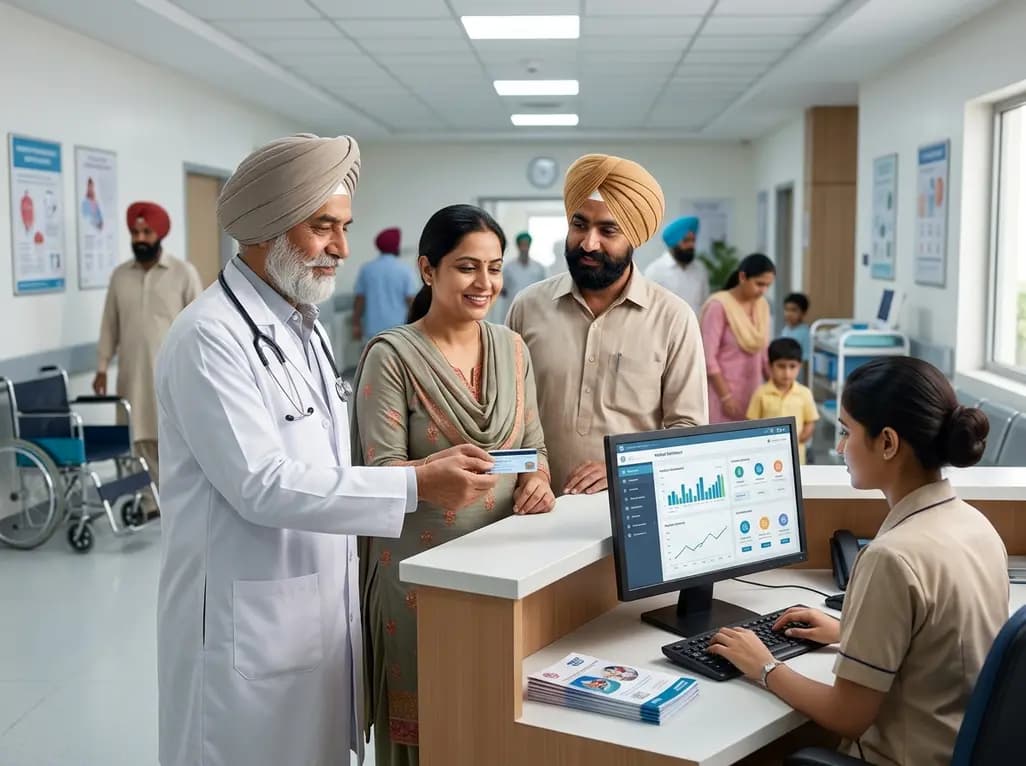
Recently, the Government of Punjab has made rapid progress in implementing its flagship healthcare initiative, the Mukh Mantri Sehat Yojna.
Furthermore, Chief Minister Bhagwant Mann announced that over 3.79 lakh patients have already availed of cashless medical treatments.
This scheme provides free medical care up to Rs 10 lakh for every family in the state.
Consequently, the program is transforming universal healthcare access across Punjab.
To begin with, officials have issued 47.27 lakh health cards under this program.
These cards cover approximately 23.01 lakh families in Punjab.
Specifically, women represent 51.5 per cent of the cardholders, while men account for 48.5 per cent.
Additionally, rural residents hold 69 per cent of these cards, compared to 31 per cent in urban areas.
In order to simplify the process, the government is developing a WhatsApp-based download facility.
Similarly, a new mobile application is underway to assist with registrations.
Importantly, the state has empanelled 835 hospitals under the scheme to ensure broad medical access.
This network includes 223 government hospitals and 612 private clinics.
Therefore, patients can access high-quality treatment near their homes.
Moreover, the program has disbursed Rs 654 crore to settle medical claims so far.
For instance, the health department spent around Rs 86 lakh on treating critical respiratory illnesses.
Overall, the initiative seeks to cover all 65 lakh families in the state of Punjab.
Q1: What is the maximum coverage under the Mukh Mantri Sehat Yojna?
The scheme offers free and cashless medical treatment of up to Rs 10 lakh per family annually without any income restrictions.
Q2: How many hospitals are empanelled under this health scheme?
A total of 835 healthcare facilities are currently empanelled under the scheme. This network consists of 223 government hospitals and 612 private medical centers.
Q3: How is the government improving card accessibility for beneficiaries?
Specifically, the government is developing a WhatsApp-based facility, a web portal, and a mobile app to simplify card downloading.
Disclaimer: This content is for informational and educational purposes only. It does not constitute medical advice or replace professional judgment. Refer to the latest local and national guidelines for clinical practice.
References

Read summarized clinical updates, watch expert medical content, and earn CME certifications right from your smartphone.
Open your smartphone camera to scan and install.





Explore how Punjab's latest healthcare initiative provides free and cashless medical treatment to millions of families across the state....
4 months ago

A retrospective cohort study of 7,716 ICU patients from the MIMIC-IV database demonstrates that Gradient Boosting Decision Trees significantly outperform traditional SOFA scores in predicting in-hospital mortality among patients with sepsis and diabetes, with SHAP analysis providing clinical interpretability.
Today

A prenatal case highlights severe glutaric acidemia type II presenting as bilateral hyperechoic cystic kidneys at 18 weeks. Whole-exome sequencing revealed a novel homozygous ETFDH frameshift variant, demonstrating the power of rapid genetic testing in fetal renal anomalies.
Today

Review how tailored exercise programs benefit frail older patients with heart failure. Explore pathophysiological mechanisms, individualized training prescriptions, and strategies to overcome adherence barriers in clinical practice.
Yesterday

This comparative study evaluates posterior labral tears with and without glenohumeral instability, highlighting distinct demographic patterns, MRI underestimation in stable shoulders, and successful arthroscopic repair outcomes.
Yesterday

A clinical study demonstrates that early intervention with tocilizumab, either as monotherapy or bridged with corticosteroids, achieves significant proptosis reduction and resolves active inflammation in treatment-naive thyroid eye disease.
Yesterday
