.webp&w=384&q=75)

Loading, please wait...
Loading, please wait...
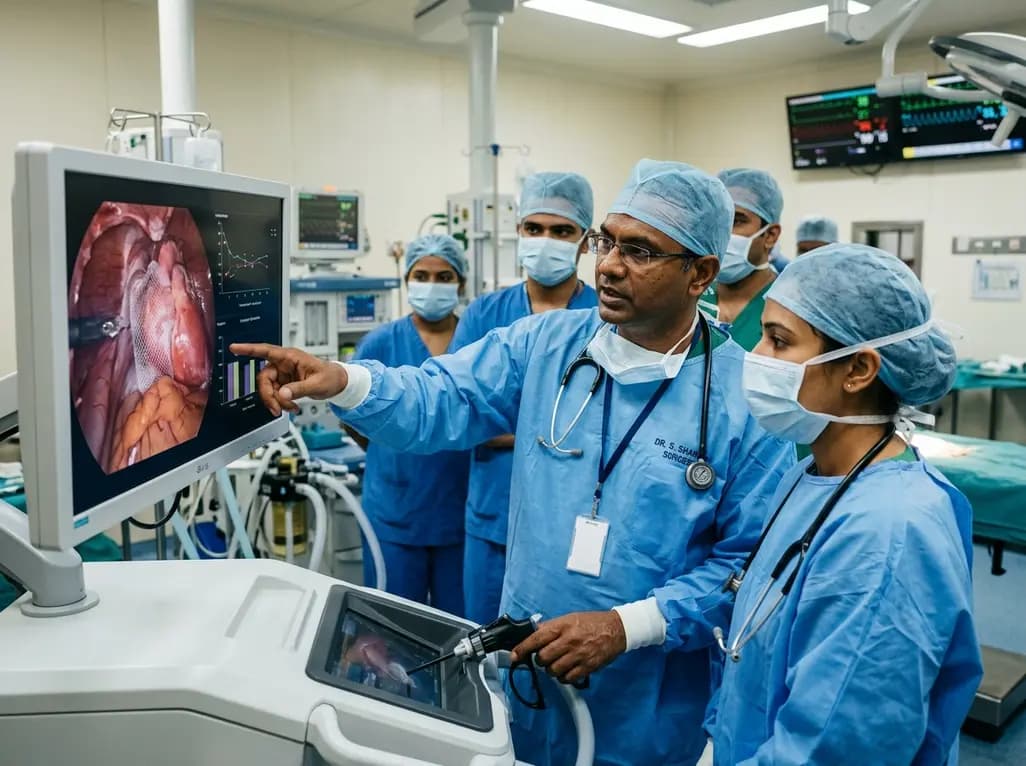
Morgagni hernia represents an uncommon congenital diaphragmatic defect resulting from failure of the sternal and costal embryologic components to fuse anteriorly. Although clinicians frequently diagnose congenital diaphragmatic defects in pediatric cohorts, adult presentations remain rare and frequently challenging to diagnose promptly. Timely Morgagni hernia repair remains essential because organ incarceration can provoke catastrophic mechanical obstruction, strangulation, or bowel perforation.
Adult patients presenting with anterior diaphragmatic defects exhibit diverse clinical presentations. In addition, retrospective clinical analyses demonstrate that approximately seventy percent of affected adult individuals experience active symptoms. The most common presenting complaint is progressive dyspnea, which occurs because herniated abdominal contents exert significant mass effect on the thoracic cavities and lower pulmonary lobes. Patients also frequently report epigastric distress, postprandial discomfort, and obstipation. Furthermore, the transverse colon and greater omentum represent the most common herniated structures, though the stomach and small bowel may also migrate through the anterior defect. Consequently, clinicians must recognize that right-sided retrosternal defects predominate due to pericardial protection on the left. However, left-sided defects, historically designated as Larrey hernias, and rare bilateral defects also occur in adult populations. Because symptoms mimic cardiac and chronic pulmonary conditions, surgeons frequently identify these hernias after protracted medical evaluations.
Accurate preoperative diagnosis requires high-resolution cross-sectional imaging to distinguish anterior diaphragmatic herniation from mediastinal masses. Consequently, contrast-enhanced computed tomography of the chest and upper abdomen represents the gold-standard modality. This imaging pathway clearly delineates defect boundaries, identifies specific herniated visceral structures, and detects potential vascular compromise. Furthermore, coronal and sagittal reconstructions provide surgical teams with critical anatomical landmarks, such as the exact distance from the pericardium and internal mammary vessels. Routine chest radiographs often show non-specific retrosternal opacities or air-fluid levels that clinicians mistake for pneumonia, pericardial fat pads, or pulmonary consolidations. Therefore, incorporating multidetector computed tomography early in the workup prevents inappropriate biopsies of thoracic masses. Additionally, preoperative pulmonary function tests and thorough cardiac evaluations help optimize elderly patients who carry multiple cardiovascular comorbidities prior to undertaking elective or urgent surgical intervention.
Minimally invasive transabdominal access has emerged as the definitive surgical standard for managing these conditions. Specifically, surgeons can perform Morgagni hernia repair through either conventional laparoscopy or robotic-assisted platforms with exceptional clinical efficacy. Recent comparative evidence demonstrates that robotic approaches provide significant advantages regarding hospital stay, yielding a median stay of only two days compared to six days for laparoscopic procedures. Moreover, the robotic console offers three-dimensional magnification and articulating instruments that facilitate precise retrosternal dissection. Laparoscopy remains widely accessible across secondary healthcare settings, but rigid instruments can restrict maneuverability along the steep anterior diaphragmatic rim. In contrast, robotic multi-jointed arms allow surgeons to suture against the posterior rectus sheath and sternum with remarkable ergonomics. Consequently, both modalities deliver outstanding safety profiles without operative mortality, yet robotic platforms significantly accelerate patient ambulation and clinical recovery.
Successful repair requires methodical surgical execution to ensure long-term repair integrity and patient safety. Initially, the operating team places the patient in the reverse Trendelenburg position to allow gravity to assist visceral reduction. Surgeons then carefully reduce the incarcerated omentum, colon, or stomach into the peritoneal cavity using atraumatic graspers. Although complete excision of the hernia sac eliminates seroma formation, surgeons often leave chronic, tightly adherent mediastinal sacs in situ to prevent pneumothorax or pericardial injury. Subsequently, the surgical team evaluates whether primary approximation of the defect margins is feasible under minimal tension. In large defects, surgeons routinely utilize prosthetic mesh reinforcement. Many experts advocate a preperitoneal approach where surgeons place a self-fixing or composite prosthetic mesh behind a developed peritoneal flap. Therefore, extraperitoneal placement protects intra-abdominal viscera from dense adhesions while securing durable diaphragmatic support without extensive transfascial suturing.
Postoperative care following minimally invasive repair emphasizes rapid recovery and rigorous monitoring for occult pulmonary complications. Patients generally resume a light diet within twenty-four hours because the transabdominal approach minimizes bowel manipulation. Furthermore, surgical teams must maintain vigilance for subclinical pneumothoraces, especially if mediastinal dissection disrupted pleural boundaries during hernia sac reduction. Early ambulation and incentive spirometry significantly reduce postoperative pulmonary complications, which is critical since elderly patients comprise a large portion of this population. Long-term follow-up confirms excellent clinical outcomes, showing no hernia recurrences across extended surveillance intervals. In resource-diverse environments, clinicians must balance equipment costs against clinical benefits. While conventional laparoscopy remains a dependable, accessible approach, centers with robotic technology can leverage enhanced dexterity to safely manage complex, incarcerated presentations while substantially shortening inpatient hospital utilization.
Adult patients frequently present with non-specific respiratory and gastrointestinal complaints. Shortness of breath remains the most common clinical feature due to pulmonary compression from intrathoracic viscera. Furthermore, patients often experience epigastric pain, nausea, postprandial vomiting, constipation, or acute obstruction. Because these clinical findings frequently mimic cardiopulmonary disorders, diagnostic suspicion must remain high, particularly in older patients presenting with persistent, unexplained dyspnea.
The transabdominal route allows surgeons to directly inspect, reduce, and evaluate potentially ischemic abdominal viscera under clear visual guidance. Additionally, transabdominal access avoids the significant pain, respiratory splinting, and prolonged chest tube drainage associated with formal thoracotomy. Consequently, minimally invasive transabdominal techniques, including laparoscopy and robotic surgery, significantly reduce postoperative complications, accelerate overall functional recovery, and shorten hospital admissions.
Surgeons utilize prosthetic mesh reinforcement whenever defect dimensions preclude tension-free primary closure or when diaphragmatic margins exhibit significant attenuation. Because excessive tension increases recurrence risks, primary suture closure alone is reserved strictly for small defects. Furthermore, surgeons often employ composite or barrier-coated meshes in preperitoneal planes to prevent dense visceral adhesions while ensuring long-term structural integrity.
Disclaimer: This content is for informational and educational purposes only... Refer to the latest local and national guidelines for clinical practice.
References

Read summarized clinical updates, watch expert medical content, and earn CME certifications right from your smartphone.
Open your smartphone camera to scan and install.





A retrospective review highlights the safety and efficacy of minimally invasive Morgagni hernia repair in adults. Robotic approaches demonstrate shorter hospital stays than laparoscopic methods without complications, offering key clinical insights for surgical teams.
last month

Novel diimide and hydrazone scaffolds, particularly compound #C4, synergistically reactivate latent HIV-1 when combined with JQ1 or PKC activators. Demonstrating donor-matched proviral transcription ex vivo and non-canonical signaling, these findings advance shock and kill strategies toward reservoir eradication.
Today

A comparative cohort study evaluates vNOTES vs TLH hysterectomy for benign conditions, demonstrating shorter operative duration, faster return to daily activities, and equivalent female sexual function scores without increased dyspareunia.
Today

Review how tailored exercise programs benefit frail older patients with heart failure. Explore pathophysiological mechanisms, individualized training prescriptions, and strategies to overcome adherence barriers in clinical practice.
Yesterday

This comparative study evaluates posterior labral tears with and without glenohumeral instability, highlighting distinct demographic patterns, MRI underestimation in stable shoulders, and successful arthroscopic repair outcomes.
Yesterday

A clinical study demonstrates that early intervention with tocilizumab, either as monotherapy or bridged with corticosteroids, achieves significant proptosis reduction and resolves active inflammation in treatment-naive thyroid eye disease.
Today
