.webp&w=384&q=75)

Loading, please wait...
Loading, please wait...

Dietary guidelines serve as the cornerstone of public health, acting as a bridge between complex scientific research and daily nutritional choices. The current revision of the Australian Dietary Guidelines (ADG) highlights the inherent difficulties in translating nutrition evidence into actionable policy recommendations. This process is vital because guidelines directly influence clinical practice, food labeling, and national health programs. However, the shift from laboratory findings to real-world dietary patterns involves navigating a labyrinth of data. Clinicians often rely on these guidelines to manage the rising global burdens of obesity and type 2 diabetes. Consequently, the accuracy of the underlying methodology determines the success of these public health interventions. In India, where nutritional transitions are occurring rapidly, understanding these methodological hurdles is equally crucial for local practitioners. Guidelines must balance biochemical rigor with the practical realities of human behavior and diverse food systems. Therefore, the revision process represents an opportunity to integrate modern scientific paradigms. It also addresses the contemporary dietary challenges that affect millions across different socio-economic strata. Ultimately, the goal remains to reduce chronic disease risk through clear, evidence-based guidance that resonates with both clinicians and the general population.
One of the primary challenges in translating nutrition evidence stems from the nature of nutritional epidemiology. Much of our current understanding of diet and health relies on observational studies. While these studies provide valuable longitudinal data, they often face limitations such as residual confounding and measurement errors. Systematic reviews and meta-analyses frequently aggregate this data to provide a clearer picture. Nevertheless, this synthesis can sometimes obscure significant contextual variations and heterogeneity in dietary assessment methods. For instance, different studies might define a "healthy diet" using varied parameters, making direct comparisons difficult. In addition, the reliance on self-reported dietary intake frequently introduces recall bias. Clinicians must recognize that a single meta-analysis might not account for the unique metabolic responses of specific patient populations. Furthermore, researchers must reconcile global evidence with local nutritional realities. This inconsistency in definitions—ranging from what constitutes a "dietary pattern" to the classification of specific nutrients—creates a complex landscape for policy-makers. By acknowledging these methodological gaps, the revision process aims to enhance the precision of dietary advice. This requires a transition toward more robust, context-specific data that can withstand rigorous scientific scrutiny while remaining relevant to the clinical setting.
The rising prevalence of obesity and type 2 diabetes underscores the urgent need for effective dietary guidance. Guidelines are not merely educational tools; they are essential instruments for chronic disease management. When health authorities translate nutritional evidence, they prioritize interventions that mitigate cardiometabolic risks. Notably, the current ADG revision focuses on how specific food groups and overall dietary patterns influence long-term health outcomes. For the clinician, this translates into more nuanced advice for patients struggling with weight management or glycemic control. However, the evidence linking specific foods to metabolic outcomes is often complex. For example, while the relationship between high sugar intake and diabetes is well-documented, the impact of whole-food structures is still being elucidated. Moreover, the guidelines must address the shifting landscape of non-communicable diseases (NCDs) in both developed and developing nations. In India, the dual burden of undernutrition and overnutrition necessitates a highly adaptable methodological framework. Therefore, strengthening the connection between epidemiological data and clinical outcomes is paramount. By focusing on high-quality evidence, the revised guidelines aim to provide a roadmap for preventing metabolic deterioration. This proactive approach supports the healthcare system by reducing the clinical and economic pressure of chronic lifestyle diseases.
A significant challenge in creating universal dietary guidelines is the immense cultural and geographical diversity of modern populations. Australia’s unique food systems and the distinct practices of Aboriginal and Torres Strait Islander peoples highlight the need for inclusivity. Similarly, in the Indian context, regional dietary variations are vast and deeply rooted in tradition. Generic recommendations often fail to account for these specific food cultures, which can lead to poor adherence in clinical practice. Consequently, translating nutrition evidence requires a deep understanding of local food sovereignty and traditional knowledge. Researchers now emphasize the importance of context-specific research to inform national recommendations. This involves moving beyond nutrient-centric models toward food-based guidelines that respect cultural identity. Furthermore, culturally inclusive research ensures that the guidance is not only scientifically sound but also socially acceptable. When guidelines reflect the lived experience of a community, they become far more effective as tools for behavioral change. Clinicians should advocate for research that captures the nuances of diverse dietary habits. By integrating these perspectives, dietary policies can better address health disparities among marginalized groups. Ultimately, culturally relevant guidelines foster trust between healthcare providers and their patients, leading to more successful nutritional interventions and better health equity.
The contemporary food environment is increasingly dominated by ultra-processed foods (UPFs), which present a unique challenge for evidence translation. Modern guidelines are shifting their focus from isolated nutrients to broader dietary patterns and the degree of food processing. This change reflects the growing body of evidence linking high UPF consumption to various adverse health outcomes, including cancer and metabolic syndrome. However, defining and categorizing ultra-processed foods remains a subject of intense methodological debate. Inconsistencies in terminology can confuse both the public and healthcare professionals. Therefore, the ADG revision prioritizes the development of clear definitions to guide consumers toward healthier choices. Similarly, the concept of a "dietary pattern" recognizes that foods are consumed in combination, creating synergistic effects on health. This holistic approach is more representative of real-world eating habits than focusing on single vitamins or minerals. In the clinical setting, advising a patient to follow a specific pattern, such as a Mediterranean or traditional whole-food diet, is often more effective than focusing on macronutrient ratios alone. Additionally, understanding the multidimensional nature of diet helps in addressing the complexities of obesity. By emphasizing the quality of the food supply, guidelines can better combat the environmental factors that drive poor nutrition and chronic disease globally.
The future of effective dietary guidance depends on sustained investment in high-quality, robust nutrition research. To overcome the current methodological challenges, the global scientific community must prioritize longitudinal studies with more accurate dietary assessment tools. This includes the integration of biomarkers and digital technologies to reduce the reliance on self-reported data. Furthermore, international collaboration is essential to share best practices in translating nutrition evidence across different cultural contexts. For Indian doctors and researchers, this means contributing to a global database that reflects the unique nutritional challenges of the subcontinent. Strengthening the underlying data quality ensures that guidelines remain credible and immune to commercial interests. Moreover, the revision of national guidelines should be a dynamic process that evolves alongside emerging scientific discoveries. As our understanding of the microbiome and precision nutrition grows, policies must remain flexible enough to incorporate these insights. Ultimately, the strength of clinical advice is only as good as the evidence upon which it is built. By advocating for methodological improvements, the medical community can ensure that dietary guidelines remain a powerful tool for public health. A commitment to evidence-based, contextually relevant nutrition will pave the way for healthier generations and more resilient healthcare systems worldwide.
Translating nutrition evidence from observational studies is challenging because these designs primarily show associations rather than direct causation. Factors like residual confounding—where lifestyle habits such as exercise or smoking overlap with diet—can distort results. Furthermore, dietary assessment often relies on participant memory, which introduces significant recall bias and measurement error. Consequently, clinicians must interpret these guidelines with the understanding that they represent the best available, though sometimes imperfect, evidence for population-level health.
Cultural food systems are vital because they determine the practical relevance of nutritional advice. If guidelines ignore traditional eating habits or the availability of local ingredients, patients are less likely to follow them. For example, generic advice on whole grains must be adapted to include regional staples like millet or brown rice. Inclusive guidelines that respect cultural diversity improve health equity and ensure that recommendations are accessible and actionable for all segments of a population.
Ultra-processed foods (UPFs) are a major focus in current guideline revisions because of their strong links to obesity and chronic diseases. Methodologically, the challenge lies in creating consistent definitions for what constitutes a UPF across different food systems. By addressing these foods, guidelines shift the focus from individual nutrients to the overall quality and processing level of the diet. This provides clearer guidance for clinicians to help patients navigate a complex and often unhealthy modern food environment.
Disclaimer: This content is for informational and educational purposes only and does not constitute professional medical advice, diagnosis, or treatment. Always seek the advice of your physician or other qualified health provider with any questions regarding a medical condition. Do not disregard professional medical advice or delay in seeking it because of something you have read here. Refer to the latest local and national guidelines for clinical practice.
References
Melaku YA et al. Methodological challenges in translating nutrition evidence into the Australian Dietary Guidelines. Br J Nutr. 2026 Jul 03. doi: 10.1017/S0007114526107855. PMID: 42393504.
Mozaffarian D. et al. A Food is Medicine approach to achieve nutrition security and improve health. Nat. Med. 2022. 28: 2238–2240.
ICMR-National Institute of Nutrition. Dietary Guidelines for Indians. 2024. Hyderabad, India.
Patel L, La Vecchia C. Improving nutritional epidemiology to take on global challenges. Academia Nutrition. 2024;1. doi:10.20935/AcadNutr7441.

Read summarized clinical updates, watch expert medical content, and earn CME certifications right from your smartphone.
Open your smartphone camera to scan and install.





The revision of the Australian Dietary Guidelines highlights the difficulty of translating epidemiological evidence into policy. This analysis explores the impact of observational data, cultural diversity, and ultra-processed foods on metabolic health recommendations for clinicians worldwide.
2 months ago

A systematic review of 41 preclinical studies reveals that baicalin dampens systemic inflammation, inhibits NF-κB and NLRP3 pathways, and improves organ preservation in sepsis models. However, substantial study heterogeneity and a complete lack of human clinical trials highlight the need for further translational research.
Today
Discover the crucial distinctions between mesonephric and mesonephric-like proliferations of the female genital tract. Learn the key histomorphologic, immunohistochemical, and molecular differences essential for accurate diagnosis and clinical management.
Today
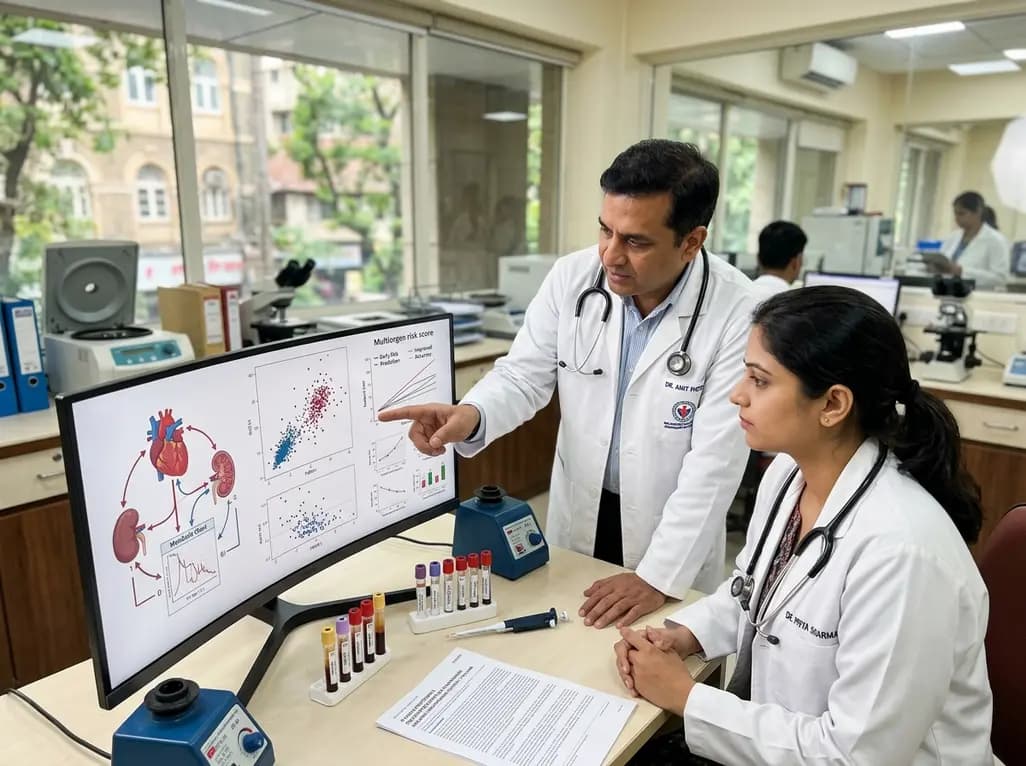
A large UK Biobank study reveals that plasma proteomic signatures capture preclinical organ damage and improve multiorgan risk prediction across early CKM syndrome stages 0 to 2 beyond traditional PREVENT clinical models.
Today
A narrative review investigates whether the articularis genus muscle functions as an independent anatomical entity or blends with the vastus intermedius. We evaluate its morphology, role in retracting the suprapatellar bursa, and direct clinical significance in anterior knee pain and arthroplasty.
Today

A Bayesian multilevel meta-analysis reveals that aerobic training combined with moderate carbohydrate restriction modestly lowers HbA1c in type 2 diabetes. However, sparse data and very low certainty leave incremental benefits over exercise or diet alone unproven, highlighting the need for individualized care.
Today
