.webp&w=384&q=75)

Loading, please wait...
Loading, please wait...
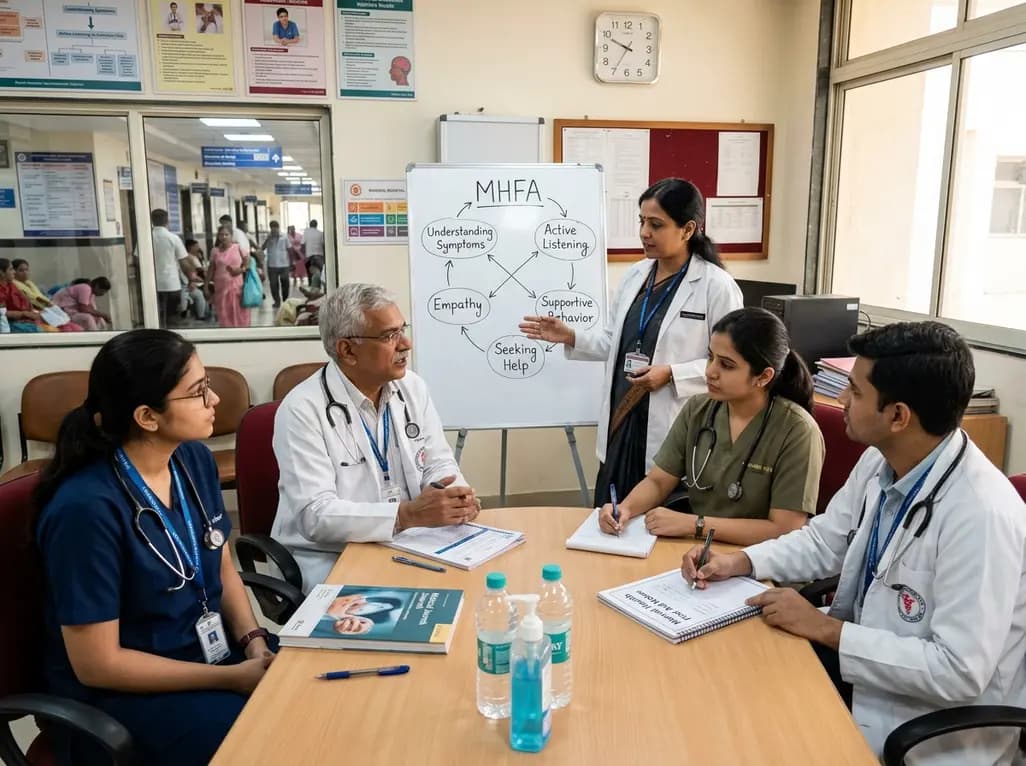
Mental distress represents a major public health challenge worldwide, impairing productivity, absenteeism rates, and social functioning across modern workplaces. While organizations regularly emphasize physical safety protocols, psychological emergencies often go unaddressed due to stigma and limited literacy. Consequently, structured psychoeducational programs such as Mental Health First Aid have emerged to equip non-specialists with supportive intervention strategies. Recent nationwide data from public-sector employees demonstrate that targeted training significantly improves baseline literacy and practical responsiveness. Clinicians and occupational leaders must understand how these educational frameworks translate into measurable workplace behavioral changes.
Employees in public sector environments regularly face intense psychosocial pressures and heavy workloads. Unfortunately, comprehensive assessments regarding their baseline mental health literacy remain scarce. In a large nationwide cross-sectional study of French civil servants, investigators assessed employee competencies across knowledge, attitudes, and supportive behaviors. The researchers normalized each subscore to a forty-point scale to generate an overall composite evaluation. The findings revealed that civil servants possessed a mean score falling squarely within the marginal competency category. Although participants demonstrated solid theoretical knowledge regarding psychological conditions, their scores for proactive supportive behaviors were notably lower. This disparity indicates that theoretical awareness does not automatically translate into effective interpersonal intervention. Furthermore, employees frequently experience hesitation when attempting to assist a struggling colleague. Therefore, structured training programs must bridge the gap between cognitive knowledge and practical behavioral execution. Clinicians managing occupational health programs should prioritize interactive behavioral simulations to help individuals overcome hesitation during workplace crises.
Formal educational interventions generate significant improvements across all critical psychological assessment metrics. In the nationwide French cohort, participants who completed Mental Health First Aid achieved substantially higher overall scores than their untrained colleagues. Specifically, trained employees demonstrated marked gains in recognizing psychiatric symptoms, maintaining supportive non-judgmental attitudes, and executing appropriate crisis de-escalation actions. Multivariable linear regression models confirmed that formal training served as an independent predictor of adequate mental health literacy, even after controlling for baseline sociodemographic variables and professional hierarchy. Moreover, trained personnel expressed greater confidence when discussing emotional distress openly with peers. By standardizing supportive protocols, structured coursework demystifies complex psychiatric conditions and replaces ambiguity with actionable steps. Consequently, trained workers become effective conduits to professional medical care rather than passive bystanders. Primary care physicians and psychiatrists should actively encourage institutional uptake of these evidence-based training modules across diverse corporate and public settings.
A crucial aspect of any professional training initiative involves long-term retention of acquired skills and behavioral competence. While initial post-course assessments demonstrate substantial gains, longitudinal data indicate that competencies gradually attenuate over time. In cross-sectional analyses assessing time gradients since course completion, researchers observed measurable declines in both attitude scores and proactive behaviors as years elapsed. Theoretical knowledge remained relatively stable, but the willingness to initiate supportive conversations decreased steadily. This phenomenon highlights the natural decay of procedural confidence when practical skills are not reinforced routinely. Therefore, organizations cannot rely solely on a one-time educational workshop to maintain a supportive workplace climate. Instead, leadership must establish structured refresher courses and periodic peer debriefing sessions. Regular clinical updates help reinforce crisis identification algorithms and maintain communicative readiness among staff. Occupational health teams should design biennial recertification protocols to preserve optimal peer-support capabilities over extended professional careers.
Pervasive social stigma remains a primary barrier preventing individuals from seeking timely psychiatric assistance in workplace environments. Employees frequently conceal severe depressive symptoms, generalized anxiety, and distress due to fears of professional marginalization. However, wide-scale implementation of structured peer-support programs significantly alters organizational culture by normalizing psychological vulnerability. When colleagues learn to identify early warning signs without judgment, they foster an environment where vulnerable workers feel safe disclosing their struggles. Additionally, training alters interpersonal attitudes by debunking harmful myths surrounding mental disorders and recovery potential. Consequently, coworkers shift from punitive reactions toward empathetic validation and constructive guidance. Supportive workplace cultures also reduce the psychological burden on medical teams by encouraging early consultation before acute decompensation occurs. Medical practitioners collaborating with organizational leaders should emphasize that psychological safety directly protects operational efficiency and employee retention. Ultimately, fostering empathy transforms institutional workplaces into robust therapeutic ecosystems.
Translating research insights into sustainable workplace interventions requires coordinated collaboration between corporate administrators, human resources departments, and occupational health physicians. Health systems must recognize that non-specialist training programs complement rather than replace professional psychiatric services. To maximize institutional efficacy, organizations should identify internal champions across various management tiers to participate in standardized training curricula. Furthermore, employers must establish clear referral pathways connecting initial workplace first aid to specialized psychiatric consultations and employee assistance programs. Medical directors should guide companies in tracking objective performance indicators, such as reduced absenteeism and enhanced help-seeking rates. Moreover, corporate leadership should ensure that first responders receive appropriate emotional supervision to prevent secondary traumatic stress. By integrating structured peer support with accessible clinical resources, organizations build a resilient workforce capable of navigating acute psychosocial stressors. Standardized educational interventions provide a proven, scalable foundation for comprehensive occupational wellness.
Mental Health First Aid serves as an initial supportive bridge rather than a formal therapeutic clinical treatment. Trained non-specialists learn how to recognize early psychological distress, offer non-judgmental listening, and de-escalate immediate crises safely. Consequently, they guide distressed individuals toward qualified medical specialists, occupational therapists, or emergency psychiatric resources. This educational framework empowers laypeople to provide timely early assistance without diagnosing illnesses or delivering complex clinical psychotherapy.
Theoretical knowledge relies primarily on semantic memory, which persists relatively well over extended periods without active practice. In contrast, supportive behaviors demand practical interpersonal confidence, rapid situational judgment, and emotional readiness. Without regular application or refresher training, employees often experience heightened anxiety and hesitation when confronting real-world crises. Therefore, periodic simulation exercises and structured refresher courses are essential to maintain active behavioral intervention capabilities across organizations.
Implementing structured training programs creates a psychologically safe workplace culture that substantially diminishes stigma and shame. Trained colleagues identify emerging psychiatric distress early, preventing minor emotional challenges from escalating into debilitating medical crises. Consequently, organizations observe decreased absenteeism, reduced presenteeism, and improved employee retention rates. Furthermore, early intervention facilitates timely medical referrals, significantly easing the clinical burden on occupational health professionals and psychiatric treatment networks.
Disclaimer: This content is for informational and educational purposes only and does not constitute medical advice, diagnosis, or treatment. Healthcare professionals should exercise their independent clinical judgment. Refer to the latest local and national guidelines for clinical practice.
References

Read summarized clinical updates, watch expert medical content, and earn CME certifications right from your smartphone.
Open your smartphone camera to scan and install.





A nationwide cross-sectional study among French civil servants demonstrates that Mental Health First Aid training significantly elevates knowledge, attitudes, and supportive behaviors, highlighting the critical necessity for ongoing refresher education.
last month

India's food safety authority has cracked down on high-caffeine beverages sold under stimulant branding, prompting legal challenges from major beverage corporations. This review examines FSSAI regulations, cardiac and metabolic complications, pediatric risks, and actionable counseling strategies for physicians.
Today

A ten-year cohort study of ABU case logs reveals that URPS fellowship training significantly drives higher annual case volumes, advanced surgical complexity, and increased female representation in pelvic floor reconstruction, underscoring the vital need for structured subspecialty training.
Today

A breakthrough study identifies transcription factor TBX2 as a master repressor of vascular calcification. In chronic kidney disease, TBX2 deficiency uncouples osteogenic RUNX2 regulation and triggers NLRP3 inflammasome activation, driving severe arterial mineralisation and cardiovascular vulnerability.
Today

Posttraumatic pisotriquetral instability is a rare wrist injury causing severe hypothenar pain and weakness. Explore clinical examination, imaging, and pisiformectomy.
Today

Cardiovascular-kidney-metabolic (CKM) syndrome links metabolic, renal, and cardiovascular diseases along a shared continuum. This review examines holistic CKM management, PREVENT risk assessment, multi-organ pharmacotherapies like SGLT2i and GLP-1 RAs, and multidisciplinary care models to improve patient outcomes.
Today
