.webp&w=384&q=75)

Loading, please wait...
Loading, please wait...
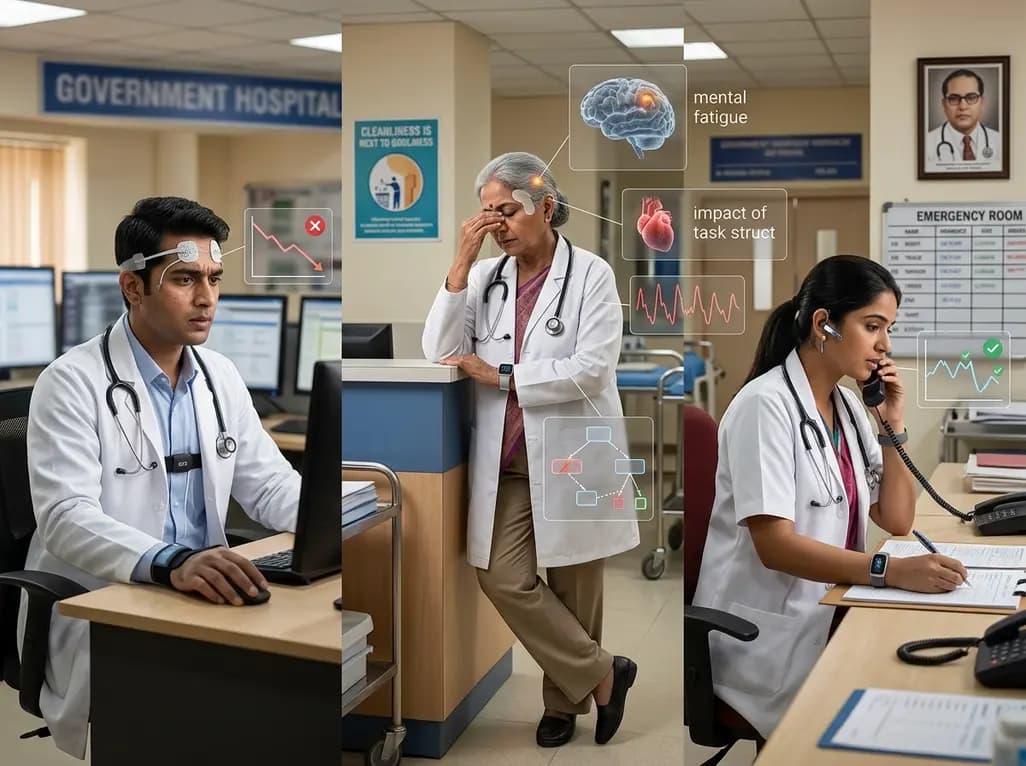
Doctors face high cognitive loads daily. Therefore, mental fatigue monitoring becomes essential for maintaining patient safety in Indian hospitals. A recent study involving 40 participants explored how task segmentation influences fatigue levels and physiological responses. Researchers used a Stroop-based task under two structures: NORMAL and HALF. While both lasted the same amount of time, they differed in block segmentation. Consequently, the results showed that task design significantly alters how fatigue develops over time.
Initially, participants used compensatory control to maintain performance. However, as exhaustion grew, they shifted toward increased automaticity. This change resulted in faster reaction times but caused a notable decline in accuracy. Electrodermal activity (EDA) and electrocardiography (ECG) emerged as the most reliable single-signal indicators for clinicians to track.
Multimodal physiological signals provided the most reliable data. By combining five distinct signals, including respiration and EEG, the researchers achieved high precision. Specifically, using the LightGBM algorithm for fusion resulted in an F1 score of 0.9186. This demonstrates the power of integrated data in predicting cognitive decline.
In contrast, the HALF structure attenuated physiological differentiation at higher fatigue levels. This suggests that task blocks influence how we perceive exhaustion. Understanding these dynamics is vital for high-risk settings, such as emergency departments and surgical suites, where continuous monitoring can prevent errors.
Electrodermal activity (EDA) and electrocardiography (ECG) are the most effective single-signal indicators. However, combining multiple signals yields the highest accuracy for detection.
Task segmentation affects how fatigue manifests physiologically. For instance, the HALF structure in this study attenuated physiological differentiation, potentially masking true exhaustion levels compared to standard structures.
Disclaimer: This content is for informational and educational purposes only. It does not constitute professional medical advice, diagnosis, or treatment. Always seek the advice of your physician or other qualified health provider with any questions you may have regarding a medical condition. Refer to the latest local and national guidelines for clinical practice.
References
Liu S et al. Impact of task structure on mental fatigue induction and work performance. Ergonomics. 2026 Jun 05. doi: 10.1080/00140139.2026.2681130. PMID: 42247254.
Ren L, Wu L, Feng T, Liu X. A New Method for Inducing Mental Fatigue: A High Mental Workload Task Paradigm Based on Complex Cognitive Abilities and Time Pressure. Brain Sci. 2025;15(6):541. doi: 10.3390/brainsci15060541.
Cos CA, et al. Enhancing Mental Fatigue Detection through Physiological Signals and Machine Learning Using Contextual Insights and Efficient Modelling. JSAN. 2023;12(11):234. doi: 10.3390/jsan12060234.

Read summarized clinical updates, watch expert medical content, and earn CME certifications right from your smartphone.
Open your smartphone camera to scan and install.





This study explores how task structure affects mental fatigue progression and the effectiveness of multimodal physiological signals for fatigue detection....
4 months ago

Novel diimide and hydrazone scaffolds, particularly compound #C4, synergistically reactivate latent HIV-1 when combined with JQ1 or PKC activators. Demonstrating donor-matched proviral transcription ex vivo and non-canonical signaling, these findings advance shock and kill strategies toward reservoir eradication.
Today

A cross-sectional study reveals that maternal RSV vaccination coverage reached only 43.7% in Argentina, with maternal vaccine knowledge being the sole independent predictor of uptake. Clinicians play a crucial role in eliminating informational and structural barriers to optimize infant health.
Today

Review how tailored exercise programs benefit frail older patients with heart failure. Explore pathophysiological mechanisms, individualized training prescriptions, and strategies to overcome adherence barriers in clinical practice.
Yesterday

This comparative study evaluates posterior labral tears with and without glenohumeral instability, highlighting distinct demographic patterns, MRI underestimation in stable shoulders, and successful arthroscopic repair outcomes.
Yesterday

A clinical study demonstrates that early intervention with tocilizumab, either as monotherapy or bridged with corticosteroids, achieves significant proptosis reduction and resolves active inflammation in treatment-naive thyroid eye disease.
Yesterday
