.webp&w=384&q=75)

Loading, please wait...
Loading, please wait...
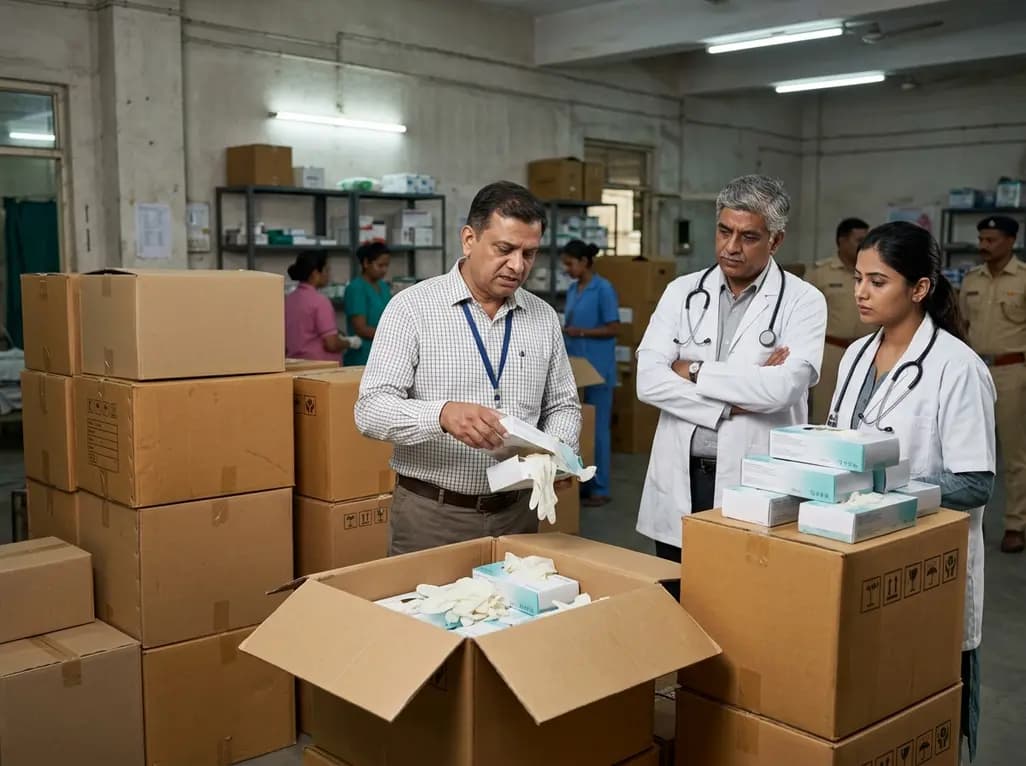
The Maharashtra Food and Drug Administration (FDA) recently uncovered a major healthcare racket. Specifically, the regulatory agency raided a Palghar-based manufacturer for distributing unsterilised surgical gloves to major state-run medical colleges. These institutions included Mumbai's JJ Hospital and St George Hospital. Consequently, the FDA froze healthcare stocks worth Rs 1.26 crore pending a thorough investigation.
The investigation revealed that Saachi Medic imported the bulk stock from Malaysia. Furthermore, Saachi Medic distributed these items without a valid storage and sales license. They sold the imported gloves to Mediearth Lifecare Pvt Ltd. Subsequently, Mediearth Lifecare supplied them to various government hospitals as sterile goods. This unauthorized distribution occurred while Mediearth's sterilization machinery was malfunctioning.
Consequently, hospital authorities unknowingly received non-sterile equipment. Although the company claims they ordered a product recall, FDA officials reported that the manufacturer showed no such order during the raids. Therefore, the state government launched a massive enforcement campaign under the Drugs and Cosmetics Act of 1940.
Surgical procedures require absolute sterility to prevent severe hospital-acquired infections (HAIs). Using unsterilised surgical gloves during operations exposes vulnerable patients to pathogenic bacteria, fungi, and viruses. As a result, patients face a significantly higher risk of surgical site infections, sepsis, and prolonged hospital stays. Thus, clinicians must maintain rigorous vigilance regarding the integrity of sterile packages.
Additionally, medical staff should always inspect chemical sterility indicator strips inside bulk packaging. If the indicator strip has not changed color, medical staff must discard the product immediately. Healthcare facilities should also cross-verify the manufacturer's FDA registration status on official portals before clinical use.
Q1: What did the Maharashtra FDA find during the raids?
The Maharashtra FDA discovered a racket where non-sterile surgical gloves were falsely labeled and supplied to government hospitals as sterile. In addition, they seized unlicensed stocks of bandages and cotton worth Rs 2.17 crore.
Q2: Why did the non-sterile gloves reach the hospitals?
According to reports, the manufacturer's sterilization machinery malfunctioned during a bulk order. However, the company proceeded with the urgent shipment instead of verifying the sterility status of each batch.
Q3: How can hospitals verify if medical gloves are sterile?
Hospitals can verify sterility by checking the chemical indicator strips placed inside the packaging. Furthermore, they should inspect the FDA registration details on the outer carton.
Disclaimer: This content is for informational and educational purposes only. It does not constitute medical advice or replace professional judgment. Refer to the latest local and national guidelines for clinical practice.
References

Read summarized clinical updates, watch expert medical content, and earn CME certifications right from your smartphone.
Open your smartphone camera to scan and install.





The Maharashtra FDA's raid seized Rs 2.17 crore of unsterilised gloves falsely labeled as sterile and supplied to major government hospitals....
4 months ago

Discover the crucial role of glymphatic dysfunction in stroke, where perivascular clearance failure and neuroinflammation exacerbate cerebral edema and post-stroke brain injury.
Today

A prenatal case highlights severe glutaric acidemia type II presenting as bilateral hyperechoic cystic kidneys at 18 weeks. Whole-exome sequencing revealed a novel homozygous ETFDH frameshift variant, demonstrating the power of rapid genetic testing in fetal renal anomalies.
Today

Review how tailored exercise programs benefit frail older patients with heart failure. Explore pathophysiological mechanisms, individualized training prescriptions, and strategies to overcome adherence barriers in clinical practice.
Yesterday

This comparative study evaluates posterior labral tears with and without glenohumeral instability, highlighting distinct demographic patterns, MRI underestimation in stable shoulders, and successful arthroscopic repair outcomes.
Yesterday

A clinical study demonstrates that early intervention with tocilizumab, either as monotherapy or bridged with corticosteroids, achieves significant proptosis reduction and resolves active inflammation in treatment-naive thyroid eye disease.
Yesterday
