.webp&w=384&q=75)

Loading, please wait...
Loading, please wait...
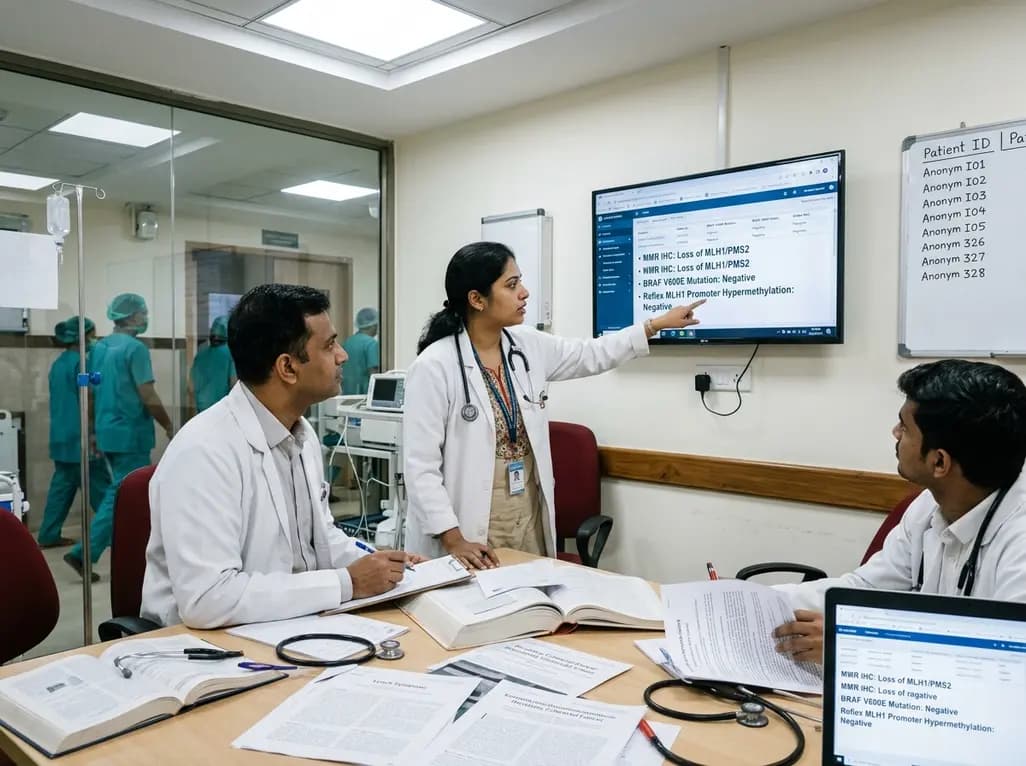
Colorectal cancer remains a significant cause of global oncology morbidity, with hereditary cancer predisposing syndromes explaining approximately five percent of all presenting cases. Lynch syndrome represents the most frequent hereditary predisposition, originating from pathogenic germline alterations in mismatch repair genes. Universal screening protocols recommend tumor mismatch repair immunohistochemistry or microsatellite testing for every newly diagnosed colorectal malignancy. However, real-world clinical implementation often falters between initial tissue screening and formal Lynch syndrome germline testing. Consequently, identifying systemic obstacles and closing diagnostic gaps are paramount for clinician teams managing colorectal malignancies today.
International oncology bodies advocate universal mismatch repair testing in all resected or biopsied colorectal specimens. When functional proteins fail to express, microsatellite instability develops, signaling impaired genomic proofreading during DNA replication. Pathologists routinely examine four primary proteins: MLH1, MSH2, MSH6, and PMS2. Consequently, immunohistochemistry provides an efficient, cost-effective initial filter to identify potential hereditary cases. When tumor tissue exhibits mismatch repair deficiency, clinicians must determine whether somatic alterations or true germline variants cause the loss. For example, hypermethylation of the MLH1 gene promoter or concurrent BRAF V600E mutations accounts for most sporadic cases. Therefore, clinicians can safely exclude these individuals from immediate familial genetic investigations. However, individuals lacking somatic explanatory markers require prompt referral to clinical genetics services. This diagnostic algorithm ensures appropriate allocation of specialized counseling resources. Nevertheless, public hospital audits reveal substantial attrition across sequential steps of this established pathway. Clinicians must understand where these drop-offs emerge to maintain diagnostic continuity and optimize cancer risk assessments.
Recent public healthcare data illustrates both notable successes and concerning drop-offs along the diagnostic trajectory. In large tertiary healthcare cohorts, multidisciplinary teams achieved baseline screening rates exceeding ninety percent of all colorectal cancer cases. Furthermore, mismatch repair deficiency appeared in approximately twelve to thirteen percent of evaluated tumors, mirroring historical global benchmarks. After clinicians systematically excluded somatic MLH1 hypermethylation, more than one-third of deficient cases qualified for immediate clinical genetics evaluation. However, the trajectory deteriorated significantly at the referral and completion phases. Nearly one-quarter of eligible patients never received a formal genetic consultation referral. More critically, less than half of qualifying patients actually completed Lynch syndrome germline testing. Confirmed Lynch syndrome emerged in roughly nine percent of mismatch repair-deficient cancers, while another seven percent showed unexplained persistent deficiency termed Lynch-like syndrome. These attrition metrics highlight that universal laboratory screening alone does not guarantee downstream diagnostic completion. Clinicians must actively monitor patient navigation beyond the initial pathology report.
Distinguishing somatic epigenetic phenomena from hereditary mismatch repair mutations is vital for clinical precision. Isolated MLH1 and PMS2 protein loss represents the vast majority of mismatch repair-deficient colorectal cancers encountered in routine surgical practice. However, somatic hypermethylation of the MLH1 promoter drives approximately eighty percent of these dual-negative cases. Additionally, the presence of an oncogenic BRAF V600E mutation strongly indicates an acquired somatic pathway rather than an inherited syndrome. Pathologists perform reflex BRAF molecular testing or direct methylation assays to resolve this distinction promptly. Conversely, tumors showing isolated MSH2, isolated MSH6, or isolated PMS2 loss rarely stem from promoter hypermethylation. Consequently, these non-MLH1 patterns warrant direct referral for constitutional genomic assessment without requiring supplementary tumor-level exclusion assays. In patients with Lynch-like syndrome, tumors display high microsatellite instability without MLH1 methylation, yet germline testing reveals normal sequences. Researchers now recognize that double somatic mutations in mismatch repair genes explain many Lynch-like presentations. Therefore, comprehensive somatic next-generation sequencing increasingly helps clarify ambiguous phenotypes.
Securing a definitive germline diagnosis fundamentally alters surgical decision-making and systemic oncology management. For instance, patients with confirmed Lynch syndrome face substantial risks of synchronous and metachronous colorectal neoplasms throughout their lifespan. Consequently, surgical oncologists frequently consider extended colectomy rather than standard segmental resection to mitigate future primary tumor occurrence. Moreover, mismatch repair-deficient tumors exhibit pronounced immunogenicity, rendering them exceptionally responsive to immune checkpoint inhibitor therapies in advanced settings. Beyond individual therapeutic benefits, identifying a pathogenic germline variant delivers profound preventive advantages for biological relatives. Cascade genetic testing enables at-risk family members to undergo targeted testing before any malignant transformation develops. Unaffected carriers can subsequently initiate intensive endoscopic surveillance starting between ages twenty and twenty-five. Frequent colonoscopic surveillance with polypectomy dramatically reduces colorectal cancer incidence and overall mortality in mutation carriers. Additionally, female carriers benefit from structured endometrial and ovarian cancer risk-reduction discussions. Failing to complete germline evaluations forfeits these critical secondary prevention opportunities across entire family lineages.
Audits of clinical workflows reveal repetitive structural barriers that hinder timely genetics consultations. Firstly, traditional referral models rely heavily on manual paperwork generated by treating surgeons or medical oncologists. When clinical encounters focus predominantly on immediate operative recovery or chemotherapy regimens, hereditary risk discussions often slip from attention. Secondly, patient relocation, socio-economic challenges, and fragmented electronic medical records cause significant loss to clinical follow-up. Thirdly, misunderstandings regarding genetic discrimination and anxiety regarding inherited risks provoke voluntary patient refusals. To overcome these multifaceted hurdles, health networks must adopt standardized, automated reflex testing pathways. Electronic pathology systems can automatically trigger genetic counseling notifications whenever mismatch repair deficiency lacks somatic explanation. Furthermore, embedding dedicated genetic counselors directly into multidisciplinary gastrointestinal oncology clinics drastically expedites pre-test education. Clinicians must also enhance patient communication tools to demystify genomic testing, ensuring equitable access across culturally diverse populations.
Modern oncology demands integrated, multidisciplinary collaboration to bridge the persistent gap between tissue diagnostics and hereditary cancer genetics. Surgeons, gastroenterologists, medical oncologists, and pathologists must actively review mismatch repair test results during every tumor board meeting. In addition, paired tumor-normal genomic sequencing is rapidly transforming routine diagnostic algorithms. By sequencing tumor tissue and peripheral blood concurrently, molecular pathologists can detect somatic and constitutional alterations in a single standardized assay. This streamlined strategy minimizes diagnostic delays, reduces sequential appointment burdens, and resolves Lynch-like ambiguities efficiently. Furthermore, ongoing genomic education programs must equip practicing clinicians with updated variant interpretation frameworks. As molecular therapies expand across gastrointestinal malignancies, mismatch repair status directly informs both immediate survival and long-term familial wellness. Establishing resilient institutional workflows guarantees that every qualifying patient achieves prompt, definitive constitutional evaluation.
Lynch syndrome is confirmed when geneticists identify an inherited, constitutional pathogenic variant in mismatch repair genes or EPCAM. In contrast, Lynch-like syndrome occurs when a patient displays mismatch repair-deficient or microsatellite-unstable tumors without MLH1 promoter methylation, yet blood germline testing reveals normal wild-type DNA. Many Lynch-like cases arise from acquired, double somatic mutations restricted solely within the neoplastic tumor tissue.
Reflex testing for BRAF mutations and MLH1 promoter hypermethylation provides an essential gatekeeper function in colorectal cancer triage. Most colorectal tumors lacking MLH1 protein expression originate from non-hereditary, epigenetic silencing rather than constitutional mutations. Promptly identifying these somatic alterations spares older patients unnecessary germline sequencing, minimizes unwarranted familial anxiety, and directs specialized genetics consultations toward genuine high-risk individuals.
Confirming Lynch syndrome prompts rigorous, specialized endoscopic surveillance protocols due to accelerated adenoma-carcinoma transitions. Mutation carriers undergo high-quality colonoscopies every one to two years, commencing between ages twenty and twenty-five, or five years earlier than the youngest affected relative. This intensive surveillance facilitates early premalignant polyp resection, significantly decreasing lifetime colorectal cancer incidence and cancer-related mortality.
Disclaimer: This content is for informational and educational purposes only and does not constitute medical advice, diagnosis, or treatment. Healthcare professionals should exercise their independent clinical judgment when evaluating medical information. Refer to the latest local and national guidelines for clinical practice.
References

Read summarized clinical updates, watch expert medical content, and earn CME certifications right from your smartphone.
Open your smartphone camera to scan and install.





Universal mismatch repair screening for colorectal cancer achieves high uptake, yet major drop-offs persist along the pathway to genetics referral and Lynch syndrome germline testing. Addressing systemic barriers and reflex testing protocols is essential to optimize hereditary cancer management and cascade screening.
last month

As monsoon seasons elevate arboviral disease threats, Tamil Nadu has initiated an ICMR-monitored evaluation of the tetravalent dengue vaccine in Tenkasi district. Clinicians emphasize clinical monitoring, public prevention, and high-quality early pediatric care to reduce disease morbidity across endemic regions.
Today

Leucine Rich Bio has introduced South Asia's first comprehensive vaginal microbiome test, BugSpeaks. By profiling microbial dysbiosis, pathogens, and antimicrobial resistance, this next-generation diagnostic platform provides clinicians with deeper insights into recurrent infections, fertility, and reproductive health.
Today

Review how tailored exercise programs benefit frail older patients with heart failure. Explore pathophysiological mechanisms, individualized training prescriptions, and strategies to overcome adherence barriers in clinical practice.
Today

This comparative study evaluates posterior labral tears with and without glenohumeral instability, highlighting distinct demographic patterns, MRI underestimation in stable shoulders, and successful arthroscopic repair outcomes.
Today

A clinical study demonstrates that early intervention with tocilizumab, either as monotherapy or bridged with corticosteroids, achieves significant proptosis reduction and resolves active inflammation in treatment-naive thyroid eye disease.
Today
