.webp&w=384&q=75)

Loading, please wait...
Loading, please wait...

Children with unilateral cerebral palsy face significant functional challenges during daily bimanual activities. In this condition, motor impairments predominantly affect one side of the body, leading to asymmetric upper limb control. Clinicians must accurately evaluate how an infant or older child uses the affected limb to support bimanual coordination. Traditional tests frequently measure isolated unimanual capacity in controlled clinical environments. However, true functional independence depends directly on spontaneous bimanual performance during everyday tasks. Consequently, specialized assessment batteries have transformed pediatric neurorehabilitation over recent years. Therapists now emphasize objective tools that capture natural movement during play. Early identification of asymmetric motor patterns allows teams to design targeted interventions before compensatory habits solidify. Furthermore, tracking progress across critical developmental milestones helps therapists adjust therapeutic dosages effectively. In developing nations like India, reliable assessment tools provide essential guidance for occupational therapists. Therefore, validated bimanual instruments play an indispensable role in pediatric neurorehabilitation.
Rehabilitation specialists rely on distinct age-specific instruments to monitor upper limb capacity across development. Specifically, therapists utilize the Mini-Assisting Hand Assessment, known as Mini-AHA, for infants aged 8 to 18 months. This video-recorded observation captures how effectively an infant uses their assisting hand alongside their dominant hand during play. As children grow older, clinicians transition them to the standard AHA, covering ages 18 months to 18 years. Both instruments provoke spontaneous bimanual handling through playful, semi-structured tasks. However, the items and developmental expectations between the two instruments differ noticeably. The Mini-AHA evaluates emergent actions such as early grasping, releasing, and passive stabilization. In contrast, the standard AHA demands more complex bimanual coordination and in-hand manipulation. Because test items reflect different developmental stages, clinicians cannot directly compare raw scores. As a result, rehabilitation specialists required a rigorous method to harmonize outcomes across both assessments.
To bridge this critical measurement divide, researchers designed a robust psychometric study using Rasch measurement models. The study analyzed evaluation data from 157 children on the AHA and 86 infants on the Mini-AHA. Additionally, the researchers identified a vital subgroup of 23 common children who completed both assessments within a fixed time frame. This common-person design enabled concurrent test linking, an advanced statistical technique that places distinct items onto a shared mathematical continuum. Rasch measurement transforms ordinal rating scores into linear, interval-level logit measures. Consequently, investigators can examine whether two separate tools measure the same underlying construct across varying ability strata. In this study, the common-person anchor linked item calibrations directly. Thus, researchers evaluated structural equivalence without examiner bias. Moreover, the statistical model accounted for item difficulty hierarchies across age cohorts. This rigorous methodology established the necessary mathematical foundation to calibrate both assessments onto an integrated measurement scale.
The statistical linking analysis yielded critical insights for clinical rehabilitation teams. Importantly, the common-person Rasch analysis demonstrated that Mini-AHA units and standard AHA units are not numerically equivalent. Clinicians cannot simply assume that a score on the infant tool equals the same value on the childhood scale. Instead, items on the standard AHA represent higher physical and cognitive task demands. Consequently, identical raw numbers reflect very different functional competencies in young children. Because direct numerical substitution introduces substantial scoring errors, researchers developed a dedicated mathematical conversion table. This table translates logit-based Mini-AHA units directly into standardized AHA units. Through this conversion, clinicians can now plot a continuous developmental trajectory for any child across infancy and adolescence. Furthermore, researchers can conduct longitudinal studies without fragmenting data at the 18-month threshold. Therefore, the conversion table provides an essential resource that resolves a longstanding psychometric challenge.
These psychometric findings offer immense practical value for pediatric care networks across India. In Indian clinical settings, pediatricians and therapists often manage diverse presentations of unilateral cerebral palsy under resource-constrained conditions. Early developmental intervention programs frequently commence around 8 to 12 months when parents first notice hand dominance asymmetry. However, tracking progress when children transition from early intervention centers to school-age therapy has historically proved challenging. Using the new conversion table, multidisciplinary rehabilitation teams in India can now maintain continuous functional records. For example, therapists evaluating bimanual performance before and after botulinum toxin injections can reliably detect genuine functional gains. Moreover, tertiary centers can benchmark clinical outcomes across multi-year rehabilitation trials. Consequently, Indian pediatric rehabilitation teams can elevate clinical documentation standards while optimizing therapeutic decision-making for young patients.
Continuous outcome tracking represents the cornerstone of modern neuroplasticity-based interventions. Because the infant brain exhibits peak neuroplasticity during the first two years, early bimanual training produces remarkable motor reorganization. Clinicians who initiate constraint-induced movement therapy or bimanual play protocols must quantify changes with maximal precision. Previously, switching from the Mini-AHA to the AHA at 18 months caused artificial score drops or uninterpretable plateaus. The standardized conversion framework eliminates these measurement artifacts entirely. As a result, rehabilitation teams can distinguish true motor progress from tool-related measurement discrepancies. Furthermore, this linked scale empowers clinicians to establish realistic functional goals aligned with individual maturation rates. Therapists can also demonstrate tangible progress to families, thereby fostering stronger therapy adherence. Ultimately, unified measurement scales bridge early infant intervention and long-term childhood neurorehabilitation, delivering lasting functional independence.
The Mini-AHA and standard AHA evaluate different developmental stages and movement complexities. The standard AHA demands advanced bilateral coordination and fine motor manipulation that infant assessments do not measure. Consequently, their scoring units are not numerically equivalent, requiring a validated Rasch conversion table to align the scores accurately.
Clinicians typically administer the Mini-AHA to infants aged 8 to 18 months. Once a child reaches 18 months of age, therapists transition to the standard Assisting Hand Assessment, which extends through 18 years. Applying the conversion table allows clinicians to interpret scores seamlessly across this critical age transition.
Rasch test linking provides Indian pediatricians and occupational therapists with a continuous, unified metric across early childhood and adolescence. This continuity helps rehabilitation centers monitor real functional recovery, evaluate intensive therapies like bimanual training objectively, and reassure families with clear, long-term developmental trajectories without measurement confusion.
Disclaimer: This content is for informational and educational purposes only. It does not constitute formal medical advice, diagnosis, or treatment. Always consult a qualified healthcare provider with any questions regarding medical conditions or clinical interventions. Refer to the latest local and national guidelines for clinical practice.
References

Read summarized clinical updates, watch expert medical content, and earn CME certifications right from your smartphone.
Open your smartphone camera to scan and install.





A psychometric study links the Mini-AHA (8-18 months) and standard AHA (18 months-18 years) in unilateral cerebral palsy. Using Rasch common-person test linking, researchers established a conversion table to enable seamless longitudinal tracking of bimanual hand performance from infancy through adolescence.
Today

Hantaviruses are emerging zoonotic pathogens causing hemorrhagic fever with renal syndrome and hantavirus pulmonary syndrome. Characterized by severe capillary leakage and thrombocytopenia, these infections require prompt diagnosis, vigilant hemodynamic monitoring, and specialized critical care support.
Today

The ClinGen Prenatal Gene Curation Expert Panel evaluated 63 disease relationships across 61 genes, establishing clinical validity for severe fetal phenotypes like hydrops and stillbirth to enhance prenatal genomic interpretation and clinical care.
Yesterday

Managing refractory hypoxemia after cardiothoracic surgery becomes perilous when prolonged air leak limits positive-pressure ventilation. This case-based review details how high-flow nasal cannula, paired with awake rehabilitation, enabled successful extubation and avoided invasive re-intubation.
Today

Idiopathic axillary web syndrome (IAWS) is a rare cause of shoulder pain and mobility restriction characterized by palpable axillary cording without prior surgery or trauma. Early diagnosis, nonsteroidal anti-inflammatory therapy, and physical rehabilitation lead to complete resolution of symptoms.
Today
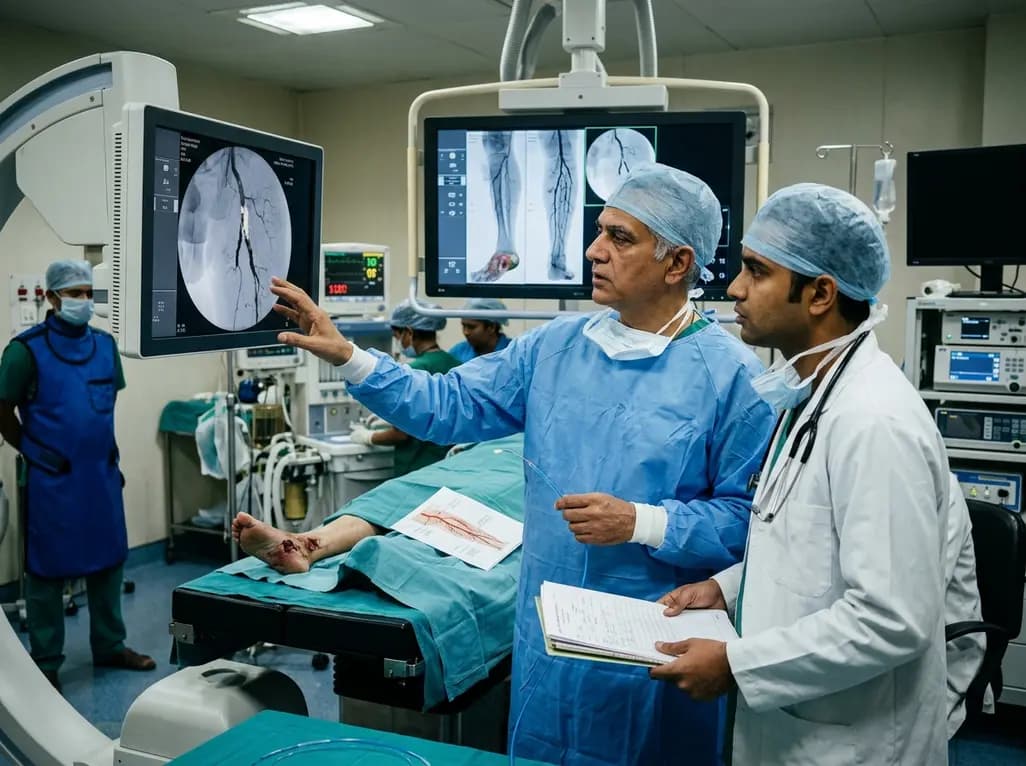
SWEDEPAD-1 trial insights show paclitaxel-coated devices do not improve long-term limb salvage in patients with chronic limb-threatening ischemia and tissue loss. While one-year reinterventions decreased, the devices were linked to a higher risk of major amputation at three months.
Today
