

Loading, please wait...
Loading, please wait...

Pediatric intensivists frequently encounter complex clinical scenarios where clinical prognosis clashes with family expectations. In critical care medicine, managing life-sustaining therapies requires a delicate equilibrium between physiological efficacy and ethical proportionality. When children suffer catastrophic neurologic injuries, clinicians must evaluate whether ongoing advanced interventions offer meaningful recovery or merely prolong irreversible suffering. While earlier medical literature predominantly examined provider perspectives on withholding interventions despite family objections, critical gaps remain regarding active continuation or withdrawal requests. Therefore, clinicians often experience profound moral distress when surrogate decision-makers insist on continuing treatments that healthcare teams consider medically non-beneficial or inappropriate. Consequently, healthcare professionals must navigate these fragile boundaries with both technical expertise and deep empathy. This ethical tension is particularly acute in pediatric critical care, where surrogate decision-makers hold broad legal and moral authority to advocate for their child's interests. In addition, clinicians must simultaneously honor the established medical dictum of non-maleficence while respecting the sacred bond between parents and critically ill children. Furthermore, these clinical encounters demand structured communication strategies to prevent escalating conflict and caregiver alienation. Moreover, understanding how frontline intensivists address these distressing scenarios provides essential insights into contemporary critical care practice.
A groundbreaking national study evaluated provider responses to an ethical dilemma involving a child with severe traumatic brain injury. In this specific clinical scenario, the patient demonstrated minimal potential for functional neurological recovery, yet the family adamantly requested the continuation of mechanical ventilation and artificial nutritional support. Interestingly, the survey outcomes demonstrated that most pediatric intensivists would initially accede to the family's requests and offer the contested interventions. However, the study uncovered substantial variation among physicians regarding the subsequent clinical steps and long-term treatment trajectories. While many clinicians chose to maintain physiological stabilization, their rationales and future boundaries diverged significantly across different institutional settings. Some physicians advocated for setting strict, time-limited trials of invasive support, whereas others preferred rapid escalation toward clinical ethics consultation. Furthermore, several respondents favored gradual consensus-building through repetitive multidisciplinary conferences to align prognostic expectations. This striking divergence illustrates that bedside clinical management frequently transcends rigid technical protocols. Instead, intensivists adopt individualized strategies that reflect their personal moral frameworks, risk tolerance, and communication competencies. Consequently, these findings highlight how subjective clinical judgment influences practical decision-making in high-stakes intensive care environments.
Qualitative analyses of free-text provider narratives illuminate the deep psychological and ethical tensions that intensivists experience during prolonged critical illness. On one hand, physicians feel an uncompromising professional obligation to uphold the principle of non-maleficence. They worry intensely about inflicting unnecessary pain, prolonging somatic death, and subjecting a vulnerable child to invasive interventions that offer no restorative benefit. On the other hand, clinicians deeply revere the vital role of parents as primary surrogate decision-makers. Because parents carry the permanent emotional burden of their child's outcome, intensivists hesitate to overrule their values or extinguish their remaining hope. Therefore, providers frequently describe an exhausting process of moral calibration as they weigh child suffering against parental disenfranchisement. Additionally, practitioners recognize that sudden treatment withdrawal without parental readiness causes catastrophic, lasting grief and psychological trauma for bereaved families. As a result, many intensivists deliberately accommodate requests for life-sustaining therapies in the short term, not because they anticipate recovery, but because they seek to shepherd the family through an agonizing transition toward acceptance. Thus, compassionate end-of-life care often involves temporal compromises that give families sufficient time to process devastating prognoses.
The pronounced variation in clinical management highlights the indispensable necessity of comprehensive institutional support systems. When managing contentious ethical dilemmas, isolated physicians face severe cognitive exhaustion, moral injury, and administrative vulnerability. Therefore, institutions must provide accessible multidisciplinary support mechanisms, including clinical ethics committees, institutional risk management, hospital legal counsel, and specialized palliative care services. Palliative care teams play an exceptionally valuable role by introducing expert symptom management, emotional support, and skilled communication facilitation early in the intensive care course. Moreover, formal clinical ethics consultations offer an objective forum where multidisciplinary teams can thoroughly evaluate the proportionality of interventions without punitive pressures. In addition, healthcare facilities must establish explicit institutional policies that outline standard operational pathways for resolving surrogate-provider impasses. Such frameworks prevent arbitrary decision-making and protect both patient welfare and clinical staff well-being. Ultimately, health systems must invest in routine simulation training, dispute resolution workshops, and structured communication curricula for intensive care fellows and faculty. By cultivating strong institutional resources, hospitals can transform adversarial disagreements into collaborative, family-centered deliberative processes that safeguard patient dignity while supporting dedicated healthcare providers.
These critical care dilemmas resonate powerfully within the Indian healthcare landscape, where pediatric intensivists routinely encounter unique socioeconomic and regulatory hurdles. In India, resource allocation, out-of-pocket healthcare expenditures, and variable access to long-term rehabilitation create formidable challenges for families of technology-dependent children. Furthermore, cultural attitudes toward filial duty and parental responsibility often motivate families to demand heroic measures despite an adverse neurological prognosis. Additionally, national professional bodies, including the Indian Academy of Pediatrics and the Indian Society of Critical Care Medicine, emphasize the ethical legitimacy of withholding or withdrawing non-beneficial interventions when continued therapy merely protracts active dying. However, many clinicians practice defensive medicine because they fear legal ambiguity, familial hostility, or institutional scrutiny. To overcome these systemic barriers, Indian intensive care units must actively integrate the Indian Council of Medical Research definitions regarding limitation of treatment into everyday clinical governance. Establishing institutional ethics committees and integrating dedicated palliative care specialists can guide families through shared decision-making. Consequently, structured communication, proactive transparency, and compassionate counseling remain the cornerstone for navigating disputed interventions, ensuring that ethical medical stewardship always aligns with pediatric patient welfare.
Potentially inappropriate therapies are interventions whose physiological goals cannot realistically restore an acceptable quality of life or alter a lethal prognosis. Clinicians consider these treatments inappropriate when the physical burdens and prolonged suffering to the pediatric patient substantially outweigh any tangible clinical benefits, despite persistent requests from surrogate family decision-makers.
Physicians should employ proactive, compassionate communication using structured multidisciplinary family conferences. Clinicians must establish clear prognostic expectations, actively listen to parental values, and validate emotional grief. Utilizing time-limited trials with predefined physiological endpoints and early palliative care involvement helps families understand clinical futility while preventing abrupt confrontational disagreements.
In India, pediatric end-of-life decisions align with ethical positions from the Indian Academy of Pediatrics and the Indian Council of Medical Research. These guidelines support withholding or withdrawing non-beneficial treatments through multidisciplinary consensus, thorough documentation, and shared decision-making with guardians, distinguishing compassionate limitation of futile therapy from active euthanasia.
Disclaimer: This content is for informational and educational purposes only... Refer to the latest local and national guidelines for clinical practice.
References

Read summarized clinical updates, watch expert medical content, and earn CME certifications right from your smartphone.
Open your smartphone camera to scan and install.





A nationwide survey reveals how pediatric critical care specialists approach parental requests for life-sustaining therapies in severe brain injury, balancing prolonging suffering against family autonomy.
Today

A new study demonstrates how explainable AI guides transparent fall risk prediction models in older adults. By pairing random survival forests and SHAP with Cox regression, researchers achieved superior accuracy and eliminated unneeded variables, enhancing clinical decision-making and patient safety.
Today

Ascertainment bias in cancer case-control studies inflates odds ratios and penetrance estimates when cases are drawn from high-risk clinics. A landmark modeling study demonstrates substantial bias ranging up to 23.72, highlighting the critical need for ascertainment adjustment in genetic risk counseling.
Today
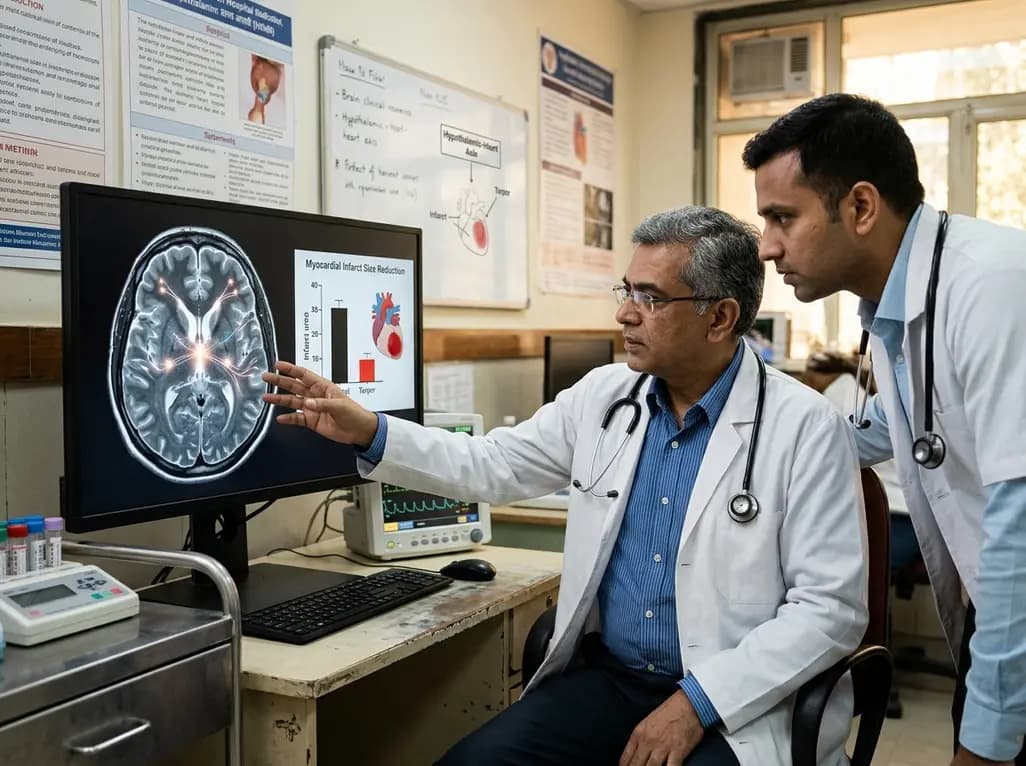
Researchers demonstrate that central induction of synthetic torpor in non-hibernating rats provides striking cardioprotection, reducing myocardial infarct size by ~40% during ischaemia-reperfusion injury through endogenous survival signaling, independent of hypothermia.
Today
A prospective study evaluates DeepSeek for knee osteoarthritis outcomes. While the model excels at baseline diagnosis and clinical scoring, its six-month prognostic predictions fall short of clinicians and simple persistence models, demonstrating high run-to-run variability.
Today

A novel fluorine-functionalized near-infrared copper fluorescent probe selectively illuminates lung tissue, revealing critical links between hyperglycemia, ER stress, and pulmonary malignancy for improved early diagnosis.
Today
