

Loading, please wait...
Loading, please wait...

Artificial intelligence continues to transform modern musculoskeletal medicine. Clinicians increasingly test generative artificial intelligence for clinical documentation and clinical decision support. However, evaluating long-term disease trajectories requires exceptional predictive accuracy. A recent prospective study evaluated how advanced large language models forecast knee osteoarthritis outcomes over a six-month window. The investigators specifically compared automated algorithmic projections against experienced rheumatologists and mathematical persistence models. Their findings highlight essential strengths in baseline record synthesis alongside notable vulnerabilities in longitudinal clinical forecasting.
Medical teams frequently struggle with expanding documentation demands in busy outpatient orthopedic clinics. Consequently, researchers want to know if generative models can streamline baseline evaluations and predict knee osteoarthritis outcomes accurately. In this prospective single-center investigation, researchers enrolled 128 adult patients presenting with primary knee osteoarthritis. Overall, 111 patients completed the complete six-month longitudinal follow-up protocol. Investigators tasked DeepSeek-V4-Flash and an experienced rheumatologist with evaluating identical standardized clinical interview transcripts and radiographic imaging reports. Both the human clinician and the computational algorithm extracted baseline Western Ontario and McMaster Universities Osteoarthritis Index scores and Kellgren-Lawrence grades. Furthermore, both evaluators generated six-month prognostic estimates for functional symptom progression and joint space alteration. A separate senior physician established the definitive reference standard by reviewing confirmed six-month clinical evaluations. In addition, the research team implemented a basic persistence model to establish a quantitative baseline benchmark. This comprehensive design enabled direct, blinded comparisons between generative machine learning, specialist clinical acumen, and naive mathematical projection.
The computational model demonstrated remarkable competence when processing unstructured clinical text at baseline presentation. Specifically, the model achieved a 94.6% diagnostic concordance rate with the examining rheumatologist, correctly classifying 105 out of 111 patients. Moreover, the algorithmic tool successfully interpreted narrative descriptions to derive baseline Kellgren-Lawrence radiographic grades and total Western Ontario and McMaster Universities Osteoarthritis Index scores. Modern generative architectures excel at natural language parsing because developers train them on vast corpora containing clinical notes and medical textbooks. Therefore, the model accurately mapped complex symptom descriptions into standard clinical categories without requiring specialized local parameter fine-tuning. Orthopedic surgeons and rheumatologists often spend considerable time translating patient interviews into standardized documentation. These initial results confirm that large language models can reliably assist clinicians during routine initial consultations. Consequently, healthcare organizations can potentially leverage these automated tools to reduce clerical burdens and standardize baseline clinical registry data.
Despite impressive baseline text extraction, the model struggled significantly when forecasting disease trajectory across the six-month follow-up period. Specifically, the model produced Western Ontario and McMaster Universities Osteoarthritis Index predictions with mean absolute errors between 5.92 and 6.58 points across three runs. In contrast, the supervising rheumatologist achieved a substantially superior mean absolute error of 3.86 points. Furthermore, the algorithmic model failed to outperform the simple persistence model, which produced a mean absolute error of 5.43 points by simply assuming no change from baseline. The model exhibited similar predictive deficiencies when forecasting radiographic alterations. While the specialist clinician correctly predicted exact six-month Kellgren-Lawrence grades in 86.5% of cases, the generative model achieved exact agreement in only 66.7% to 68.5% of patients. Osteoarthritis progression involves intricate biomechanical, biological, and lifestyle factors that textual records do not fully capture. Thus, without explicit mathematical grounding or longitudinal training, language models frequently hallucinate unrealistic improvements or exaggerated joint deterioration.
Clinical deployment of automated software demands unwavering consistency across consecutive patient queries. However, this prospective evaluation uncovered severe run-to-run instability within identical prompt sequences. The researchers executed three identical computational runs on the patient cohort to examine algorithmic stability. Superficially, statistical calculations yielded impressive intraclass correlation coefficients of 0.982 for clinical scores and 0.965 for radiographic grades. Nevertheless, deeper inspection revealed alarming discrepancies in patient-level prognostic outputs. Exact score agreement across the three independent runs reached merely 31.5% for symptom indices and a dismal 6.3% for radiographic classifications. In clinical practice, an orthopedic surgeon cannot tolerate software that alters a patient's six-month surgical risk based solely on the hour of calculation. Generative language models rely on probabilistic sampling mechanisms that inevitably introduce non-deterministic variability. Consequently, high macro-level correlation coefficients can mask dangerous individual fluctuations. Therefore, healthcare systems must demand strict deterministic reproducibility before authorizing any algorithmic predictive tool for direct clinical workflow.
These prospective findings provide crucial guidance for orthopedic specialists, rheumatologists, and health informatics teams. First, clinicians must separate the impressive text extraction capabilities of generative artificial intelligence from its unproven prognostic utility. Generative models offer immense value for automating medical chart summaries, structuring clinical trial entry data, and calculating baseline functional scores. However, practitioners must never delegate longitudinal clinical forecasting or surgical timeline decisions to generative language models. In outpatient settings, simple baseline persistence models often predict short-term status far more accurately than complex probabilistic networks. Moreover, clinicians must remain vigilant regarding hidden prompt variability, which can generate contradictory prognostic advice for the same patient. Indian orthopedic centers and global joint registries can safely deploy these models as administrative scribes or diagnostic summarizers under direct physician supervision. Nevertheless, experienced clinical judgment, patient-specific physical examination, and careful serial imaging remain irreplaceable cornerstones for directing knee osteoarthritis care.
Current evidence indicates that large language models cannot reliably predict longitudinal knee osteoarthritis outcomes. In prospective testing, the model performed worse than an experienced rheumatologist and failed to beat a simple persistence model. While the software accurately extracts baseline functional scores from clinical text, it lacks the biological reasoning necessary to forecast disease progression. Therefore, clinicians should never rely on generative algorithms for individual patient prognosis or surgical planning.
A persistence model serves as a fundamental benchmark in clinical forecasting research by assuming that a patient's future health status remains unchanged from baseline. In knee osteoarthritis studies, this naive model simply predicts that the six-month symptom score matches the initial intake score. Because chronic joint degeneration often progresses gradually, any advanced machine learning tool must demonstrate superior predictive accuracy over this baseline benchmark before claiming clinical utility.
Generative language models rely on probabilistic token generation rather than rigid mathematical formulas. Unless developers lock sampling temperature to absolute zero, models select subsequent words using probability distributions, which introduces inherent randomness. Consequently, identical clinical prompts can yield differing numerical predictions across separate runs. In prospective trials, this stochastic behavior resulted in exact agreement across repeated runs in less than one-third of evaluated patient cases.
Disclaimer: This content is for informational and educational purposes only and should not be considered as medical advice or used as a substitute for professional healthcare guidance. Refer to the latest local and national guidelines for clinical practice.
References

Read summarized clinical updates, watch expert medical content, and earn CME certifications right from your smartphone.
Open your smartphone camera to scan and install.





A prospective study evaluates DeepSeek for knee osteoarthritis outcomes. While the model excels at baseline diagnosis and clinical scoring, its six-month prognostic predictions fall short of clinicians and simple persistence models, demonstrating high run-to-run variability.
Today
Tucuxi-CDSS provides an open-source clinical decision support system that automates model-informed precision dosing. By integrating robust error safeguards, it elevates therapeutic target attainment and delivers expert pharmacometric oversight to resource-limited healthcare environments.
Today
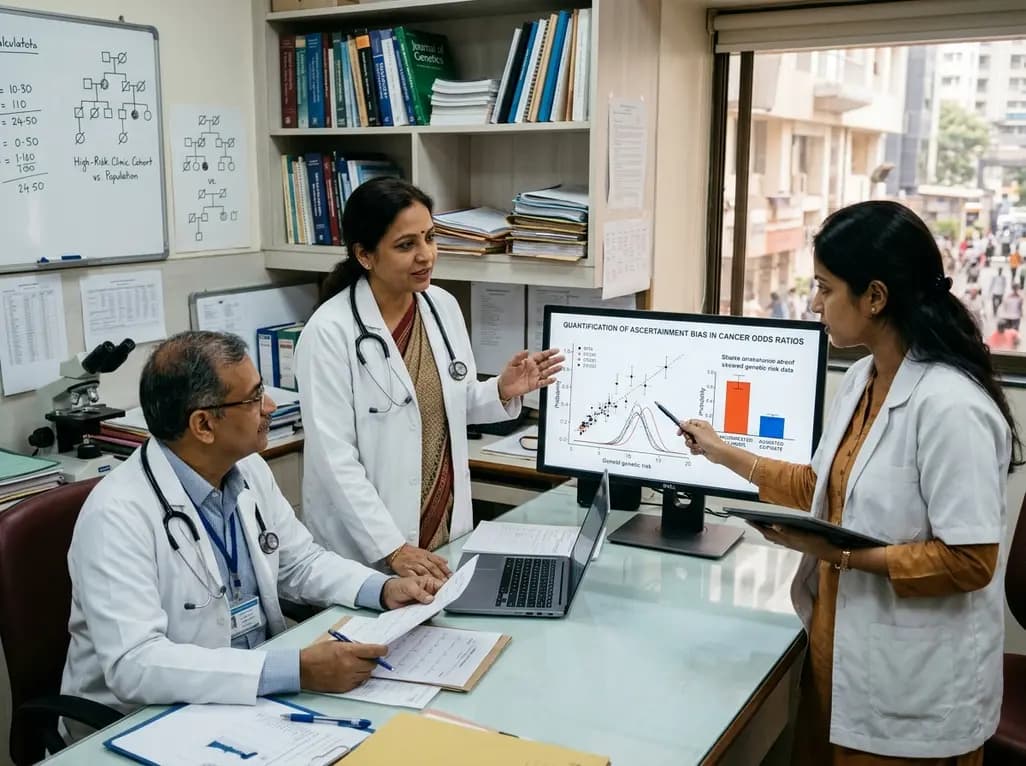
Ascertainment bias in cancer case-control studies inflates odds ratios and penetrance estimates when cases are drawn from high-risk clinics. A landmark modeling study demonstrates substantial bias ranging up to 23.72, highlighting the critical need for ascertainment adjustment in genetic risk counseling.
Today
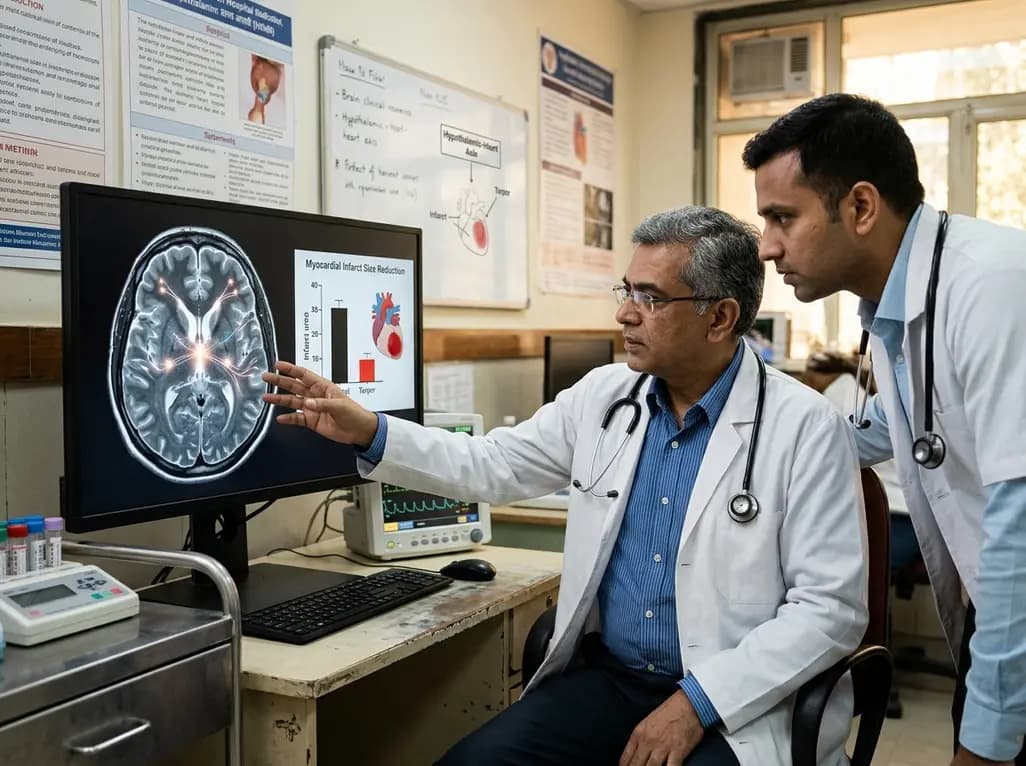
Researchers demonstrate that central induction of synthetic torpor in non-hibernating rats provides striking cardioprotection, reducing myocardial infarct size by ~40% during ischaemia-reperfusion injury through endogenous survival signaling, independent of hypothermia.
Today

A novel fluorine-functionalized near-infrared copper fluorescent probe selectively illuminates lung tissue, revealing critical links between hyperglycemia, ER stress, and pulmonary malignancy for improved early diagnosis.
Today
