.webp&w=384&q=75)

Loading, please wait...
Loading, please wait...
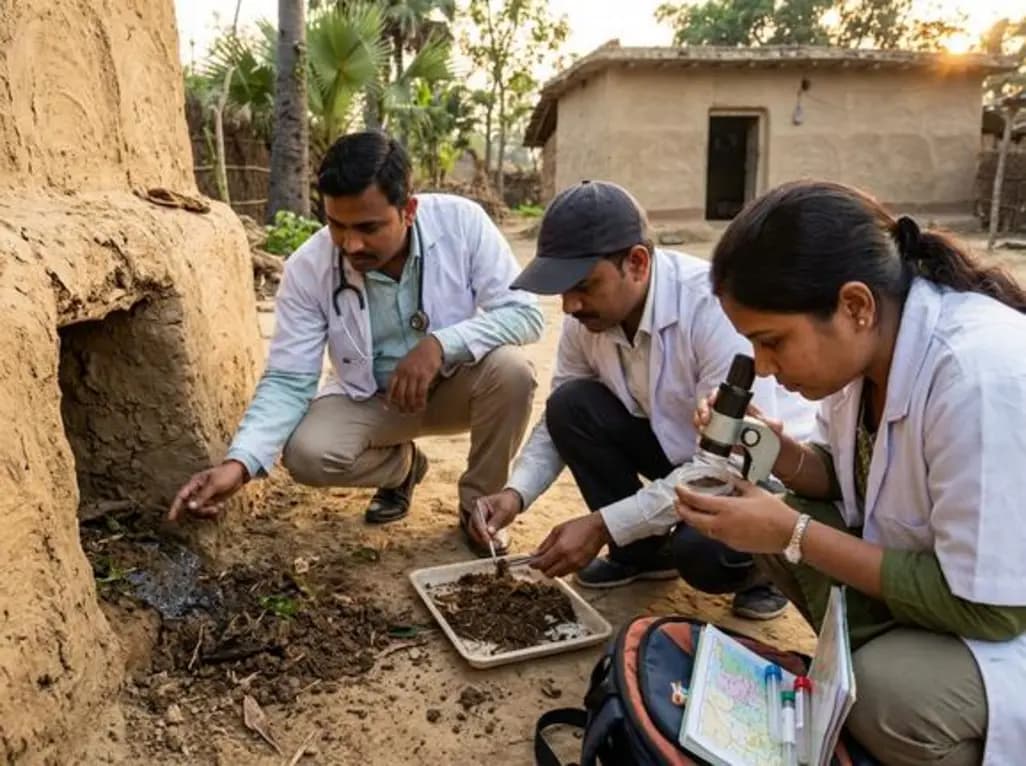
Leishmaniasis remains a major public health challenge in India. Specifically, endemic districts in Bihar and West Bengal continue to report significant case numbers. While national programs successfully reduce adult vector populations, achieving zero transmission requires a shift toward sandfly ecology and control. Focusing on immature stages like larvae is essential to disrupt the biological processes that replenish adult vector populations.
Unlike mosquitoes, sandflies thrive in hidden terrestrial microhabitats that evade routine detection. These sites include moisture-rich soil and cracks in mud walls within cattle sheds. Furthermore, research indicates that breeding activities follow a specific spatial structure. Consequently, surveillance of oviposition behavior can make vector population dynamics more measurable. Therefore, adopting biology-based strategies is critical for sustaining recent gains in disease elimination.
Current vector control operations primarily target endophilic adult flies. However, experts argue that ignoring the vector source limits the long-term efficacy of chemical interventions. Additionally, environmental management can significantly reduce breeding potential by removing organic waste and improving housing conditions. Effectively bridging this knowledge gap will empower local health authorities to implement targeted measures. Ultimately, these advancements are vital for the final mile of leishmaniasis elimination.
Focusing on immature stages prevents the emergence of new adult vectors. This provides a more sustainable solution than simply suppressing existing adult populations with insecticides.
Sandflies like Phlebotomus argentipes primarily breed in damp, organic-rich soil found in cattle sheds and the crevices of mud-plastered walls.
Monitoring breeding sites helps identify specific "hotspots" for intervention. This allows for more precise resource allocation and more effective environmental management strategies.
Disclaimer: This content is for informational and educational purposes only. It does not constitute professional medical advice, diagnosis, or treatment. Always seek the advice of your physician or other qualified health provider with any questions you may have regarding a medical condition. Refer to the latest local and national guidelines for clinical practice.
References
Narayanasamy S et al. Bridging a critical gap in leishmaniasis control: focus on immature sandfly ecology. Trans R Soc Trop Med Hyg. 2026 Jun 23. doi: undefined. PMID: 42332347.
World Health Organization. Vector control for leishmaniasis. 2024. Available at: https://www.who.int/news-room/fact-sheets/detail/leishmaniasis
Poché DM, et al. Visceral leishmaniasis on the Indian Subcontinent: Efficacy of fipronil-based cattle treatment in controlling sand fly populations. PLoS Negl Trop Dis. 2020;14(2):e0008011.

Read summarized clinical updates, watch expert medical content, and earn CME certifications right from your smartphone.
Open your smartphone camera to scan and install.





Targeting adult sandflies is common, but controlling immature stages is the missing link for sustainable leishmaniasis elimination. Learn how sandfly ecology and control strategies in India are evolving to address cryptic breeding sites in endemic regions like Bihar and West Bengal.
4 months ago

Discover the crucial role of glymphatic dysfunction in stroke, where perivascular clearance failure and neuroinflammation exacerbate cerebral edema and post-stroke brain injury.
Today

A prenatal case highlights severe glutaric acidemia type II presenting as bilateral hyperechoic cystic kidneys at 18 weeks. Whole-exome sequencing revealed a novel homozygous ETFDH frameshift variant, demonstrating the power of rapid genetic testing in fetal renal anomalies.
Today

Review how tailored exercise programs benefit frail older patients with heart failure. Explore pathophysiological mechanisms, individualized training prescriptions, and strategies to overcome adherence barriers in clinical practice.
Yesterday

This comparative study evaluates posterior labral tears with and without glenohumeral instability, highlighting distinct demographic patterns, MRI underestimation in stable shoulders, and successful arthroscopic repair outcomes.
Yesterday

A clinical study demonstrates that early intervention with tocilizumab, either as monotherapy or bridged with corticosteroids, achieves significant proptosis reduction and resolves active inflammation in treatment-naive thyroid eye disease.
Yesterday
