

Loading, please wait...
Loading, please wait...

Percutaneous nephrolithotomy and nephrostomy demand exceptional procedural accuracy and rigorous psychomotor training. Consequently, mastering ultrasound-guided percutaneous renal access remains a formidable milestone for urologists and interventional radiologists worldwide. Historically, surgical education relied heavily on fluoroscopic guidance, which exposed personnel and patients to cumulative ionizing radiation. However, modern endourology increasingly prioritizes radiation-free ultrasound targeting to visualize calyces and adjacent viscera in real time. Because live patient training introduces safety risks, high-fidelity synthetic simulation has become indispensable. Traditional bench models often fail to replicate intricate intrarenal anatomy, realistic acoustic properties, or restrictive rib barriers. Recently, researchers designed a dual-configuration kidney phantom platform to resolve these persistent educational challenges. This novel system provides a standardized environment for ultrasound needle puncture, multimodal imaging, and robotic instrumentation. By combining adjustable anatomy with authentic tissue resistance, the platform directly addresses critical gaps in procedural preparation. Furthermore, it establishes objective benchmarks for surgical trainees before they enter operative suites. Therefore, training institutions can systematically flatten steep learning curves while protecting patients from preventable complications.
The engineering of this platform relies on an anatomically accurate kidney model encased in a thin silicone shell. Inside this shell, developers incorporated a synthetic gel-filled renal compartment surrounding a hollow multicalyceal collecting system. This internal architecture faithfully reproduces normal and dilated calyces during needle entry. Moreover, the platform offers two complementary operational setups tailored to different learning phases. The water-based configuration emphasizes structural flexibility and procedural repetition. It allows clinicians to adjust kidney depth and spatial orientation freely, while featuring an easily replaceable puncture membrane. Consequently, instructors can alter calyceal access angles quickly between successive training attempts. In contrast, the gel-based configuration integrates realistic physical resistance mimicking surrounding retroperitoneal tissues. Furthermore, this second setup incorporates computed tomography-derived ribs and an automated respiratory actuation mechanism. As a result, trainees encounter authentic rib acoustic shadows and dynamic organ displacement during simulated breathing cycles. This realistic motion challenges learners to time needle advancement carefully. Together, the two configurations offer progressive complexity, transitioning from basic needle guidance to highly realistic surgical rehearsals.
Accurate ultrasound propagation is essential when replicating interventional procedures in artificial tissues. To ensure sonographic realism, investigators measured the acoustic sound speed across all synthetic materials. The measured velocities ranged from 1004 to 1490 meters per second, matching human soft tissue characteristics closely. As a result, both two-dimensional and three-dimensional ultrasound imaging clearly delineated parenchymal borders and sharp calyceal targets. Furthermore, the platform demonstrated excellent imaging fidelity under computed tomography examination. Computed tomography verified authentic anatomical proportions and documented precise spatial relationships among the internal chambers. In addition, CT-derived ribs generated accurate posterior acoustic shadowing on ultrasound displays, forcing trainees to navigate realistic acoustic windows. Moreover, researchers successfully conducted qualitative electromagnetic-ultrasound navigation overlays. Navigational sensors confirmed reliable tracking inside the phantom without significant signal interference. Consequently, technical developers can utilize this standardized substrate to test needle-tracking systems, electromagnetic sensors, and automated puncture algorithms. By bridging multiple diagnostic imaging modalities, the platform ensures that simulated technical skills translate directly to real-world procedural success.
Comprehensive surgical training requires physical models that support complete procedural sequences beyond simple initial needle punctures. Crucially, this dual-configuration platform supports combined retrograde and percutaneous endourological workflows. Operators successfully advanced flexible ureteroscopes into the upper collecting system while simultaneously targeting calyces percutaneously from the flank. In addition, the hollow calyceal cavities permitted effortless guidewire insertion, serial fascial dilation, and nephrostomy catheter positioning. During initial functional validation involving 188 puncture attempts, operators achieved successful collecting system access in 94.1 percent of trials. This outstanding accuracy proves that the phantom offers clear tactile feedback and reliable confirmation upon entry. Furthermore, the synthetic materials exhibited remarkable durability under repeated needle trauma. The water-based configuration tolerated approximately 120 needle punctures, requiring membrane renewal only after every 40 punctures. Similarly, gel-based units supported approximately 30 needle passes before structural degradation required replacement. Therefore, training centers can conduct multi-candidate endourology workshops without facing sudden material disintegration or excessive replacement costs. These robust qualities make the system an economical solution for institutional simulation programs.
Transitioning from fluoroscopy to ultrasound guidance significantly elevates patient safety during percutaneous renal procedures. Most importantly, sonography completely eliminates ionizing radiation exposure for operating personnel and surgical patients. Moreover, real-time ultrasound imaging delineates intervening retroperitoneal organs, including the colon, spleen, and pleura, thereby preventing catastrophic visceral perforation. However, acquiring precise needle-beam alignment demands substantial spatial coordination that beginners rarely possess. Novices often misjudge needle tip depth, increasing the danger of vascular laceration and severe renal hemorrhage. Therefore, realistic bench models with respiratory movement provide the missing link in surgical education. By practicing on this dual-configuration platform, trainees learn to anticipate breathing displacement and establish stable access tracts safely. In addition, medical device engineers can leverage this reproducible environment to develop automated robotic needle guides and augmented reality navigation. Automated systems require rigorous bench testing before receiving clearance for human clinical investigations. Consequently, this versatile platform advances educational curricula while accelerating surgical technology innovation. Ultimately, widespread adoption of high-fidelity simulators will improve procedural precision, reduce operative complications, and enhance overall clinical outcomes.
The platform integrates an automated respiratory actuation module within its gel-based configuration to replicate physiological diaphragmatic displacement. Specifically, mechanical actuators induce cyclic translational and rotational shifts in the synthetic kidney, matching human breathing excursions. Consequently, trainees must synchronize their needle puncture with organ excursion, learning to puncture during end-expiration. This dynamic capability prevents needle shear injuries and prepares clinicians for authentic intraoperative challenges during complex percutaneous nephrostomy procedures.
Ultrasound guidance eliminates ionizing radiation exposure entirely, protecting surgical staff and patients from cumulative radiation toxicity. Furthermore, real-time sonography clearly visualizes surrounding non-opaque retroperitoneal organs, such as the colon, pleura, and spleen, thereby reducing accidental visceral puncture. Additionally, Doppler ultrasound identifies major intrarenal vascular branches, enabling safer calyceal puncture along the relatively avascular plane of Brodel. Consequently, ultrasound improves access safety while simultaneously maintaining high clinical stone-free rates.
The phantom platform demonstrates exceptional mechanical resilience across intensive training drills. In functional assessments, the water-based configuration endured approximately 120 needle punctures, requiring only simple membrane swaps after every 40 punctures. Similarly, the gel-based model supported roughly 30 repeated needle insertions before structural track degradation necessitated replacement. Therefore, training centers can run cost-effective workshops with multiple residents practicing needle navigation, wire insertion, and tract dilation without premature hardware breakdown.
Disclaimer: This content is for informational and educational purposes only... Refer to the latest local and national guidelines for clinical practice.
References

Read summarized clinical updates, watch expert medical content, and earn CME certifications right from your smartphone.
Open your smartphone camera to scan and install.





A novel dual-configuration kidney phantom replicates complex human renal anatomy, respiratory motion, and rib constraints to advance ultrasound-guided percutaneous renal access training, device development, and surgical skill acquisition.
Today
In cognitive impairment and dementia, residents often lose the ability to articulate discomfort. Consequently, clinicians frequently misinterpret pain indicators as behavioral disturbances. Discover how structured observational pain assessment protocols improve clinical outcomes and curb inappropriate psychotropic use.
Today
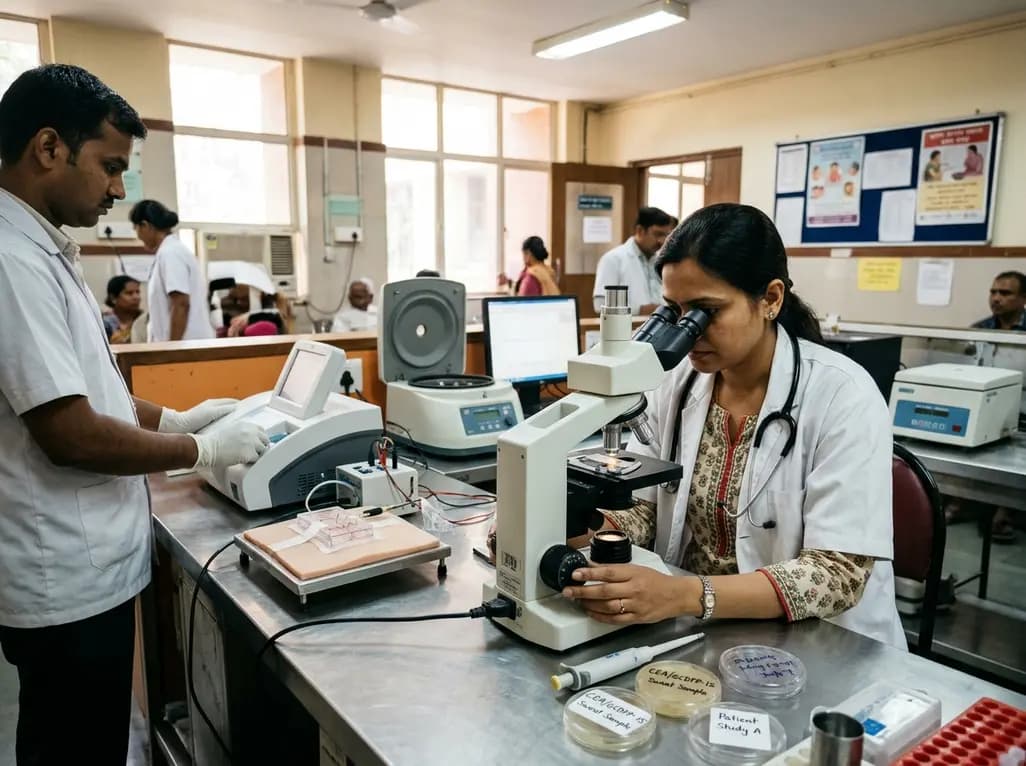
A pilot study evaluated WearDOXXN, a capillary microfluidic sweat patch, for noninvasive breast cancer monitoring by comparing sweat and serum CEA and PIP/GCDFP-15 levels.
Yesterday

India faces a massive diabetes burden with over 89 million adults affected. Managing blood sugar in isolation fails to prevent severe cardiorenal complications. Clinicians must adopt an integrated metabolic ecosystem that prioritizes early detection, multifactorial risk assessment, and personalized therapies.
Yesterday
A qualitative study highlights the clinical role of MRI in axial spondyloarthritis, exposing disparities in access, reporting gaps in private healthcare, and the urgent need for standardized imaging protocols and multidisciplinary collaboration between rheumatologists and radiologists.
Today
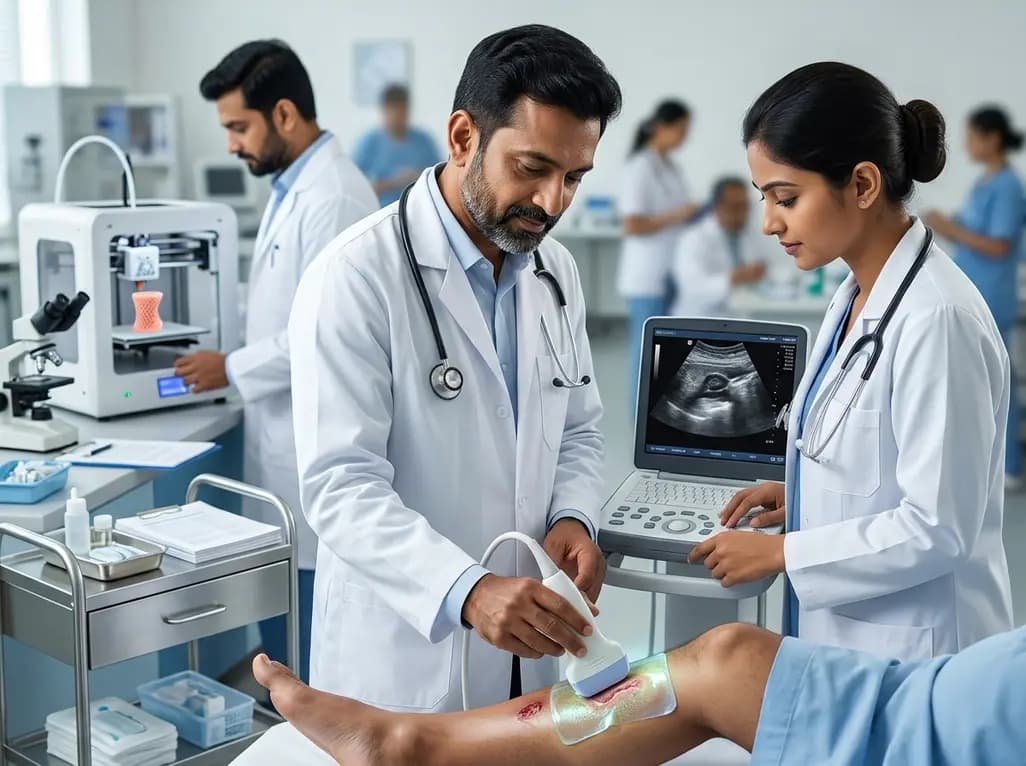
A breakthrough 3D-printed piezoelectric collagen hydrogel activated by ultrasound accelerates diabetic wound repair, demonstrating 98.5% wound closure, robust antibacterial action, and enhanced vascularization without toxic chemical crosslinkers.
Yesterday
