.webp&w=384&q=75)

Loading, please wait...
Loading, please wait...
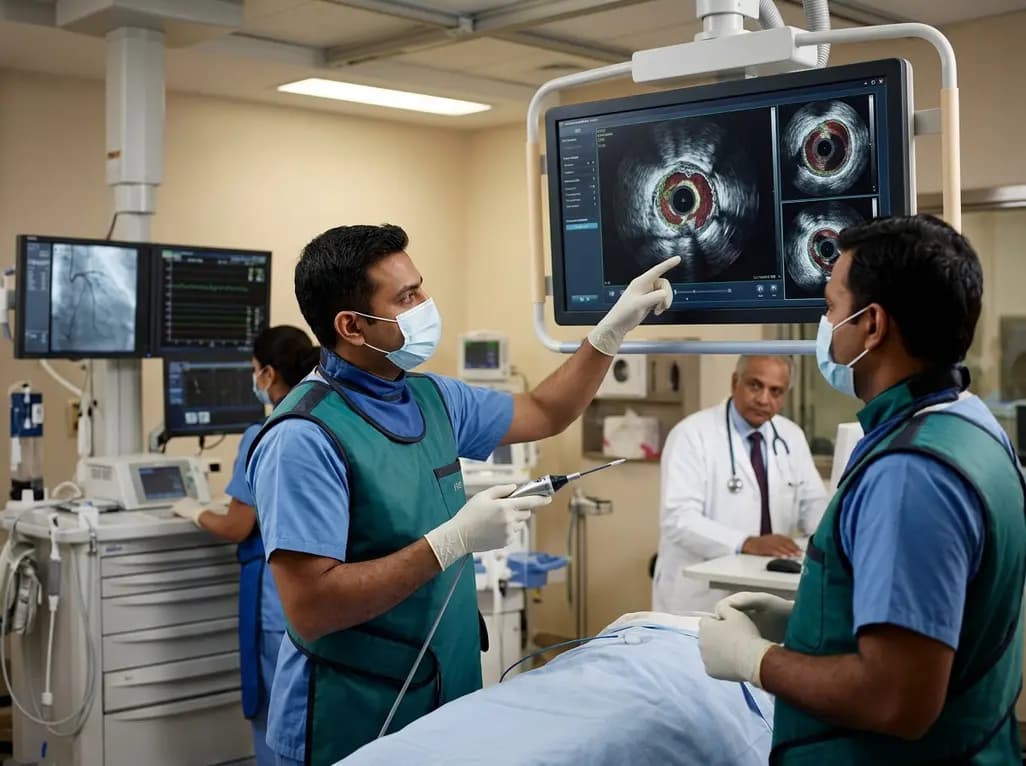
Managing in-stent restenosis (ISR) presents a recurring challenge for interventional cardiologists today. Recent clinical evidence highlights that IVUS guided intracoronary brachytherapy offers a transformative solution for these complex cases. By utilizing high-resolution intravascular ultrasound (IVUS), clinicians can accurately identify mechanical triggers of stent failure. Consequently, this detailed assessment allows for superior lesion preparation before radiation delivery.
Researchers conducted a retrospective analysis of 221 patients between 2016 and 2024 to evaluate procedural efficacy. The study compared patients who underwent intracoronary brachytherapy (ICBT) with and without the help of IVUS guidance. Specifically, 59.7% of the cohort received IVUS-guided treatment during their procedures. Notably, the IVUS group achieved larger vessel diameters and underwent more frequent high-pressure post-dilation. These procedural adjustments appear critical for ensuring long-term success and vessel patency.
The clinical results favor the routine use of IVUS significantly. Patients in the IVUS-guided group showed a target lesion revascularization (TLR) rate of only 21.0% at follow-up. In contrast, those treated without IVUS guidance experienced a much higher TLR rate of 37.1%. Furthermore, major adverse cardiovascular events (MACE) were notably lower in the IVUS-guided group, sitting at 31.3% versus 46.1% in the angiography-only group. Therefore, routine implementation of IVUS during ICBT can dramatically improve patient survival and reduce the need for repeat interventions.
IVUS provides real-time, high-definition images that help doctors identify stent underexpansion and plaque morphology. This allows for optimized balloon sizing and better lesion preparation, which are vital for effective brachytherapy.
The primary benefits include a significant reduction in target lesion revascularization (TLR) and a lower incidence of major adverse cardiovascular events (MACE) during long-term follow-up.
While angiography is standard, the study suggests that IVUS guidance leads to larger post-procedural vessel diameters and significantly better long-term clinical outcomes, making it a highly recommended adjunctive tool.
Disclaimer: This content is for informational and educational purposes only and does not constitute medical advice or a professional relationship. Refer to the latest local and national guidelines for clinical practice.
References
Kharsa C et al. Impact of IVUS Guidance on Clinical and Procedural Outcomes in Intracoronary Brachytherapy. JACC Adv. 2026 Jun 11. doi: undefined. PMID: 42275682.
Brilakis ES et al. Outcomes of Intracoronary Brachytherapy for In-Stent Restenosis. Am J Cardiol. 2025 Jun 1. doi: 10.1016/j.amjcard.2025.02.024. PMID: 40157830.
Johnson TW et al. Clinical use of intracoronary imaging. Part 2: acute coronary syndromes, ambiguous coronary angiography findings, and guiding interventional decision-making: an expert consensus document of the European Association of Percutaneous Cardiovascular Interventions. Eur Heart J. 2019 Aug 14;40(31):2566–84.
"
Read summarized clinical updates, watch expert medical content, and earn CME certifications right from your smartphone.
Open your smartphone camera to scan and install.





A study of 221 patients reveals that IVUS guidance during intracoronary brachytherapy for in-stent restenosis significantly reduces target lesion revascularization (21% vs 37%) and major adverse cardiovascular events, ensuring better long-term procedural success and improved patient safety.
4 months ago

Novel diimide and hydrazone scaffolds, particularly compound #C4, synergistically reactivate latent HIV-1 when combined with JQ1 or PKC activators. Demonstrating donor-matched proviral transcription ex vivo and non-canonical signaling, these findings advance shock and kill strategies toward reservoir eradication.
Today

A comparative cohort study evaluates vNOTES vs TLH hysterectomy for benign conditions, demonstrating shorter operative duration, faster return to daily activities, and equivalent female sexual function scores without increased dyspareunia.
Today

Review how tailored exercise programs benefit frail older patients with heart failure. Explore pathophysiological mechanisms, individualized training prescriptions, and strategies to overcome adherence barriers in clinical practice.
Yesterday

This comparative study evaluates posterior labral tears with and without glenohumeral instability, highlighting distinct demographic patterns, MRI underestimation in stable shoulders, and successful arthroscopic repair outcomes.
Yesterday

A clinical study demonstrates that early intervention with tocilizumab, either as monotherapy or bridged with corticosteroids, achieves significant proptosis reduction and resolves active inflammation in treatment-naive thyroid eye disease.
Today
