

Loading, please wait...
Loading, please wait...
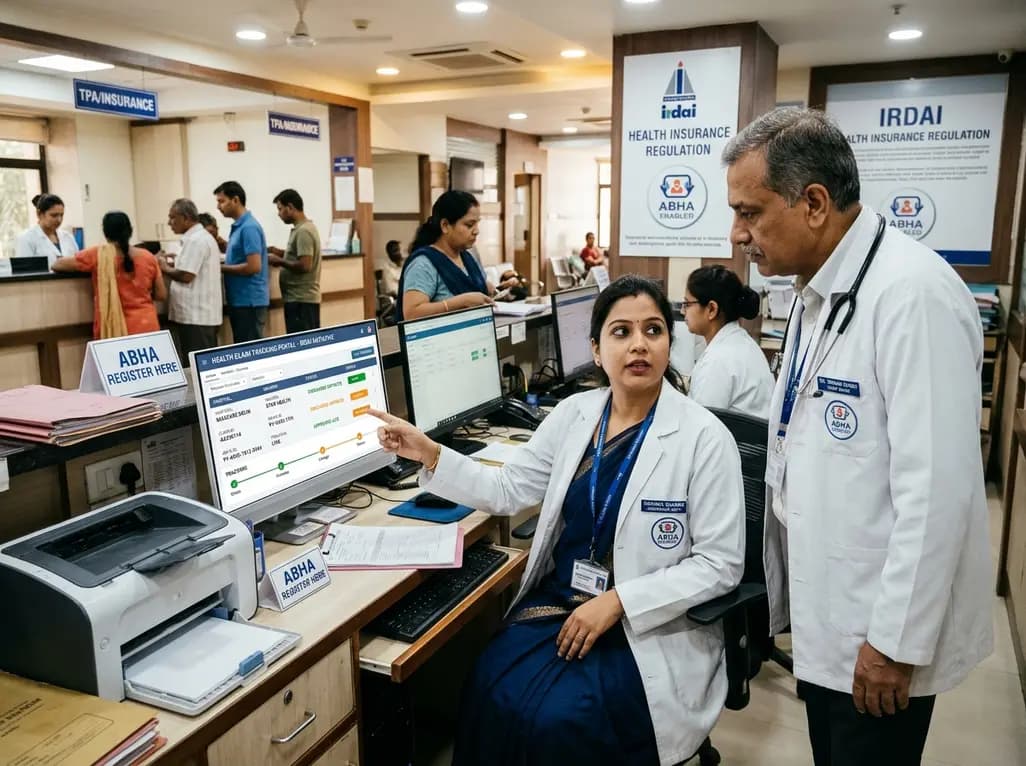
Navigating medical reimbursements in India often creates substantial operational friction for clinicians and administrative teams. Consequently, the Insurance Regulatory and Development Authority of India has introduced a decisive initiative to enhance health insurance claim transparency across the healthcare ecosystem. Announced by IRDAI Chairman Ajay Seth at the CII Financing Summit 2026, the regulator will formally establish two specialized industry working groups within ten days. These committees aim to eliminate persistent ambiguities that plague hospital discharge desks, cashless approvals, and claims settlement procedures. Furthermore, this regulatory shift directly addresses the long-standing trust deficit between healthcare providers, insurance carriers, and patients seeking seamless medical care.
The first industry working group will focus primarily on delivering end-to-end visibility throughout the claim life cycle. Currently, clinicians and billing personnel face an informational blackout after submitting pre-authorisation requests or final discharge documentation. Therefore, the regulator seeks to mandate real-time status tracking for every medical claim. This workflow includes initial pre-authorisation queries, interim hospital treatment updates, discharge clearance, and final financial settlement. In addition, the panel will assess overall policyholder experience and generate actionable market conduct feedback for insurance carriers.
Moreover, the working group plans to institute comprehensive patient feedback loops using standardized digital assessment frameworks. For instance, the National Health Authority will collaborate with industry stakeholders to conduct objective net promoter surveys. These surveys will systematically measure patient satisfaction at the point of clinical discharge. By capturing authentic provider-patient interactions, regulatory authorities can quickly identify recurring administrative logjams. Consequently, hospital networks will spend significantly less time mediating disputes between confused policyholders and third-party administrators, allowing clinical staff to prioritize direct inpatient medical care.
The second working group will target the arbitrary denial of medical claims by standardizing adjudication metrics. Historically, reasons for claim repudiation or partial deductions have lacked structural consistency across private and public insurers. Because insurers communicate rejections via vague internal terminology, neither attending doctors nor administrative billing heads can identify the precise clinical or contractual basis for deductions. To rectify this disparity, the committee will establish universal definitions, objective claims metrics, and uniform rejection codes.
Furthermore, this standardized framework will mandate that every insurer record exact medical denial rationale in an interconnected, auditable system. Chairman Seth emphasized that incomplete or fragmented claim data currently prevents meaningful peer comparisons across the health sector. Standardized codes will allow hospitals to clearly determine whether deductions stem from non-covered consumables, room-rent capping, or disputable medical necessity clauses. Therefore, transparent benchmarking will hold insurers accountable for disproportionate deduction patterns. Ultimately, this transparency ensures that treating clinicians are not unfairly blamed when insured patients receive unexpected out-of-pocket medical expenses upon discharge.
A pivotal aspect of the regulatory overhaul involves redefining how the industry computes claims settlement ratios. Under conventional reporting conventions, insurers boast impressive settlement ratios often exceeding ninety-nine percent. However, these traditional calculations merely count the gross volume of settled cases rather than the actual monetary value delivered to claimants. In reality, a claim that pays only twenty percent of the submitted hospital bill is often registered as settled alongside full settlements.
Consequently, the regulator is questioning these misleading settlement statistics to reflect accurate patient realities. The working group will develop performance indicators that explicitly separate full reimbursements from partial deductions, repudiated claims, and closed files. In addition, insurers must report the actual settlement amounts relative to submitted provider invoices. For hospital administrations and practicing physicians, this crucial reform exposes habitual corporate practices that reduce valid inpatient claims. As a result, medical institutions can negotiate corporate network agreements with greater leverage, relying on verified data rather than inflated marketing figures.
Alongside procedural transparency, the regulatory authority is pursuing deep technological integration through the Ayushman Bharat Digital Mission. Specifically, the regulator plans to adopt the Ayushman Bharat Health Account identity as the central backbone for all individual and group insurance policies. Today, hospitals struggle with fragmented digital histories when patients transition between employer-sponsored corporate policies and retail health coverage. Because previous clinical and coverage identities remain disjointed, medical underwriting often remains conservative and pricing stays excessively volatile.
Moreover, linking ABHA IDs directly with hospital management information systems will accelerate digital pre-authorisations through the National Health Claims Exchange. When treating doctors upload verified diagnostic reports and digital discharge summaries, integrated payer engines can authenticate claims automatically. This process drastically reduces tedious document scanning, illegible physical paperwork, and manual adjudication errors. In addition, comprehensive identity tracking enables insurers to better understand longitudinal clinical risk profiles. Therefore, insurers can provide more competitive premiums for well-managed chronic conditions while streamlining emergency cashless approvals across tertiary facilities.
Beyond hospital claims processing, the regulator expressed strong concern regarding market practices that monetise essential policyholder data. Specifically, several digital aggregator platforms demand private personal details before displaying basic insurance premium quotes. The regulator criticized this practice, noting that technology meant to enhance operational efficiency should not function as a toll booth. In response, regulatory guidelines will require clear product summaries written in accessible regional languages without requiring invasive pre-quote personal disclosures.
Additionally, the initiative emphasizes data governance through the proposed Public Insurance Registry. This digital registry will allow patients and healthcare providers to inspect policy exclusions, standard terms, and insurer performance metrics independently. By decentralizing policy data and promoting plain-language documentation, the regulator empowers families to make informed healthcare choices during elective admissions. Furthermore, clear statutory disclosures will prevent deceptive policy sales, ensuring patients arrive at healthcare centers fully aware of their specific copayments and sub-limits.
Q1: What are the two IRDAI working groups mandated to accomplish?
One working group will design systems for real-time visibility across the claims life cycle, covering pre-authorisation, hospital discharge, and final settlement. The second group will create standardized metrics for claims processing, grievance redressal, and uniform rejection codes across all insurance carriers in India.
Q2: How will standardized claim rejection codes assist treating doctors and hospitals?
Standardized rejection codes eliminate ambiguous corporate explanations for claim repudiation or partial deductions. Consequently, hospital TPA desks and attending clinicians can easily verify whether denials arise from policy exclusions, non-medical consumables, or documented clinical necessity, reducing patient disputes.
Q3: Why is the regulator linking health insurance policies to ABHA IDs?
Using ABHA IDs establishes a unified health identifier across both individual and group policies. This integration enables hospitals to transmit medical records seamlessly through the National Health Claims Exchange, speeding up pre-authorisations while enabling insurers to improve medical underwriting and policy pricing.
Disclaimer: This content is for informational and educational purposes only. It does not constitute medical advice or replace professional judgment. Refer to the latest local and national guidelines for clinical practice.
References

Read summarized clinical updates, watch expert medical content, and earn CME certifications right from your smartphone.
Open your smartphone camera to scan and install.





To resolve chronic friction between hospitals and insurers, the insurance regulator has announced two specialised panels. These working groups will establish real-time visibility from pre-authorisation to discharge, standardise claim rejection codes, and integrate digital identities through ABHA across India.
Today

A Bayesian component network meta-analysis of 130 RCTs reveals that self-monitoring and gamification provide the clearest positive effects in mHealth physical activity interventions, while social comparison may have adverse psychological trade-offs.
Today

The GESS-AEEM consensus establishes a clear clinical implementation framework for testosterone therapy in postmenopausal women with hypoactive sexual desire disorder, focusing on transdermal dosing, precise laboratory monitoring, and safety communication.
Today

A multicenter observational study evaluated an 8-week digital health monitoring platform using wearable sensors in ambulatory heart failure. While participants achieved high daily wear-time of 11.7 hours and 80% completion, initial recruitment revealed significant technology-related onboarding barriers.
Today

A paired cadaveric study compared triple and quintuple percutaneous Achilles tendon lengthening. While quintuple hemisection showed numerically greater elongation, differences were not statistically significant.
Yesterday

A clinical decision-support framework using health checkup data from 231,683 adults predicts incident obesity with high discrimination (AUROC 0.918). The system integrates temporal survival analysis and risk-factor explanations to prioritize individualized preventive interventions.
Today
