.webp&w=384&q=75)

Loading, please wait...
Loading, please wait...
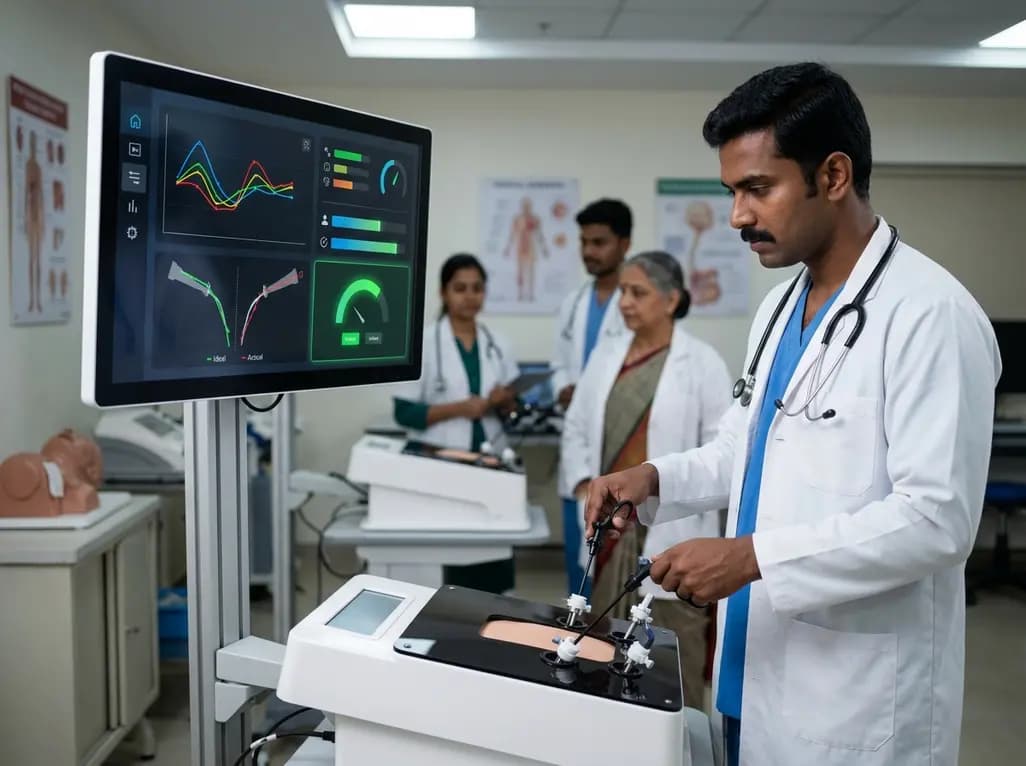
The digital transformation of medical education represents a significant global trend. Recently, researchers developed an intelligent clinical skill assessment system to modernize traditional manual evaluation methods. Historically, clinical skill assessment depended on subjective observation and conventional manual inspection. To further explore intelligent training paradigms, this study introduces contrastive learning methods. This approach creates a novel system characterized by unified standards and objective evaluation.
Furthermore, practical validation indicates that the model effectively differentiates varying proficiency levels in specific surgical procedures. Specifically, the prediction of one operational procedure achieved a peak accuracy of 94.01%. With a one-point tolerance, accuracy further improved to 96.41%. Consequently, the model significantly enhances the scientific rigor and efficiency of the clinical skill training process. It also provides immediate feedback on performance to accelerate the learning curve of trainees. Therefore, this technology offers a scalable solution for medical institutions seeking to automate their instruction and assessment paradigms.
The system utilizes contrastive learning to create objective and standardized evaluation metrics. This reduces the variability found in manual assessments and provides trainees with instant, data-driven feedback on their surgical performance.
The model demonstrated high precision during testing, reaching a peak accuracy of 94.01% for specific surgical steps. When the researchers allowed for a one-point tolerance, the assessment accuracy rose further to 96.41%.
Disclaimer: This content is for informational and educational purposes only. It does not constitute professional medical advice, diagnosis, or treatment. Always seek the advice of your physician or other qualified health provider with any questions you may have regarding a medical condition. Refer to the latest local and national guidelines for clinical practice.
References
Dai Q et al. Development and application of an intelligent assessment system for medical clinical skill training. NPJ Digit Med. 2026 Jun 10. doi: 10.1038/s41746-026-02877-y. PMID: 42271165.
Anastasiou D et al. CoRe-DA: Contrastive Regression for Unsupervised Domain Adaptation in Surgical Skill Assessment. arXiv:2603.29666. 2026 Mar 31.
Simoni et al. Artificial intelligence in undergraduate medical education clinical skills curricula: a scoping review of implementations since 2022. Frontiers. 2026.

Read summarized clinical updates, watch expert medical content, and earn CME certifications right from your smartphone.
Open your smartphone camera to scan and install.





A breakthrough study in NPJ Digital Medicine introduces an AI-based intelligent clinical skill assessment system. Utilizing contrastive learning, this model achieves up to 96% accuracy in surgical training evaluation, providing standardized, objective, and immediate feedback for medical education outcomes.
4 months ago

Novel diimide and hydrazone scaffolds, particularly compound #C4, synergistically reactivate latent HIV-1 when combined with JQ1 or PKC activators. Demonstrating donor-matched proviral transcription ex vivo and non-canonical signaling, these findings advance shock and kill strategies toward reservoir eradication.
Today

A cross-sectional study reveals that maternal RSV vaccination coverage reached only 43.7% in Argentina, with maternal vaccine knowledge being the sole independent predictor of uptake. Clinicians play a crucial role in eliminating informational and structural barriers to optimize infant health.
Today

Review how tailored exercise programs benefit frail older patients with heart failure. Explore pathophysiological mechanisms, individualized training prescriptions, and strategies to overcome adherence barriers in clinical practice.
Yesterday

This comparative study evaluates posterior labral tears with and without glenohumeral instability, highlighting distinct demographic patterns, MRI underestimation in stable shoulders, and successful arthroscopic repair outcomes.
Yesterday

A clinical study demonstrates that early intervention with tocilizumab, either as monotherapy or bridged with corticosteroids, achieves significant proptosis reduction and resolves active inflammation in treatment-naive thyroid eye disease.
Yesterday
