.webp&w=384&q=75)

Loading, please wait...
Loading, please wait...
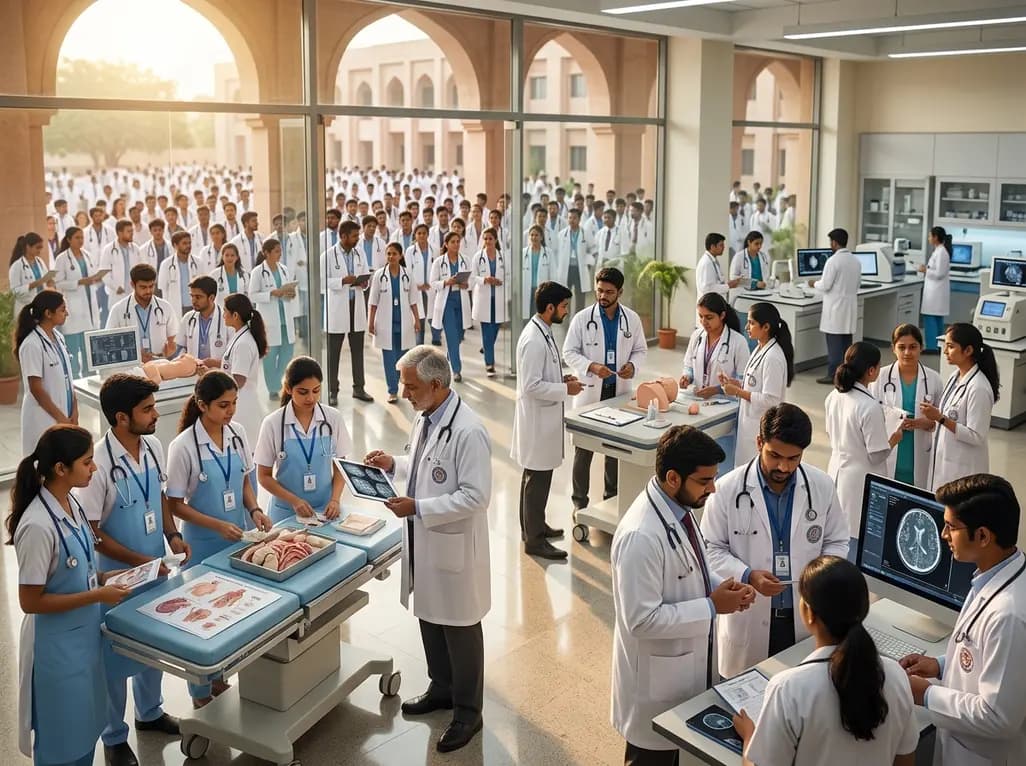
Recently, Union Minister JP Nadda announced a major medical education expansion in India. Specifically, the government will add 75,000 UG and PG seats over five years. Furthermore, the Centre has already established nearly 23,000 of these medical seats. Therefore, this represents a significant leap in the country's medical infrastructure.
In addition, the medical education ecosystem has grown rapidly over the last decade. For instance, the number of AIIMS institutions has increased to 23. Similarly, medical colleges have increased from 387 to over 820. In fact, undergraduate seats have risen from 59,000 to more than 1.28 lakh. Meanwhile, postgraduate seats have grown from 31,000 to over 86,000. As a result, more medical professionals will soon enter the workforce.
Besides expanding colleges, the government focuses heavily on preventive healthcare. Currently, over 1.82 lakh Ayushman Arogya Centres serve as primary health contacts. Consequently, millions of citizens now receive early health screenings. For example, over 36 crore people have undergone oral cancer screenings. Moreover, health workers have screened over 17 crore women for breast cancer. In addition, over 9 crore women received screenings for cervical cancer. Consequently, these robust screening campaigns also target diabetes and hypertension.
During his visit to AIIMS Bathinda, Nadda inaugurated several advanced facilities. Specifically, he launched a state-of-the-art PET-CT facility. Indeed, this technology will significantly enhance local cancer diagnosis and treatment. Additionally, he inaugurated a second High Energy Linear Accelerator unit. He also dedicated a new Burns Intensive Care Unit to the community. Ultimately, these developments show the government's strong commitment to Punjab.
Q1: How many medical seats does the Centre plan to add over the next five years?
The government plans to add 75,000 undergraduate (UG) and postgraduate (PG) medical seats over the next five years, with nearly 23,000 seats already established over the last two years.
Q2: What new facilities were inaugurated at AIIMS Bathinda?
Union Minister JP Nadda inaugurated a state-of-the-art PET-CT facility, a second High Energy Linear Accelerator (HELA) unit, and a dedicated Burns Intensive Care Unit (Burns ICU) at AIIMS Bathinda.
Q3: How many Ayushman Arogya Centres are currently operational across India?
Currently, over 1.82 lakh Ayushman Arogya Centres are operational, serving as the first point of contact for healthcare services nationwide.
Disclaimer: This content is for informational and educational purposes only. It does not constitute medical advice or replace professional judgment. Refer to the latest local and national guidelines for clinical practice.
References

Read summarized clinical updates, watch expert medical content, and earn CME certifications right from your smartphone.
Open your smartphone camera to scan and install.





Union Minister JP Nadda announced a massive expansion of India's medical education, pledging 75,000 new UG and PG seats and key healthcare infrastructure....
4 months ago

Novel diimide and hydrazone scaffolds, particularly compound #C4, synergistically reactivate latent HIV-1 when combined with JQ1 or PKC activators. Demonstrating donor-matched proviral transcription ex vivo and non-canonical signaling, these findings advance shock and kill strategies toward reservoir eradication.
Today

A cross-sectional study reveals that maternal RSV vaccination coverage reached only 43.7% in Argentina, with maternal vaccine knowledge being the sole independent predictor of uptake. Clinicians play a crucial role in eliminating informational and structural barriers to optimize infant health.
Today

Review how tailored exercise programs benefit frail older patients with heart failure. Explore pathophysiological mechanisms, individualized training prescriptions, and strategies to overcome adherence barriers in clinical practice.
Yesterday

This comparative study evaluates posterior labral tears with and without glenohumeral instability, highlighting distinct demographic patterns, MRI underestimation in stable shoulders, and successful arthroscopic repair outcomes.
Yesterday

A clinical study demonstrates that early intervention with tocilizumab, either as monotherapy or bridged with corticosteroids, achieves significant proptosis reduction and resolves active inflammation in treatment-naive thyroid eye disease.
Yesterday
