.webp&w=384&q=75)

Loading, please wait...
Loading, please wait...

Resistance training practitioners frequently debate whether distinct joint angles stimulate isolated muscular adaptations. Specifically, exercise configuration significantly influences mechanical leverage, torque curves, and subsequent elbow flexor hypertrophy. Sports medicine professionals routinely prescribe targeted movements for upper-limb strengthening and post-injury rehabilitation. Incline dumbbell curls position the glenohumeral joint into extension. Consequently, this orientation tensions the biarticular biceps brachii at longer resting lengths. Conversely, preacher curls support the upper arm in forward shoulder flexion. This orientation eliminates momentum and alters joint moment arms across the range of motion. A recent twelve-week trial compared these popular variations to determine their morphological effects.
Biomechanical alignment dictates active torque distribution throughout the entire arc of elbow flexion. For example, the incline dumbbell curl fixes the upper arm behind the torso. Therefore, this posture imposes high mechanical tension when the elbow reaches full extension. Mechanical tension at extended lengths triggers robust intracellular signaling pathways that drive structural remodeling. In contrast, the preacher curl supports the humerus at approximately forty-five degrees of shoulder flexion. As a result, external torque demands peak early when the forearm is parallel to the ground. Furthermore, shoulder flexion places the long head of the biceps brachii in active insufficiency. This mechanical position reduces its force generation capacity during elbow flexion. Consequently, monoarticular synergists must assume a greater share of the mechanical burden. When clinicians design rehabilitation protocols, understanding these positional nuances remains paramount. Thus, changing bench angles substantially modifies intramuscular biomechanics without altering external dumbbell load.
To resolve historical questions regarding exercise specificity, researchers designed a rigorous within-subject randomized experimental protocol. Twenty-one untrained adults completed a twelve-week supervised resistance training intervention. Each participant trained one upper limb with incline curls and the contralateral limb with preacher curls. Consequently, this contralateral limb model effectively controlled for systemic hormonal responses and genetic variations. The participants performed five sets of ten repetitions at seventy percent of their one-repetition maximum twice weekly. Additionally, progressive overload guidelines ensured consistent mechanical tension throughout the intervention. The investigators utilized high-resolution magnetic resonance imaging to capture precise anatomical changes. Specifically, they analyzed cross-sectional area scans sampled at continuous one-percent intervals along the entire muscle length. This sophisticated methodology quantified individual muscle volumes for the biceps brachii, the brachialis, and the brachioradialis. Moreover, investigators grouped slices into proximal, middle, and distal compartments. Therefore, the resulting data offer dependable insights into true muscle volumetric expansion.
The volumetric analysis revealed distinct, exercise-dependent morphological adaptations across individual muscle bellies. Specifically, the biceps brachii achieved greater hypertrophy following incline curl training compared to preacher curl training. The incline condition elicited a twenty-two percent volume increase, whereas the preacher condition generated a nineteen percent increase. This advantage highlights the potent stimulus of initiating contractions from extended muscle lengths. Conversely, the deeper monoarticular elbow flexors demonstrated an opposing growth pattern. The brachialis muscle expanded by over twenty-one percent following preacher curls, compared to seventeen percent after incline curls. Similarly, the brachioradialis showed superior growth after preacher training, achieving eighteen percent hypertrophy versus under fourteen percent for incline curls. These statistically significant variations confirm that shoulder positioning selectively shifts mechanical demand among functional synergists. However, total elbow flexor volume expanded similarly between both training protocols. Thus, overall elbow flexion capacity adapts robustly regardless of curl configuration.
In addition to evaluating whole-muscle volumes, researchers examined whether exercise selection induced non-uniform regional hypertrophy along each muscle belly. Many strength coaches hypothesize that preacher curls preferentially build the distal muscle belly near the elbow joint. Nevertheless, the magnetic resonance imaging data demonstrated broadly similar regional patterns between both training modalities. Both incline and preacher curls produced the greatest relative expansion in the middle belly of the biceps brachii and brachialis. In contrast, the brachioradialis demonstrated preferential remodeling within its proximal and middle regions across both conditions. Furthermore, statistical analysis confirmed that exercise configuration did not alter regional distribution along the muscle length. These outcomes challenge long-standing assumptions regarding selective lower-bicep peaking techniques. Instead, muscle architecture and intrinsic tension distribution appear to govern longitudinal growth patterns. Consequently, clinicians should not expect exercise variations alone to sculpt isolated muscle regions. Overall regional remodeling follows systematic biological pathways across the elbow flexor complex.
These clinical findings provide clear, evidence-based guidance for sports medicine physicians, physiotherapists, and strength conditioning specialists. For example, patients recovering from distal biceps tendon repairs require cautious, progressive loading protocols. Because the incline curl places high passive strain on the healing biceps tendon, clinicians should initially avoid loaded shoulder extension. Conversely, preacher curls provide stable humeral support and emphasize brachialis recruitment, making them an ideal transitional rehabilitation exercise. Furthermore, athletes seeking balanced upper-arm development should incorporate both movements across structured training cycles. Incline curls effectively challenge the biceps brachii long head through full operational muscle lengths. Meanwhile, preacher curls ensure robust development of the brachialis and brachioradialis, thereby improving overall joint stability. Additionally, combining these complementary exercises prevents localized connective tissue overuse. Because total hypertrophy remains equivalent between exercises, practitioners can comfortably prioritize individual joint comfort and functional tolerance. Ultimately, thoughtful exercise programming optimizes athletic performance and orthopedic recovery.
Current evidence demonstrates that exercise angle does not significantly alter total elbow flexor growth. A twelve-week training trial revealed that incline curls and preacher curls generated statistically equivalent overall muscular development. However, shoulder angle distinctly shifts hypertrophy among individual synergists. Incline curls stimulate superior biceps brachii expansion, whereas preacher curls preferentially enlarge the brachialis and brachioradialis. Therefore, overall arm growth remains comparable regardless of the chosen angle.
Preacher curls position the glenohumeral joint into forward flexion during the movement. Consequently, this arm position places the biarticular biceps brachii into active insufficiency, diminishing its capacity to produce maximum force. To maintain required torque against resistance, the neuromuscular system recruits the monoarticular brachialis and brachioradialis more aggressively. Over a multi-week resistance training program, this elevated mechanical burden drives greater relative hypertrophy within these synergists compared to incline variations.
Rehabilitation professionals should definitely integrate both curl variations into progressive exercise programs. Incline curls develop the biceps brachii through stretched operational lengths, enhancing muscular resilience at end ranges. In contrast, preacher curls provide mechanical stability and isolate the brachialis without placing excessive strain on healing proximal shoulder structures. Prescribing both movements ensures comprehensive structural development, mitigates regional overuse injuries, and restores complete upper-extremity pulling strength during orthopedic recovery protocols.
Disclaimer: This content is for informational and educational purposes only... Refer to the latest local and national guidelines for clinical practice.
References
Kobayashi Y et al. Exercise-specific preferential hypertrophy of individual elbow flexor muscles after incline versus preacher dumbbell curl training. J Sports Sci. 2026 Oct 04. doi: 10.1080/02640414.2026.2741751. PMID: 42829982.
Oliveira LF, Matta TT, Alves DS, Garcia MA, Vieira TM. Effect of the shoulder position on the biceps brachii emg in different dumbbell curls. J Sports Sci Med. 2009;8(1):24-29.
Schoenfeld BJ, Grgic J, Haun C, et al. Regional Hypertrophy: The Effect of Muscle Length and Exercise Selection. Strength Cond J. 2020;42(5):23-35.

Read summarized clinical updates, watch expert medical content, and earn CME certifications right from your smartphone.
Open your smartphone camera to scan and install.





A 12-week within-subject trial compared incline and preacher dumbbell curls, finding incline curls elicited greater biceps brachii growth while preacher curls favored the brachialis and brachioradialis. Total elbow flexor hypertrophy and regional growth profiles remained comparable between the two exercises.
Today

Following 37,899 reported cases and 9 deaths, Odisha has scaled up active case detection, rapid diagnostic testing, and vector control across high-burden districts. Here is a comprehensive clinical breakdown of the state's aggressive containment protocols, diagnostic pathways, and targeted field management.
Today
A retrospective study of 86,012 pregnancies demonstrates that size-selective cfDNA enrichment boosts mean fetal fraction to 18.88% and achieves a 59.20% PPV for fetal copy number variants. However, 85.83% of CNVs showed size discrepancies, underscoring the mandatory role of confirmatory microarray testing.
Today
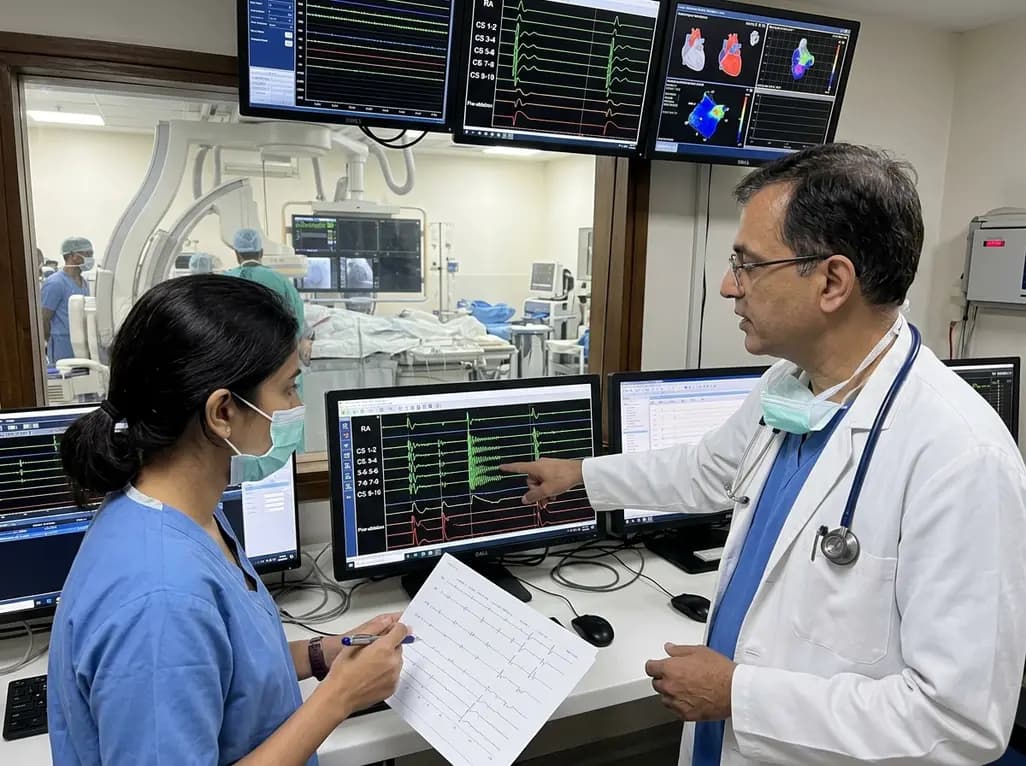
Radiofrequency catheter ablation of the cavotricuspid isthmus successfully terminates typical atrial flutter. This article reviews the mechanisms driving coronary sinus electrogram changes, wavefront activation pathways, and clinical criteria to verify bidirectional block during electrophysiology studies.
Today
A cross-sectional study demonstrates that increased BMI in adolescents significantly enhances mandibular length and alters salivary adipokines like adiponectin and resistin, providing novel insights into craniofacial growth and orthodontic planning.
Today
