

Loading, please wait...
Loading, please wait...

Cystic fibrosis causes chronic airway obstruction, persistent inflammation, and progressive parenchymal destruction. While clinicians traditionally track forced expiratory volume in one second (ppFEV1), evaluating lung volumes in CF offers deeper insight into respiratory pathophysiology. Small airway mucus plugging impedes normal airflow and precipitates severe gas trapping. Consequently, air becomes trapped behind collapsed bronchioles during tidal breathing. This pathological process elevates residual volume and functional residual capacity. Furthermore, progressive hyperinflation places significant mechanical stress on respiratory muscles and compromises diaphragmatic efficiency. As a result, affected individuals experience debilitating dyspnea, increased work of breathing, and reduced exercise tolerance. Traditional spirometry frequently underestimates these peripheral ventilatory abnormalities because it primarily captures airflow limitation in central conducting airways. Therefore, clinicians require advanced physiological assessments to quantify peripheral airway clearance and mechanical unloading. Body plethysmography captures these static lung compartments accurately. Recent clinical evaluations now confirm that addressing basic CFTR dysfunction directly alleviates peripheral hyperinflation. Thus, monitoring lung volume indices provides an indispensable diagnostic perspective for specialized clinicians managing chronic suppurative airway diseases.
In a prospective observational cohort study conducted across a major Canadian cystic fibrosis center, researchers tracked 111 adult patients initiating elexacaftor/tezacaftor/ivacaftor (ETI). The team gathered comprehensive plethysmographic measurements within one year before treatment initiation. Subsequently, they repeated these assessments approximately one year following therapy. The investigators observed remarkable and statistically significant improvements across several physiological parameters. Specifically, patients demonstrated substantial reductions in residual volume (RV) and functional residual capacity (FRC). In addition, the ratios of RV to total lung capacity (RV/TLC) and FRC to total lung capacity (FRC/TLC) decreased significantly (all p < 0.001). However, total lung capacity (TLC) remained unchanged throughout the observation timeframe. This stability in total capacity underscores that the primary benefit represents a genuine decompression of trapped gas rather than parenchymal restriction. Furthermore, the decompression of gas trapping allows lung volume recruitment, converting previously non-ventilated lung units into active participants in gas exchange. As a result, thoracic gas volume drops, thereby restoring resting diaphragmatic position and improving chest wall compliance. These objective plethysmographic data confirm that triple combination therapy fundamentally alters static lung mechanics in patients living with cystic fibrosis.
A critical finding from this prospective cohort involves the broad clinical efficacy observed across all stages of baseline lung impairment. Clinicians frequently wonder whether individuals with advanced bronchiectasis and severe airway distortion can still achieve physiological recovery. Notably, the study revealed that gas trapping improved across all disease severity strata. Patients exhibiting more severe baseline airflow obstruction experienced even larger absolute reductions in residual volume and gas trapping metrics. Consequently, those individuals with the greatest baseline physiological handicap derived substantial mechanical decompression. In addition, the research demonstrated modest correlations between changes in static lung volumes and standard spirometric gains. Although ppFEV1 increased reliably, improvements in forced expiratory parameters did not entirely mirror the profound drops in residual volumes. Therefore, relying exclusively on spirometry can overlook meaningful physiological responses occurring in the distal pulmonary tree. Clinicians evaluating patients after therapy initiation should recognize that stable or modest spirometric changes may conceal pronounced reductions in pulmonary hyperinflation. Moreover, this divergence emphasizes the clinical value of assessing multiple physiological domains simultaneously. Modulator therapy clearly exerts systemic restorative effects across mild, moderate, and severe patient subgroups alike.
The physiological mechanisms explaining these dramatic reductions in hyperinflation center on small airway clearance and mucociliary restoration. Cystic fibrosis transmembrane conductance regulator modulators restore chloride and bicarbonate transport across the respiratory epithelium. Consequently, airway surface liquid rehydrates rapidly, thinning previously tenacious, inspissated secretions. As patients clear stubborn mucus plugs from bronchioles, peripheral airways reopen during expiration. Thus, premature dynamic airway closure diminishes significantly during normal breathing cycles. Furthermore, high-resolution imaging and lung clearance index studies demonstrate similar reductions in structural abnormalities and ventilation heterogeneity following modulator therapy. When peripheral airway collapsibility decreases, trapped alveolar volume empties more completely. Consequently, the residual volume ratio declines, relieving hyperinflation without altering the structural boundaries of total lung capacity. In addition, lower thoracic gas volumes reduce elastic threshold loading on inspiratory muscles, especially the diaphragm. This mechanical relief diminishes the sensation of respiratory effort during daily activities. Therefore, the physiological advantages of CFTR modulation extend well beyond simple forced airflow velocity, transforming global ventilatory biomechanics and pulmonary gas distribution.
These prospective plethysmographic observations offer direct practice-changing lessons for pulmonologists, internists, and pediatricians caring for chronic suppurative lung disease. Firstly, clinicians must appreciate that spirometry measures dynamic airflow limitations, whereas plethysmography quantifies lung hyperinflation and gas trapping. Therefore, incorporating lung volume measurements into routine annual monitoring provides a more complete assessment of therapeutic efficacy. For example, when a patient on modulator therapy reports significant symptom relief despite modest ppFEV1 improvement, resolving hyperinflation often explains the clinical discordance. Furthermore, clinicians managing individuals with advanced pulmonary disease should not withhold CFTR modulator evaluation based on severe baseline obstruction. The data clearly demonstrate that patients with low baseline lung function achieve the most substantial reductions in gas trapping. In addition, these findings encourage ongoing surveillance of peripheral airway dynamics in specialized pulmonary function laboratories. Clinicians practicing in tertiary care environments can utilize body plethysmography to verify airway reopening and guide individualized pulmonary rehabilitation. Consequently, structured physiological monitoring ensures that therapeutic decisions rely on comprehensive ventilatory mechanics rather than isolated forced expiratory maneuvers.
As modern CFTR modulators redefine long-term cystic fibrosis management, pulmonary function monitoring protocols must continue to evolve. Historically, clinical trials utilized ppFEV1 as the primary regulatory benchmark for drug approval. However, emerging evidence demonstrates that gas trapping and small airway dysfunction precede spirometric decline and persist even during clinical stability. Therefore, future clinical registries and observational studies should systematically integrate body plethysmography, nitrogen multiple-breath washout, and chest imaging. Combining these modalities will allow clinicians to track small airway remodeling over extended therapeutic durations. Furthermore, investigators must examine whether sustained reductions in residual volume directly decrease long-term pulmonary exacerbation frequencies and slow bronchiectasis progression. In addition, evaluating patient-reported outcomes alongside plethysmographic improvements will clarify how hyperinflation reduction correlates with daily functional gains and physical endurance. Ultimately, adopting multiparametric physiological assessments will optimize personalized therapy for individuals with cystic fibrosis. Through standardized tracking of static and dynamic volumes, medical teams can deliver comprehensive, evidence-based pulmonary care that addresses both proximal and peripheral airway disease.
ETI therapy restores epithelial chloride and bicarbonate secretion by enhancing CFTR protein folding and channel gating. Consequently, airway surface liquid rehydrates, enabling effective clearance of thick mucus plugs from peripheral bronchioles. As small airways clear, air flows freely during expiration rather than becoming trapped behind collapsed segments. Therefore, this physiological clearance directly reduces residual volume and hyperinflation, relieving mechanical strain on the respiratory pump.
Spirometry primarily measures dynamic airflow rates, such as forced expiratory volume in one second, reflecting central airway patency. However, spirometry cannot measure absolute residual volume or functional residual capacity. In contrast, body plethysmography measures thoracic gas volume, accurately quantifying gas trapping and pulmonary hyperinflation. Therefore, plethysmography uncovers critical physiological improvements in peripheral lung units that standard spirometric testing frequently misses or underestimates during CFTR modulator therapy.
Yes, patients with severe baseline airway obstruction achieve substantial benefits from ETI therapy. Prospective cohort data demonstrate that individuals with lower baseline ppFEV1 experience the largest absolute reductions in residual volume and gas trapping. Although irreversible parenchymal damage may exist, resolving active mucus plugging decompresses hyperinflated lung units. Consequently, these physiological improvements alleviate dyspnea, enhance ventilatory mechanics, and markedly improve overall functional performance in advanced disease.
Disclaimer: This content is for informational and educational purposes only. It is not intended as medical advice, diagnosis, or treatment. Healthcare professionals should exercise their clinical judgment and consult relevant clinical guidelines, pharmacopeias, and official prescribing information when making medical decisions. Refer to the latest local and national guidelines for clinical practice.
References

Read summarized clinical updates, watch expert medical content, and earn CME certifications right from your smartphone.
Open your smartphone camera to scan and install.





A Canadian prospective cohort study reveals that elexacaftor/tezacaftor/ivacaftor significantly reduces residual volume and gas trapping in cystic fibrosis patients, particularly those with severe baseline airflow obstruction.
Today
A landmark study reveals that an epigenetic p300-Musculin-DUSP22 axis fuels mechanical hyperactivity and tissue infiltration of cytotoxic CD8+ T cells in systemic lupus erythematosus, explaining organ damage and belimumab resistance.
Today

A landmark study reveals that congenital DLK1 deficiency in women with a history of central precocious puberty causes visceral adiposity, mitochondrial dysfunction, oxidative stress, and neutrophil activation, highlighting the critical need for lifelong cardiometabolic surveillance.
Today

Explore revascularisation strategies in dialysis-dependent chronic limb-threatening ischaemia. This review examines surgical bypass vs endovascular therapy, BEST-CLI trial findings, procedural morbidity, conduit availability, and multidisciplinary decision-making for optimal limb salvage.
Today

A recent cross-sectional analysis reveals that over a quarter of randomized controlled trials for non-specific low back pain face discontinuation or unknown status, while more than 36% of completed trials remain unpublished, exposing notable reporting gaps in spine and musculoskeletal clinical research.
Today
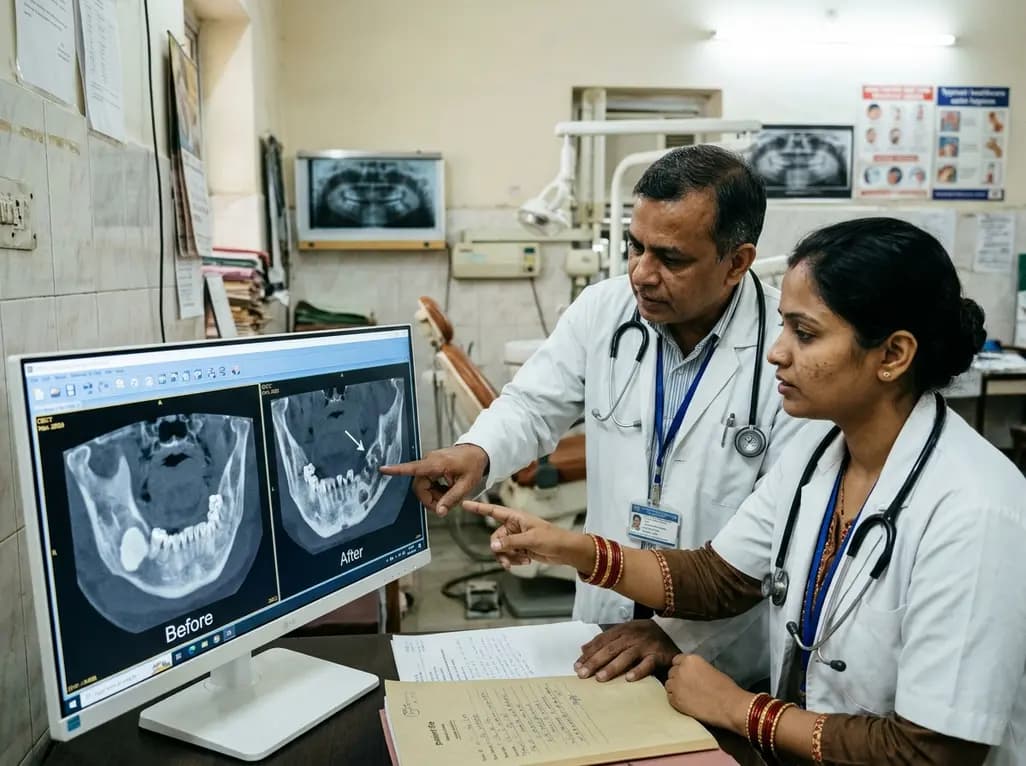
This case report examines the longitudinal CBCT evolution of Stage 2 MRONJ in a 70-year-old woman on denosumab at the site of a pre-existing mandibular dense bone island. It emphasizes the radiographic features, differential diagnosis, and multidisciplinary strategies required for high-risk bone lesions.
Today
