.webp&w=384&q=75)

Loading, please wait...
Loading, please wait...
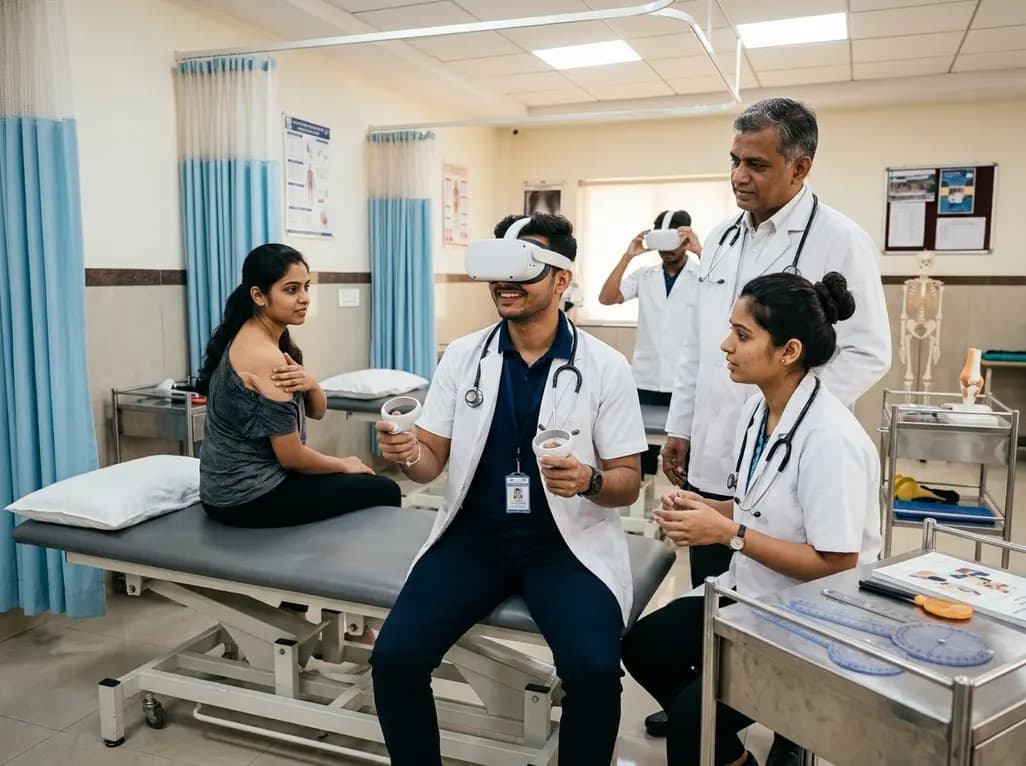
Modern healthcare training continually integrates digital innovations to improve student engagement and procedural comprehension. Recent advances in immersive VR medical education show significant promise in transforming conventional clinical instruction. While hands-on practice remains the cornerstone of musculoskeletal clinical examination, digital simulation tools offer novel ways to visualize intricate biomechanical assessments. A randomized controlled trial evaluated whether head-mounted virtual reality improves learner satisfaction, technology acceptance, motivation, and immediate cognitive retention in physiotherapy trainees.
Educators often face logistical hurdles when demonstrating complex physical examination maneuvers to large cohorts. Traditional teaching relies heavily on flat two-dimensional video demonstrations and in-person faculty modeling. However, standard video formats restrict visual perspective and depth perception. Consequently, trainees may struggle to appreciate subtle joint positioning, clinician hand placements, and patient response cues during physical assessments.
Musculoskeletal special tests require precise patient stabilization, targeted passive movements, and immediate symptom appraisal. For instance, tests evaluating subacromial impingement, biceps pathology, or median nerve compression demand rigorous anatomical orientation. Immersive video modalities allow trainees to view clinical maneuvers from flexible viewpoints. Therefore, researchers developed a specialized curriculum comparing immersive head-mounted displays against conventional flat-screen video formats to assess educational efficacy objectively.
The randomized controlled trial recruited fifty-two undergraduate physical therapy students to compare two distinct instructional formats. Investigators randomly assigned twenty-eight participants to the immersive head-mounted display cohort and twenty-four participants to the standard monitor control group. Importantly, both groups received identical instructional content covering four standard musculoskeletal examinations: the pronator teres test, Hawkins-Kennedy test, Yergason test, and Neer test.
Participants completed four focused instructional sessions within a single training day, each lasting approximately three to four minutes. The experimental group experienced the instructional modules via stereoscopic 180-degree video on virtual reality headsets. In contrast, the control group viewed identical recorded demonstrations on standard flat desktop screens. Researchers measured learning satisfaction as the primary outcome, alongside secondary metrics including technology acceptance, learning motivation, and procedural knowledge evaluated through a twelve-item quiz.
Statistical analysis using analysis of covariance revealed remarkable differences between the two educational approaches. After adjusting for baseline scores, the virtual reality group demonstrated significantly higher learning satisfaction compared to the control group. The adjusted mean score reached 107.04 in the virtual reality cohort versus 93.28 in the standard screen cohort, showing a robust effect size.
Furthermore, technology acceptance significantly favored the immersive platform over conventional viewing methods. Trainees reported an adjusted mean score of 74.44 in the immersive group compared to 68.03 among controls. Participants appreciated the vivid visual clarity, natural spatial orientation, and interactive feeling of clinical presence. Consequently, these findings highlight that immersive media substantially enhances student receptivity and overall enjoyment during early skill acquisition phases.
Despite substantial gains in satisfaction and platform acceptance, the trial observed nuanced results regarding immediate cognitive acquisition. The adjusted post-intervention quiz scores did not show a statistically significant difference between the two cohorts. Both groups achieved comparable short-term factual retention regarding test indications, procedural sequences, and diagnostic criteria.
Similarly, assessments of learning motivation revealed complex patterns across both instructional arms. Statistical testing indicated that the baseline regression slopes were not homogeneous, requiring cautious descriptive interpretation. As a result, the data did not demonstrate a clear superiority for virtual reality in elevating raw academic motivation scores. These findings suggest that while immersive tools improve the learning experience, they do not automatically replace foundational didactic instruction.
The trial findings provide practical insights for curriculum designers and clinical educators across healthcare institutions. Integrating immersive VR medical education into existing training modules can create highly engaging pre-clinical orientations. Trainees can repeatedly observe expert clinician positioning and dynamic tissue handling in high-definition stereoscopic formats before entering live patient laboratories.
However, educators must not view virtual reality as a standalone substitute for direct psychomotor practice. Musculoskeletal examination ultimately demands tactile feedback, palpatory sensitivity, and interpersonal patient communication. Therefore, academic departments should employ immersive headsets as complementary preparatory tools. By blending digital visual immersion with hands-on faculty mentoring, training programs can optimize both learner enthusiasm and clinical competence.
Adopting virtual reality into health sciences education requires strategic resource planning and thoughtful faculty development. Institutions must balance hardware acquisition costs with tangible pedagogical benefits. Because brief, targeted instructional sessions produce strong learner satisfaction, educators should design modular micro-learning units rather than exhaustive, fatiguing simulations.
In addition, institutions must evaluate ergonomic comfort and ease of navigation to prevent simulator sickness. Standardizing high-quality video content ensures equitable training quality across diverse student cohorts. Ultimately, blending immersive visual technologies with supervised laboratory practice establishes a balanced educational paradigm. Future research should examine whether these perceptual advantages translate into superior real-world diagnostic accuracy and improved patient outcomes.
Standard video displays content on a flat screen with a fixed visual angle. In contrast, 180-degree virtual reality provides a wide stereoscopic field of view through a head-mounted display. This setup delivers true depth perception, natural head tracking, and realistic spatial positioning. Consequently, trainees experience greater visual immersion and observe nuanced clinical handling techniques more effectively than with conventional monitors.
No, virtual reality cannot replace direct hands-on practice in physical therapy training. While immersive video enhances visual understanding, spatial awareness, and learner satisfaction, it lacks physical resistance and tactile feedback. Trainees must still perform palpatory assessments and joint mobilizations on real individuals. Therefore, educators should utilize virtual reality as an adjunctive visual tool alongside faculty-led practical laboratories.
The randomized controlled trial showed no statistically significant difference in quiz-based knowledge scores between the virtual reality and control groups. Both instructional modalities yielded comparable short-term factual retention regarding musculoskeletal special tests. Virtual reality clearly improved student satisfaction and technology acceptance, but cognitive knowledge acquisition remained equivalent to standard video learning.
Disclaimer: This content is for informational and educational purposes only. It is not intended to provide medical advice or substitute for professional medical judgment, diagnosis, or treatment. Always consult a qualified healthcare provider for personalized medical guidance. Refer to the latest local and national guidelines for clinical practice.
References
Yoon H et al. Effects of an Immersive 180° Video-Based Virtual Reality Instructional Module on Learning Satisfaction, Technology Acceptance, Motivation, and Quiz-Based Learning Achievement in Undergraduate Physical Therapy Students: Randomized Controlled Trial. JMIR Med Educ. 2026 Aug 14. doi: 10.2196/94122. PMID: 42600147.
Prvu Bettger J, Green CL, Holmes DN, et al. Effects of virtual exercise rehabilitation in-home therapy compared with traditional care after total knee arthroplasty: VERITAS, a randomized controlled trial. J Bone Joint Surg Am. 2020;102(2):101-109.
Morris LD, Grimmer KA, Gilmore L, et al. Effectiveness of virtual reality interventions for patients with musculoskeletal pain: systematic review and meta-analysis. Pain. 2020;161(2):205-217.

Read summarized clinical updates, watch expert medical content, and earn CME certifications right from your smartphone.
Open your smartphone camera to scan and install.





A randomized controlled trial demonstrates that immersive 180° video-based virtual reality significantly elevates learning satisfaction and technology acceptance among undergraduate physical therapy students learning musculoskeletal clinical special tests.
last month

Ceftriaxone therapy can lead to biliary sludge and gallstone formation due to calcium-ceftriaxone precipitation. A recent cohort study shows that the noninvasive Fibrosis-4 (FIB-4) index, alongside treatment duration, independently predicts lithogenesis, enabling proactive risk stratification.
Today

A multiparametric MRI approach combining quantitative T2 shading, apparent diffusion coefficient (ADC) measurements, and morphological signs provides superior diagnostic accuracy over subjective evaluation to differentiate ovarian endometriomas from benign hemorrhagic cysts.
Today
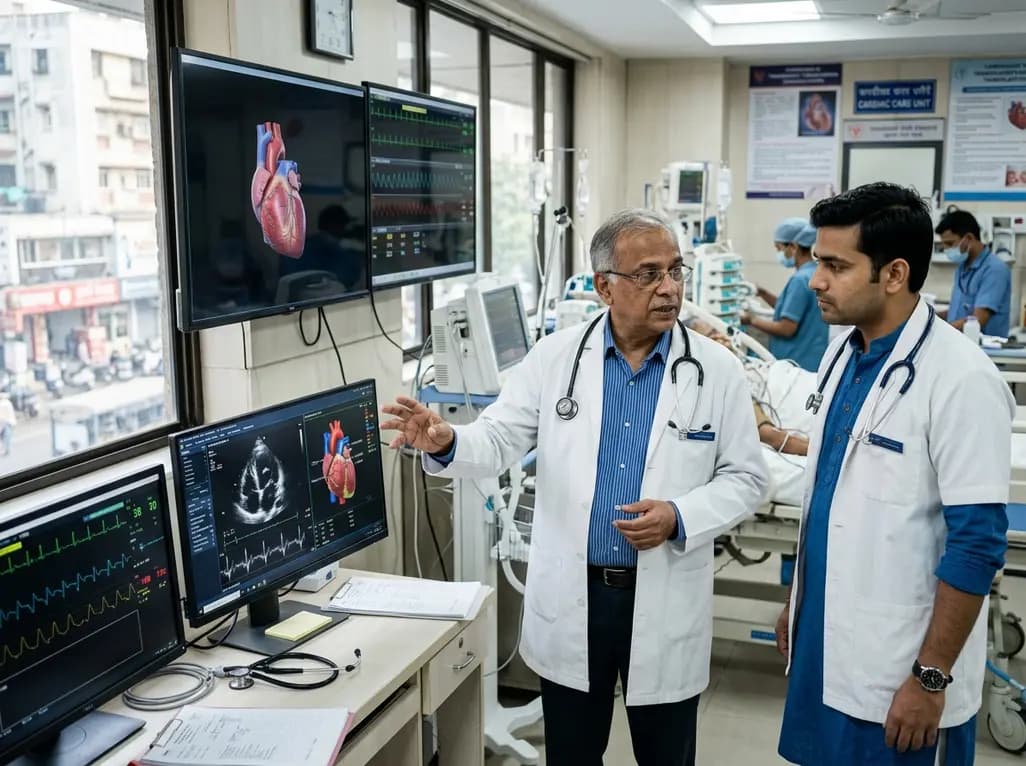
A landmark case report reveals a donor heart beating for a century in a 63-year-old recipient, challenging conventional age limits in cardiac transplantation and offering critical lessons on organ longevity, donor selection, and long-term graft survival.
Today

A propensity-matched analysis reveals that patients undergoing total hip arthroplasty on maintenance dialysis experience significantly higher rates of adverse events, periprosthetic infection, and revision surgery at 90 days, 2 years, and 5 years compared to non-dialysis peers.
Today

New research reveals that M1 macrophage-derived exosomes aggravate diabetic nephropathy by transferring WTAP to stabilize S1PR2 mRNA. Silencing WTAP in these vesicles attenuates endothelial injury and renal fibrosis, pointing toward innovative nanomedicine therapies.
Yesterday
