.webp&w=384&q=75)

Loading, please wait...
Loading, please wait...

High-translucency 4Y-TZP has transformed contemporary prosthodontic workflows by offering superior optical properties and lifelike esthetics. Clinicians frequently prescribe this monolithic ceramic material for implant-supported fixed dental prostheses. However, traditional connector design guidelines originate primarily from mechanical data on conventional 3-mol% yttria-stabilized zirconia. Because high-translucency 4Y-TZP exhibits approximately 30% to 40% lower flexural strength than 3Y-TZP, applying historical dimensional guidelines creates significant clinical uncertainty. Therefore, dental practitioners must understand how connector dimensions and span length govern the load-bearing capacity of these esthetic ceramic frameworks.
Furthermore, the connector zone represents the most mechanically vulnerable location in multi-unit prostheses. Masticatory forces generate bending moments that induce severe tensile stress along the gingival embrasure of the connector. When clinicians design long spans or undersized cross-sections, functional loads can quickly exceed the tensile strength of the ceramic. Consequently, structural microcracks initiate and propagate rapidly, leading to catastrophic framework fracture. Thus, systematic investigation into ceramic biomechanics provides essential guidelines for predictable restorative outcomes across posterior dental arches.
To evaluate structural limits, researchers investigated presintered monolithic zirconia milled into standardized bar-shaped specimens. Specifically, the study evaluated four discrete connector configurations representing distinct cross-sectional geometries. These configurations included 3×3 mm, 4×3 mm, and 4×4 mm elliptical profiles alongside a 5×4 mm rectangular control. These dimensions corresponded to cross-sectional surface areas of 7.1, 9.4, 12.6, and 20.0 square millimeters, respectively. Moreover, the team tested two standardized span lengths of 22 mm and 42 mm under standardized three-point bend testing conditions.
In addition, investigators recorded ultimate fracture loads and calculated flexural stress at each connector region. They derived flexural stress values using the local bending moment and the section modulus appropriate to each cross-sectional geometry. Simultaneously, researchers generated three-dimensional finite element models to characterize maximum principal stress and calculate stress concentration factors. Through this integrated approach, the investigators established clear correlations between physical geometry and localized tensile forces during functional loading.
The mechanical testing yielded statistically significant differences across the experimental groups. Both connector configuration and span length exerted profound effects on ultimate fracture loads. Specifically, increasing connector cross-sectional dimensions consistently elevated load-bearing capacity. Specimens featuring 5×4 mm connectors sustained the greatest failure loads under laboratory conditions. Meanwhile, specimens with 4×4 mm and 4×3 mm connectors demonstrated intermediate fracture values, whereas 3×3 mm connectors recorded the lowest fracture resistance.
Conversely, increasing the span length from 22 mm to 42 mm significantly compromised fracture resistance across all geometries. As beam length doubled, the local bending moments amplified substantially under identical vertical loads. Consequently, specimens tested over extended spans failed under markedly lower compressive loads. The data confirmed that narrow 3×3 mm connectors cannot withstand functional masticatory forces when spanning long edentulous gaps. Therefore, clinicians must avoid minimal connector profiles in multi-unit posterior restorations.
Computational modeling corroborated the empirical findings through three-dimensional finite element analysis. Finite element models revealed that peak tensile stress concentrated predictably at the gingival embrasure of the connector. Because ceramics demonstrate high compressive strength but pronounced vulnerability to tensile strain, gingival margins serve as primary fracture initiation sites. Furthermore, geometries with sharper curvature radii exhibited heightened stress concentration factors during simulated occlusal loading.
In contrast, specimens with larger cross-sectional areas and broader radii distributed stress over a wider material volume. Consequently, 4×4 mm and 5×4 mm connectors lowered maximum principal stress values considerably below the critical threshold of high-translucency 4Y-TZP. Furthermore, stress concentration decreased dramatically when designers increased vertical connector height rather than buccolingual width alone. Thus, the finite element findings emphasize that geometry and embrasure contouring directly determine tensile stress dissipation under functional masticatory forces.
These findings deliver direct clinical implications for dental practitioners designing monolithic restorations. When planning multi-unit fixed dental prostheses, clinicians must refrain from applying traditional 3Y-TZP connector rules to more translucent formulations. Because high-translucency 4Y-TZP possesses reduced intrinsic flexural strength, designers must compensate by increasing cross-sectional dimensions. Specifically, posterior multi-unit prostheses require connector areas exceeding 12 square millimeters to prevent structural failure under functional loads.
Additionally, practitioners must carefully evaluate span length during restorative treatment planning. In long-span situations, such as four-unit prostheses or extended implant spans, functional deflection generates hazardous tensile stresses. Clinicians should prioritize vertical connector height over horizontal width whenever interocclusal clearance permits. Furthermore, dental technicians must ensure gentle, rounded gingival embrasures rather than sharp notches to minimize stress concentration. By adhering to these evidence-based parameters, dental teams preserve esthetics without compromising long-term restoration survival.
Span length profoundly alters the mechanical stability of fixed prostheses because bending moments increase linearly with span length. As the distance between supports increases from 22 mm to 42 mm, identical occlusal forces generate substantially greater tensile stresses at the connectors. Consequently, longer spans exhibit significantly reduced fracture load thresholds, requiring clinicians to increase connector dimensions or consider more rigid material options for restorations.
Tensile stress concentrates intensely at the gingival surface of the connector during occlusal loading because dental bridges flex downward under masticatory forces. Since zirconia remains brittle and demonstrates much lower tensile strength than compressive strength, crack propagation initiates at areas with high tensile concentration. Sharp embrasure radii further magnify these localized stresses, making generous rounding essential to prevent premature ceramic fracture in posterior regions.
Clinicians should avoid minimal 3×3 mm connectors for high-translucency zirconia because they fail to resist functional occlusal forces reliably. Instead, evidence supports utilizing connector dimensions of at least 4×3 mm for short spans and 4×4 mm or larger for longer spans. Providing a minimum cross-sectional area of 12 square millimeters ensures adequate structural integrity while preserving necessary soft-tissue embrasure architecture during prosthetic fabrication.
Disclaimer: This content is for informational and educational purposes only... Refer to the latest local and national guidelines for clinical practice.
References

Read summarized clinical updates, watch expert medical content, and earn CME certifications right from your smartphone.
Open your smartphone camera to scan and install.





Evaluating the impact of connector size and span length on the fracture resistance of high-translucency 4Y-TZP reveals essential biomechanical design rules for dental prostheses.
Today
A randomized controlled trial compared conventional cold snare polypectomy with submucosal injection for 3-9 mm polyps. Both techniques demonstrated exceptionally low incomplete resection rates, though injection lowered the need to convert to endoscopic mucosal resection when forced pull was avoided.
Today

Maternal anaemia contributes to nearly half of pregnancy-related fatalities across India. To prevent complications, Uttar Pradesh has added single-dose parenteral iron to its essential medicines list. This clinical transition aims to restore haemoglobin rapidly and protect high-risk mothers across rural facilities.
Today
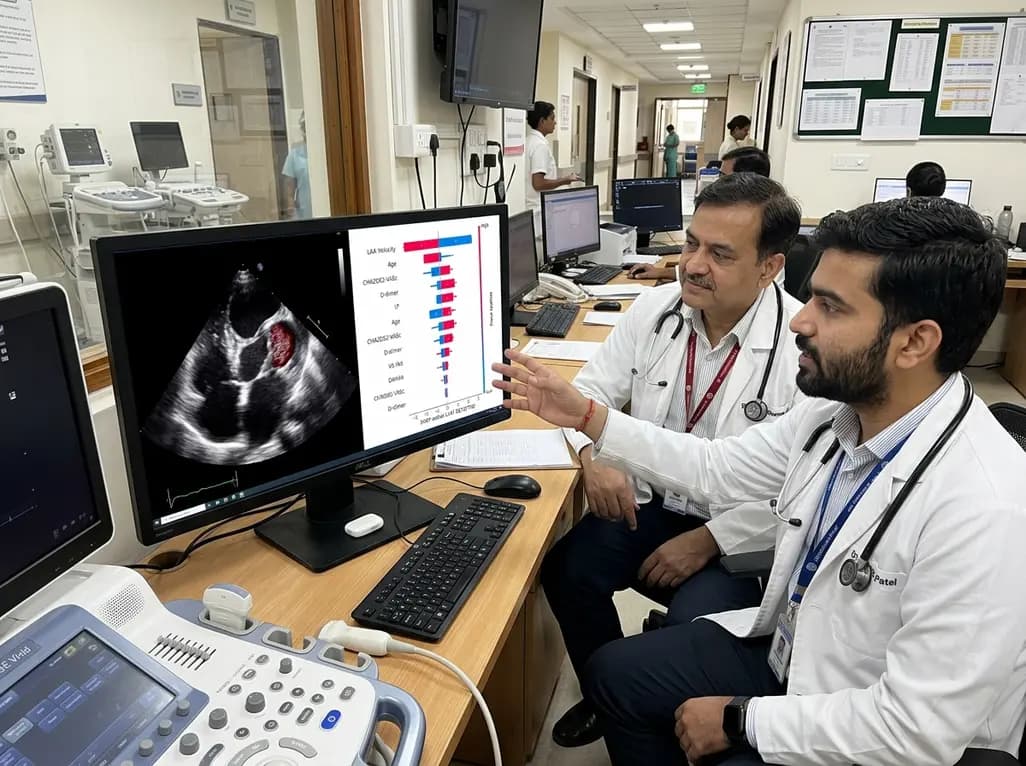
A study demonstrates an explainable machine learning framework integrating clinical and echocardiographic metrics to predict left atrial appendage thrombus in non-valvular atrial fibrillation, utilizing SHAP analysis for clinical interpretability.
Today
A longitudinal study of 1,055 chronic low back pain patients reveals that higher patient activation fosters constructive pain medication attitudes, reduces disability, and decreases short- and long-term opioid use through collaborative, multimodal care.
Today

A landmark cross-sectional study in Asian adults with type 2 diabetes identifies novel urinary metabolites linked to mild cognitive impairment. Elevated urinary sucrose and altered metabolites highlight non-invasive pathways for early cognitive risk stratification and targeted metabolic management.
Today
