.webp&w=384&q=75)

Loading, please wait...
Loading, please wait...
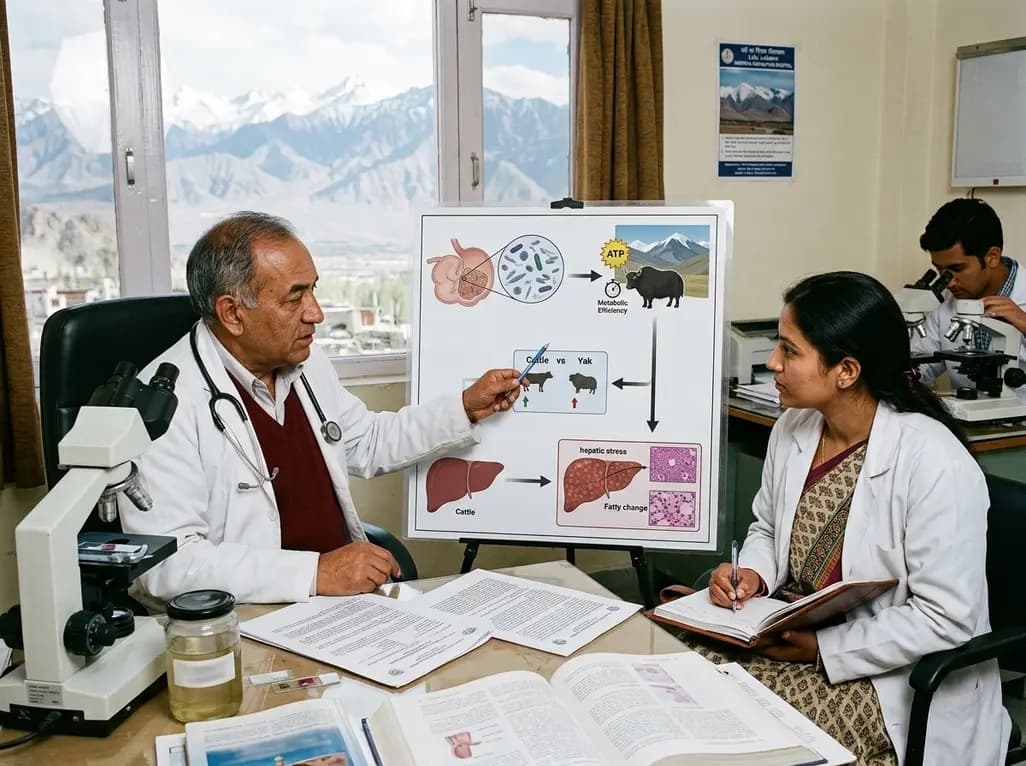
High-altitude metabolic adaptation is a vital evolutionary process for species surviving in oxygen-depleted environments. A recent study published in Animal Microbiome investigated how yaks (Bos grunniens) utilize their rumen microbiota to thrive on the Qinghai-Tibet Plateau. Researchers conducted a comparative analysis between yaks and cattle at baseline (2,200 m) and hypoxic (3,800 m) altitudes. The findings reveal that yaks employ unique microbial strategies to manage energy deficits. These strategies specifically involve shifting rumen microbiota toward amino acid degradation. This shift provides more available energy substrates for the host. Consequently, yaks maintain better energy acquisition even when their nutritional intake decreases.
The microbial strategies found in yaks are sophisticated. In addition to amino acid degradation, the study observed enhanced long-chain fatty acid biosynthesis. This allows for more efficient energy storage and utilization under stress. However, while these microbial shifts ensure survival, they also create significant physiological burdens. Specifically, the study noted that microbial crude protein (MCP) synthesis in yaks decreased by 47.3% at high altitudes. This reduction leads to significantly higher levels of ruminal ammonia-nitrogen (NH3-N). Therefore, high-altitude metabolic adaptation represents a survival trade-off where energy efficiency is prioritized over other metabolic functions.
The cost of surviving in extreme environments often manifests in organ health. The study showed that increased fatty acid metabolism and urea cycle activity contribute to hepatic stress in yaks. Notably, serum levels of alanine aminotransferase (ALT), a primary marker for liver stress, increased by 19.7% under hypoxic conditions. Ruminal NH3-N levels also surged by 147.2%. These results suggest that yaks optimize microbially mediated energy production at the expense of liver health. Furthermore, these insights deepen our understanding of host-microbiome coevolution. Researchers believe these findings highlight the biological costs associated with high-altitude metabolic adaptation and offer a framework for studying hypoxia-related metabolic diseases in other species.
Yaks adapt by shifting their rumen microbiota toward amino acid degradation and enhancing fatty acid biosynthesis. These microbial changes provide essential energy substrates that help the animal cope with hypoxic stress and reduced food availability.
The primary risk involves hepatic stress. The metabolic shift increases ammonia levels and urea cycle activity, which can lead to liver strain, evidenced by a nearly 20% increase in serum ALT levels during hypoxia.
Yes, the study found that high-altitude conditions caused a 47.3% reduction in microbial crude protein (MCP) synthesis in yaks, leading to a significant rise in ruminal ammonia-nitrogen.
Disclaimer: This content is for informational and educational purposes only. It does not constitute professional medical advice, diagnosis, or treatment. Always seek the advice of your physician or other qualified healthcare provider with any questions you may have regarding a medical condition. Refer to the latest local and national guidelines for clinical practice.
References
Tan L et al. The price of survival: comparative adaptation to high altitudes between yaks and cattle. Anim Microbiome. 2026 Jun 06. doi: 10.1186/s42523-026-00584-3. PMID: 42251450.
Zhang X et al. Metabolic responses to hypoxia. Front Physiol. 2020;11:1022. doi: 10.3389/fphys.2020.01022.
Guan Y et al. Role of the gut microbiota in adaptation to extreme environments. Microbiome Res Rep. 2017;12(4):301-315.
"
Read summarized clinical updates, watch expert medical content, and earn CME certifications right from your smartphone.
Open your smartphone camera to scan and install.





A comparative study on yaks and cattle reveals that high-altitude adaptation involves microbial energy strategies that may cause significant hepatic stress....
4 months ago

Novel diimide and hydrazone scaffolds, particularly compound #C4, synergistically reactivate latent HIV-1 when combined with JQ1 or PKC activators. Demonstrating donor-matched proviral transcription ex vivo and non-canonical signaling, these findings advance shock and kill strategies toward reservoir eradication.
Today

A cross-sectional study reveals that maternal RSV vaccination coverage reached only 43.7% in Argentina, with maternal vaccine knowledge being the sole independent predictor of uptake. Clinicians play a crucial role in eliminating informational and structural barriers to optimize infant health.
Today

Review how tailored exercise programs benefit frail older patients with heart failure. Explore pathophysiological mechanisms, individualized training prescriptions, and strategies to overcome adherence barriers in clinical practice.
Yesterday

This comparative study evaluates posterior labral tears with and without glenohumeral instability, highlighting distinct demographic patterns, MRI underestimation in stable shoulders, and successful arthroscopic repair outcomes.
Yesterday

A clinical study demonstrates that early intervention with tocilizumab, either as monotherapy or bridged with corticosteroids, achieves significant proptosis reduction and resolves active inflammation in treatment-naive thyroid eye disease.
Yesterday
