.webp&w=384&q=75)

Loading, please wait...
Loading, please wait...

Hereditary Spastic Paraplegia (HSP) represents a complex group of neurodegenerative disorders characterized by progressive limb spasticity. Because the condition involves over 90 causative genes, identifying the exact molecular cause remains a challenge for clinicians. A recent study by Davarzani A et al. explores Hereditary Spastic Paraplegia Genetics within a large cohort of 103 families. The researchers aimed to map both clinical and genetic landscapes to improve diagnostic success for this heterogeneous condition.
The study utilized Whole-exome sequencing (WES) to analyze 103 unrelated probands. Consequently, they established a genetic diagnosis in 78.6% of the cases. Among these solved families, 64 probands possessed variants in recognized HSP genes. Additionally, 14 probands showed variants in genes linked to other neurodegenerative conditions. Interestingly, the research identified four novel candidate genes: NMNAT1, SEMA3A, KCNJ14, and EMP3. These findings suggest that the biological pathways underlying HSP overlap significantly with other neurological disorders.
Specifically, four subtypes accounted for approximately 40% of the genetically solved cohort. These included SPG11, SPG4, SPG7, and SPG15. This distribution aligns with global trends, although specific frequencies vary by region. For instance, studies from India also highlight SPG11 as a dominant cause of complicated HSP. In India, clinicians frequently encounter both pure and complicated forms, making comprehensive genetic testing essential for precise management.
Furthermore, the research detected two copy number variants (CNVs) and one trinucleotide repeat expansion. This highlights the importance of using diverse diagnostic tools beyond simple sequencing. Although WES solved most cases, 22 probands remained without a diagnosis. Therefore, unidentified genes likely contribute to the pathogenesis of the remaining cases. Doctors must stay updated on these emerging genetic markers to provide accurate counseling and management for affected families.
Pure HSP primarily involves lower-limb spasticity and weakness. In contrast, complicated HSP includes additional neurological features such as ataxia, seizures, or cognitive impairment.
Genetic testing confirms the specific subtype, which helps predict disease progression. Furthermore, it allows for accurate family planning and genetic counseling for relatives.
While known genes like SPG4 and SPG11 are common, researchers frequently discover novel candidates. These new genes help explain cases that previously lacked a molecular diagnosis.
Disclaimer: This content is for informational and educational purposes only. It does not constitute medical advice or a professional relationship. Always seek the advice of a qualified healthcare provider for any medical condition or treatment. Refer to the latest local and national guidelines for clinical practice.
References
Davarzani A et al. Expanding the genetic and clinical landscapes of hereditary spastic paraplegia (HSP): a cohort study of 103 families. Orphanet J Rare Dis. 2026 May 12. doi: 10.1186/s13023-026-04373-8. PMID: 42120987.
Srivastava AK et al. Spectrum of Hereditary Spastic Paraparesis (HSP): A study from India [abstract]. Mov Disord. 2023; 38 (suppl 1).
Kumar KR et al. Novel insights into the genetic profile of hereditary spastic paraplegia in India. J Genet. 2022;101:34. doi: 10.1007/s12041-022-01372-x.
"
Read summarized clinical updates, watch expert medical content, and earn CME certifications right from your smartphone.
Open your smartphone camera to scan and install.





A study of 103 families reveals the genetic landscape of HSP, identifying common subtypes and novel candidate genes to improve diagnostic accuracy....
5 months ago
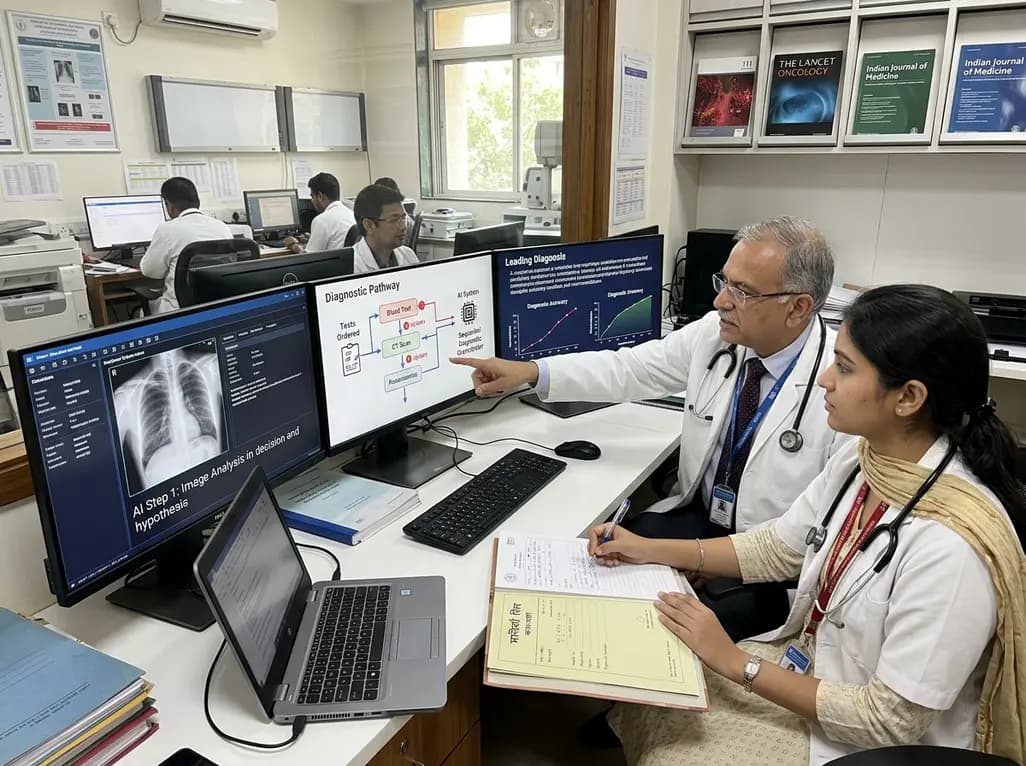
A breakthrough peer-reviewed study demonstrates that a sequential AI diagnosis system can mirror real-world clinical reasoning. By ordering stepwise tests and updating hypotheses dynamically, this multi-agent orchestrator achieved superior diagnostic accuracy while reducing investigative costs.
Today

A prenatal case highlights severe glutaric acidemia type II presenting as bilateral hyperechoic cystic kidneys at 18 weeks. Whole-exome sequencing revealed a novel homozygous ETFDH frameshift variant, demonstrating the power of rapid genetic testing in fetal renal anomalies.
Today

Review how tailored exercise programs benefit frail older patients with heart failure. Explore pathophysiological mechanisms, individualized training prescriptions, and strategies to overcome adherence barriers in clinical practice.
Yesterday

This comparative study evaluates posterior labral tears with and without glenohumeral instability, highlighting distinct demographic patterns, MRI underestimation in stable shoulders, and successful arthroscopic repair outcomes.
Yesterday

A clinical study demonstrates that early intervention with tocilizumab, either as monotherapy or bridged with corticosteroids, achieves significant proptosis reduction and resolves active inflammation in treatment-naive thyroid eye disease.
Yesterday
