.webp&w=384&q=75)

Loading, please wait...
Loading, please wait...

Healthcare service quality assessment serves as a critical foundation for enhancing patient satisfaction and clinical performance. A recent meta-analysis evaluated how effectively healthcare organisations in Turkey and other Asian countries meet client expectations. By examining 47 empirical studies involving over 13,000 patients, researchers identified significant areas where service delivery often falls short of patient needs.
The study primarily utilised the SERVQUAL scale, which is a robust tool designed to measure five dimensions of service quality: tangibles, reliability, responsiveness, assurance, and empathy. For Indian doctors and hospital administrators, these findings offer a vital benchmark. Furthermore, the results highlight the universal challenge of balancing complex institutional structures with limited resources while maintaining high standards of care.
The comprehensive review revealed that the most substantial quality gaps exist within the responsiveness and reliability dimensions. Specifically, the responsiveness gap was measured at 0.59, while the reliability gap followed closely at 0.54. These figures indicate that patients often perceive delays in service and a lack of consistency in care delivery as their primary concerns. Consequently, addressing these specific domains could significantly improve overall patient-centred outcomes.
Regular healthcare service quality assessment allows managers to monitor service levels in real-time. By identifying specific deficiencies, hospitals can implement more compassionate and efficient patient-care protocols. Moreover, understanding how patient expectations are shaped in different geographical settings helps decision-makers tailor their strategies effectively. Additionally, improving reliability ensures that medical delivery remains consistent, which is essential for fostering community trust.
Healthcare leaders should adopt systematic monitoring tools to bridge existing service gaps. For instance, implementing digital feedback loops can provide immediate data on responsiveness. Furthermore, providing staff training in patient-centred communication may reduce the empathy gap. Ultimately, a focus on high-quality service delivery not only improves patient satisfaction but also optimises the use of scarce medical resources.
The SERVQUAL scale is a multidimensional research instrument used to capture patient expectations and perceptions of service quality. It evaluates five dimensions: tangibles, reliability, responsiveness, assurance, and empathy.
Responsiveness reflects a hospital\'s ability to provide prompt service, while reliability measures the consistency and accuracy of care. Gaps in these areas often lead to patient dissatisfaction and reduced trust in the healthcare system.
Indian hospitals can apply these metrics to align with NABH and NQAS standards. By focusing on the identified gaps, administrators can prioritise resource allocation toward improving communication and service timing.
Disclaimer: This content is for informational and educational purposes only. It does not constitute medical advice or a professional recommendation. Refer to the latest local and national guidelines for clinical practice.
References
Çelik Y et al. International Assessment of Service Quality in Healthcare Organisations: A Systematic Review and Meta-Analysis. Int J Health Plann Manage. 2026 May 11. doi: 10.1002/hpm.70084. PMID: 42109192.
Darzi MA, Islam S. Service quality in the healthcare sector: a systematic review and meta-analysis. LBS Journal of Management & Research. 2023;21(1):13-29.
Sihombing R, et al. Service quality in hospital inpatient care: SERVQUAL model approach. PMC - NIH. 2023; PMC1054321.
"
Read summarized clinical updates, watch expert medical content, and earn CME certifications right from your smartphone.
Open your smartphone camera to scan and install.





A systematic review reveals significant gaps in healthcare responsiveness and reliability, emphasizing the need for patient-centered improvements in Asia....
5 months ago
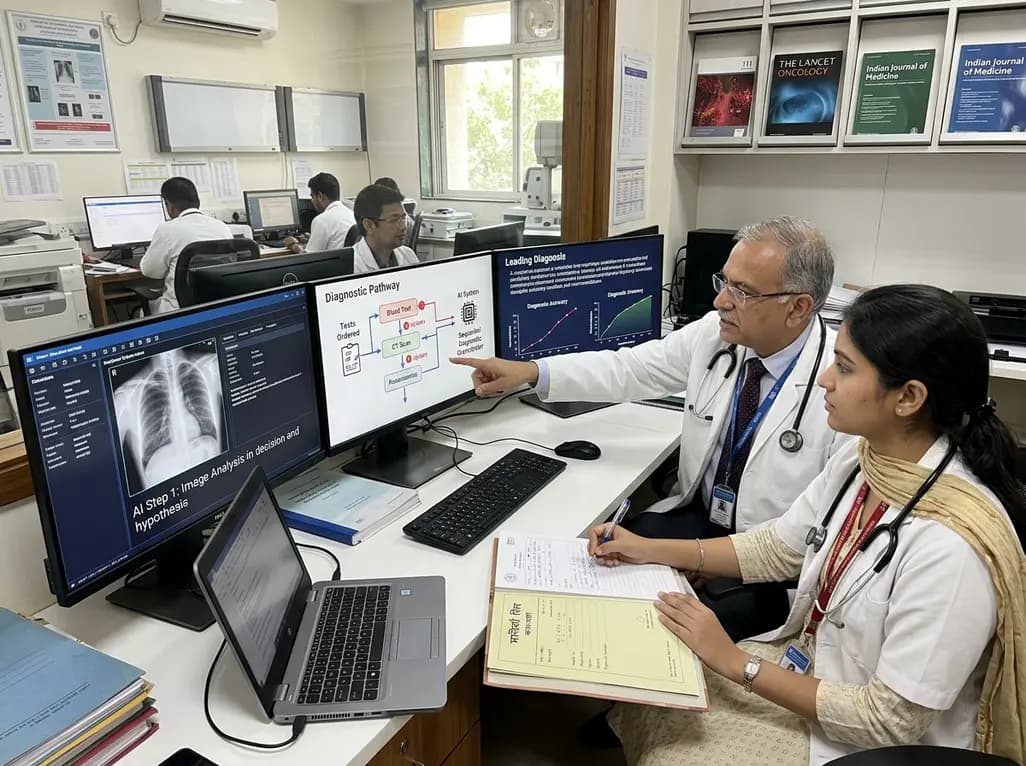
A breakthrough peer-reviewed study demonstrates that a sequential AI diagnosis system can mirror real-world clinical reasoning. By ordering stepwise tests and updating hypotheses dynamically, this multi-agent orchestrator achieved superior diagnostic accuracy while reducing investigative costs.
Today

A prenatal case highlights severe glutaric acidemia type II presenting as bilateral hyperechoic cystic kidneys at 18 weeks. Whole-exome sequencing revealed a novel homozygous ETFDH frameshift variant, demonstrating the power of rapid genetic testing in fetal renal anomalies.
Today

Review how tailored exercise programs benefit frail older patients with heart failure. Explore pathophysiological mechanisms, individualized training prescriptions, and strategies to overcome adherence barriers in clinical practice.
Yesterday

This comparative study evaluates posterior labral tears with and without glenohumeral instability, highlighting distinct demographic patterns, MRI underestimation in stable shoulders, and successful arthroscopic repair outcomes.
Yesterday

A clinical study demonstrates that early intervention with tocilizumab, either as monotherapy or bridged with corticosteroids, achieves significant proptosis reduction and resolves active inflammation in treatment-naive thyroid eye disease.
Yesterday
