.webp&w=384&q=75)

Loading, please wait...
Loading, please wait...
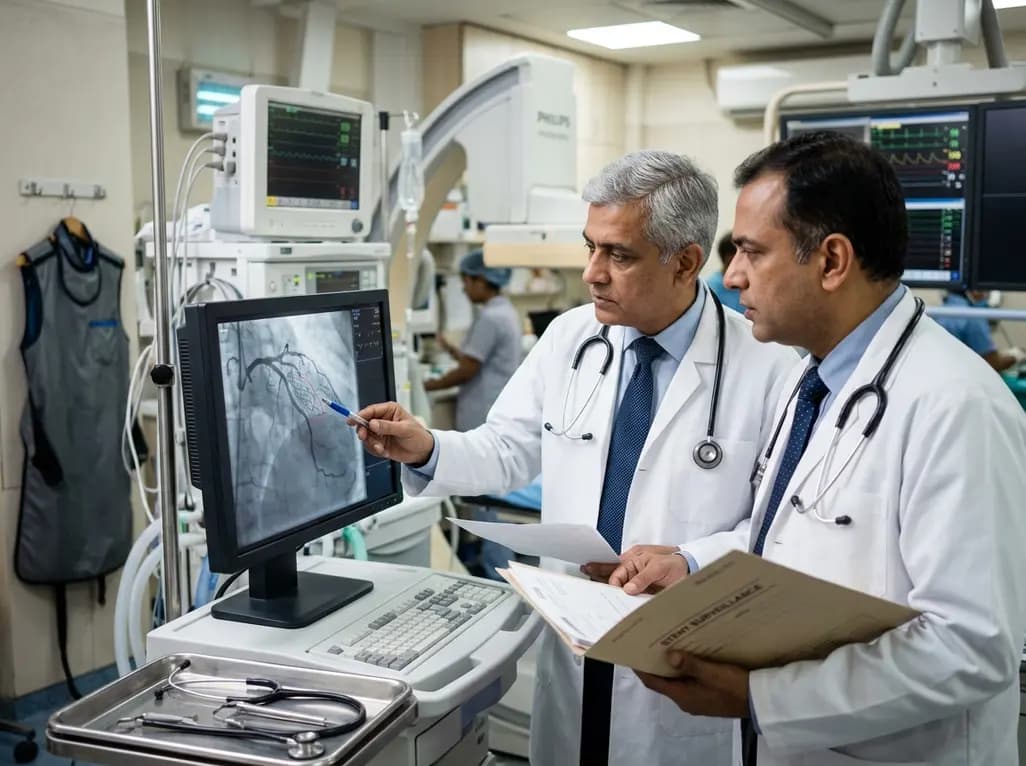
Evaluating coronary stent safety has become an urgent clinical priority following recent regulatory developments in South Asia. The Cabinet Secretariat recently directed the Union Health Ministry to investigate device quality issues after an Indian parliamentarian raised formal concerns. This intervention follows international regulatory actions where overseas authorities withdrew specific drug-eluting stent models due to mechanical failures. Consequently, interventional cardiologists and hospital administrators in India must re-examine device selection protocols. Enhancing vigilance ensures superior patient outcomes across all cardiac catheterisation laboratories.
Indian health authorities are actively reviewing safety parameters for domestic cardiovascular medical devices. Recently, Rajya Sabha member and medical practitioner Dr. Ajeet Madhavrao Gopchade submitted a formal representation regarding three Indian-manufactured drug-eluting stent models. Sri Lanka's National Medicines Regulatory Authority previously withdrew these models after identifying severe mechanical faults. Specifically, the regulatory evaluation committee noted critical issues during deployment in clinical practice. These failures included stent dislodgement, improper vessel positioning, and severe failure to expand uniformly. Moreover, regulators documented instances of acute stent thrombosis linked to these structural defects. Such adverse mechanical failures cause prolonged procedure times and require emergency secondary interventions. In response, the Cabinet Secretariat instructed the Health Ministry to address these vulnerabilities systematically. Indian regulators must now evaluate whether current domestic quality frameworks provide adequate protection against defective devices. In addition, health officials are reviewing foreign market alerts to ensure domestic patients do not face identical procedural risks. Cardiovascular teams across India must remain informed as national audits and manufacturing inspections expand. Furthermore, interventional teams should recognize that international safety alerts serve as critical warning indicators. Therefore, regulatory coordination between global surveillance agencies and Indian authorities remains essential for safeguarding patient health.
Coronary stent failure introduces acute life-threatening emergencies into routine percutaneous coronary interventions. When a stent fails to expand adequately, it disrupts laminar blood flow and damages the vessel endothelium. Consequently, this malapposition significantly accelerates platelet activation and fibrin deposition. Therefore, acute stent thrombosis can develop within minutes of deployment, precipitating extensive myocardial infarction. Additionally, stent dislodgement within tortuous calcified anatomy poses severe procedural dangers. Clinicians must often perform intricate retrieval maneuvers or deploy emergency bail-out stents. These secondary interventions drastically increase procedural times, contrast dye load, and vessel perforation risks. Furthermore, incorrect positioning prevents complete plaque scaffolding, leaving vulnerable coronary segments exposed. As a result, patients experience recurrent ischemia or sudden hemodynamic collapse. Cardiologists must therefore identify patient cohorts exhibiting high-risk anatomic lesions beforehand. In addition, catheterisation laboratories must maintain full emergency preparedness to handle device failures swiftly. Standard operating procedures should dictate immediate mechanical bail-out protocols and intravascular imaging utilization. Ultimately, early recognition of structural device defects minimizes peri-procedural morbidity and protects vulnerable cardiac patients. Moreover, surgical consultation should remain readily available whenever catheter-based device retrieval fails. By understanding the biomechanical root causes of stent failure, interventional teams can mitigate disastrous procedural outcomes and optimize long-term clinical prognosis.
Cardiologists must reinforce procedural rigor to uphold coronary stent safety during every angioplasty. First, clinicians should employ high-resolution intravascular imaging modalities, including intravascular ultrasound and optical coherence tomography. These imaging tools provide precise assessment of vessel dimensions, plaque morphology, and stent strut expansion. Consequently, imaging significantly reduces the incidence of stent under-expansion and edge dissection. Furthermore, interventional cardiologists should verify medical necessity prior to deploying any cardiovascular implant. Physicians must strictly document indications, ensuring alternative pharmacological or surgical revascularization strategies receive fair evaluation. When deploying devices, operators must adhere strictly to recommended balloon inflation pressures and nominal diameter limits. In addition, cath lab teams should avoid aggressive post-dilation when device structural integrity appears compromised. If an operator encounters abnormal resistance or asymmetric expansion, they must abort deployment immediately. Meanwhile, hospital quality committees must maintain stringent standards for procuring cardiovascular hardware. Clinicians must actively participate in hospital selection boards to evaluate clinical performance data rather than cost alone. Thus, integrating objective imaging with evidence-based decision-making establishes a reliable safeguard against substandard devices. Therefore, structured cath lab protocols help clinical teams identify manufacturing inconsistencies before device release into coronary circulation, ensuring uncompromising procedural standards.
Comprehensive device traceability represents a cornerstone of modern post-market surveillance. Regulatory authorities must enforce strict serial-number and batch tracking for all implantable cardiovascular devices. Consequently, every hospital inventory system must record the exact batch details within patient electronic health records. This meticulous documentation ensures immediate patient identification whenever manufacturers or regulatory bodies announce safety recalls. Furthermore, interventional centers must actively report adverse medical device events to the Materiovigilance Programme of India. Currently, under-reporting limits the ability of regulators to identify clustering device failures across different centers. Therefore, hospital administrators must simplify institutional adverse event reporting workflows for bedside clinicians. In addition, hospitals should establish dedicated multidisciplinary surveillance committees to review recurring device irregularities. When foreign health agencies issue safety alerts, Indian regulatory bodies must execute swift parallel investigations. Such proactive surveillance prevents hazardous inventory lots from circulating unnoticed within private and public hospitals. Thus, establishing an integrated digital tracking framework protects patient safety and promotes industrial accountability throughout the medical supply chain. Moreover, routine hospital audits should evaluate batch retention logs to identify expired or compromised lots. Consequently, real-time monitoring transforms passive device monitoring into a proactive, preventative clinical safety defense.
Long-term clinical vigilance remains vital for patients receiving drug-eluting coronary stents. Following hospital discharge, clinicians must schedule systematic clinical follow-up intervals at thirty days, six months, and annually. In addition, physicians must monitor patient adherence to dual antiplatelet therapy rigorously. Abrupt antiplatelet discontinuation markedly elevates the risk of late and very late stent thrombosis. Furthermore, clinicians must educate patients on subtle warning symptoms, such as atypical chest discomfort, exertional dyspnea, and reduced exercise tolerance. If patients present with recurrent angina, physicians should initiate prompt non-invasive ischemic evaluations or repeat coronary angiography. Meanwhile, interventional departments should maintain long-term patient registries to track five-year clinical endpoints, including target lesion revascularization and cardiac mortality. Such comprehensive registries generate invaluable real-world data regarding specific stent platforms and domestic manufacturing durability. Therefore, structured follow-up bridges the gap between acute procedural success and sustained vascular healing. By maintaining rigorous surveillance, cardiologists detect late mechanical failure, neoatherosclerosis, or chronic polymer hypersensitivity early. Ultimately, proactive follow-up safeguards long-term cardiovascular health and reinforces clinical confidence in interventional therapies. Additionally, general practitioners and cardiologists must coordinate closely during every follow-up visit. Consequently, timely communication prevents misdiagnoses and ensures prompt therapeutic adjustments for symptomatic patients.
Q1: Why did regulatory authorities withdraw specific drug-eluting coronary stent models?
Regulatory authorities initiated device withdrawals after clinical investigations revealed significant mechanical and procedural defects. The flagged stent models demonstrated severe deployment failures, including improper vessel positioning, stent dislodgement, failure to achieve uniform expansion, and acute stent thrombosis. Consequently, these structural defects endangered patient safety, prolonged interventional procedures, and necessitated costly secondary bail-out interventions, prompting immediate international recalls.
Q2: How can interventional cardiologists minimize risks associated with stent failure?
Interventional cardiologists can reduce procedural risks by routinely utilizing high-resolution intravascular imaging, such as intravascular ultrasound or optical coherence tomography, to guide stent sizing and deployment. Furthermore, clinicians must confirm clinical indications thoroughly, avoid exceeding manufacturer pressure thresholds, and maintain immediate access to mechanical retrieval equipment. Active participation in adverse event reporting programs also helps identify problematic device batches swiftly.
Q3: What actions should healthcare institutions take when medical device safety alerts occur?
Healthcare facilities must immediately cross-reference national and international recall alerts against local inventory management and batch tracking systems. When matching device lots appear, hospital administrators must quarantine affected inventory immediately to prevent further clinical use. Additionally, clinical teams should review procedural records to identify previously treated patients, schedule focused clinical assessments, and submit prompt reports to regulatory authorities.
Disclaimer: This content is for informational and educational purposes only. It does not constitute medical advice or replace professional judgment. Refer to the latest local and national guidelines for clinical practice.
References

Read summarized clinical updates, watch expert medical content, and earn CME certifications right from your smartphone.
Open your smartphone camera to scan and install.





India's health ministry has been tasked with investigating coronary stent safety following international regulatory recalls. Explore the clinical implications of stent failure, required post-market surveillance protocols, and actionable vigilance strategies for cardiologists and healthcare facilities across India.
Today

A 34-year-old postpartum woman suffered a pheochromocytoma crisis resulting in cardiac arrest and respiratory failure. Intensivists successfully deployed veno-arteriovenous ECMO to stabilize refractory arrhythmias and differential hypoxemia, bridging her safely to complete tumor resection and full clinical recovery.
Today

A Mayo Clinic study reveals that applying lower extremity elastic bandages in acute decompensated heart failure significantly improves diuretic efficiency by 340 mL per 40-mg furosemide equivalent. This mechanical therapy reduces required diuretic doses while safely maintaining necessary overall daily fluid clearance.
Today

Staphylococcus aureus undergoes significant in-patient microevolution during bone and joint infections. Genetic mutations alter biofilm formation, growth kinetics, and intracellular persistence in osteoblasts, driving unpredictable clinical relapses and complicating orthopedic management.
Today

Calcimimetic therapy for primary hyperparathyroidism can induce profound tumor fibrosis, necrosis, and reduced vascularity. These changes alter ultrasound and 4D-CT imaging and cause dense recurrent laryngeal nerve adhesions, requiring heightened surgical vigilance during definitive parathyroidectomy.
Today
