.webp&w=384&q=75)

Loading, please wait...
Loading, please wait...
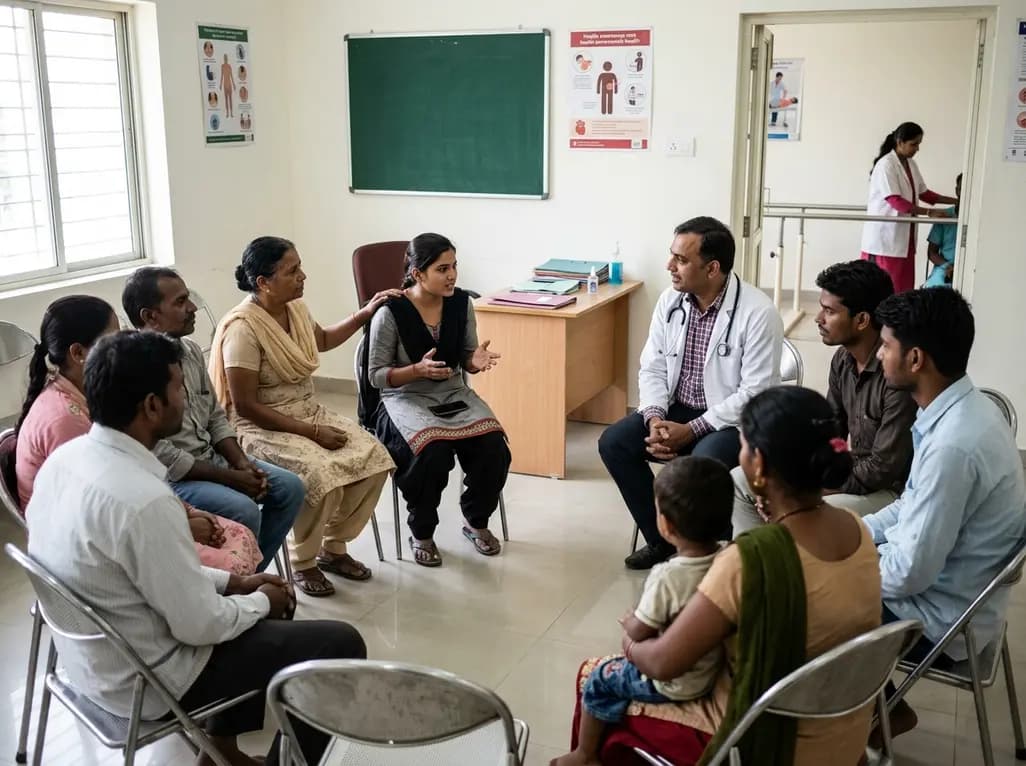
Forcibly displaced populations often endure severe trauma, yet group psychotherapy for refugees offers a robust pathway to recovery by addressing social isolation. Recent research highlights how targeted group interventions can effectively rebuild social resources among war and torture survivors. By examining Syrian refugees in Jordan, the study illustrates that healing extends far beyond individual symptom relief. These programs foster deep community and family-level connections that are vital for long-term integration.
The intervention utilized a 10-week program that combined group psychotherapy with group physiotherapy. This interdisciplinary approach targeted the complex needs of individuals who have faced torture and exile. Researchers identified a distinct two-stage process of change. Initially, participants experienced intrapersonal shifts. These changes included enhanced motivation, improved social skills, and a renewed readiness to form social bonds. Consequently, as their internal capacity grew, they transitioned to the second stage: actively expanding their social networks. Participants established new friendships within the group and reported significantly strengthened relationships within their own families.
Several underlying mechanisms drive these social gains. Group settings provide a safe space for sharing stories, which researchers found to be a core relational process that eases psychological pain. Furthermore, the combination of physical and mental therapy addresses the somatic aspects of trauma, facilitating a more holistic recovery. Therefore, refugees are better equipped to navigate the challenges of life in exile. These findings suggest that mental health outcomes should not only be measured by individual symptom reduction but also by the restoration of social and community resources.
For clinicians working with displaced populations, integrating social resource cultivation into intervention design is critical. Strengthening family and social connections serves as a protective factor against the long-term effects of trauma. Moreover, the study emphasizes that group-based models are uniquely suited to address the relational losses inherent in forced migration. By focusing on both individual readiness and collective connection, healthcare providers can help survivors rebuild the social fabric that war often destroys.
Social resources refer to the interpersonal networks, family bonds, and individual social skills that help displaced persons navigate adversity and maintain psychological well-being. Strengthening these resources is a key goal of group psychotherapy for refugees.
Trauma often manifests physically, especially in survivors of torture. Group physiotherapy addresses somatic pain and body awareness. This improves a participant's comfort and confidence in social settings, thereby complementing the psychological work done in group therapy.
The two-stage process suggests that refugees must first rebuild their internal readiness for social interaction before they can effectively expand their external networks. Recognizing this progression allows clinicians to tailor interventions to the appropriate stage of a patient's social recovery.
Disclaimer: This content is for informational and educational purposes only. It does not constitute medical advice or a professional recommendation. Always consult with a qualified healthcare professional regarding any medical condition or treatment. Refer to the latest local and national guidelines for clinical practice.
References
Bunn M et al. Leveraging the power of groups for forced migrant populations impacted by war and torture: Strengthening family and social resources among Syrian refugees in Jordan. Psychol Trauma. 2026 Jun 08. doi: 10.1037/tra0002209. PMID: 42258284.
World Health Organization. Refugee and migrant mental health. [Accessed June 2026].
UNHCR. Mental Health and Psychosocial Support (MHPSS) for refugees and other persons of concern. [Accessed June 2026].

Read summarized clinical updates, watch expert medical content, and earn CME certifications right from your smartphone.
Open your smartphone camera to scan and install.





A study on Syrian refugees shows that group psychotherapy and physiotherapy improve social resources by strengthening family ties and creating new connectio...
4 months ago

Novel diimide and hydrazone scaffolds, particularly compound #C4, synergistically reactivate latent HIV-1 when combined with JQ1 or PKC activators. Demonstrating donor-matched proviral transcription ex vivo and non-canonical signaling, these findings advance shock and kill strategies toward reservoir eradication.
Today

A cross-sectional study reveals that maternal RSV vaccination coverage reached only 43.7% in Argentina, with maternal vaccine knowledge being the sole independent predictor of uptake. Clinicians play a crucial role in eliminating informational and structural barriers to optimize infant health.
Today

Review how tailored exercise programs benefit frail older patients with heart failure. Explore pathophysiological mechanisms, individualized training prescriptions, and strategies to overcome adherence barriers in clinical practice.
Yesterday

This comparative study evaluates posterior labral tears with and without glenohumeral instability, highlighting distinct demographic patterns, MRI underestimation in stable shoulders, and successful arthroscopic repair outcomes.
Yesterday

A clinical study demonstrates that early intervention with tocilizumab, either as monotherapy or bridged with corticosteroids, achieves significant proptosis reduction and resolves active inflammation in treatment-naive thyroid eye disease.
Yesterday
