

Loading, please wait...
Loading, please wait...
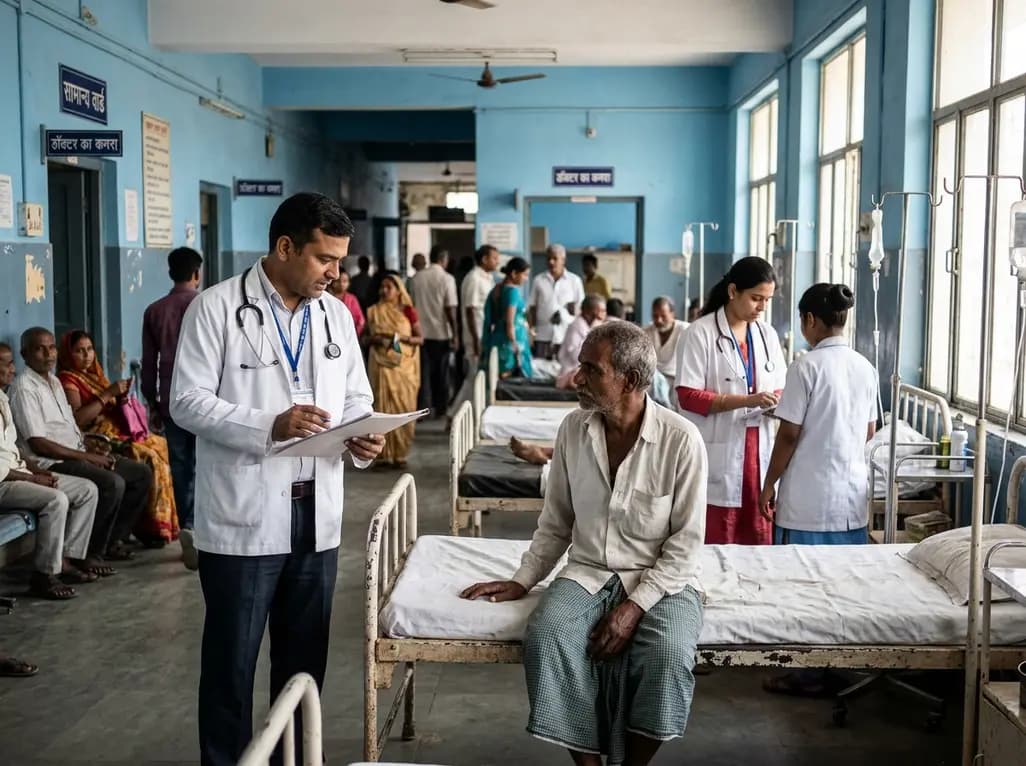
The National Health Accounts estimates for 2023-24 demonstrate significant progress alongside persistent challenges across India. At the national level, government health expenditure reached 4.1 lakh crore rupees, translating into 2,959 rupees per citizen. Furthermore, public financing accounted for 43.5 percent of total health spending and 1.43 percent of gross domestic product. However, broad national averages obscure deeply entrenched regional funding disparities. While public health spending expanded considerably across several territories, populous northern regions continue to face severe budgetary limitations. Consequently, clinicians and public health planners must navigate uneven resource landscapes. Understanding these budgetary disparities is critical for evaluating grassroots delivery systems and patient outcomes.
Public health financing shows remarkable geographic divergence across the country. Across Bihar, Uttar Pradesh, Madhya Pradesh, and Jharkhand, government health expenditure averages approximately 1,651 rupees per person. In contrast, northeastern states recorded a population-weighted regional average of 3,501 rupees per individual. Moreover, the seven Union Territories covered in the report achieved an impressive average allocation of 7,209 rupees per person. Therefore, citizens residing in these populous northern states receive less than half the public healthcare funding seen across the Northeast. Similarly, their allocation represents less than one-fourth of the budgetary support provided to residents in Union Territories. Consequently, healthcare delivery networks in densely populated states experience persistent operational strain. Medical officers frequently manage heavier caseloads with constrained infrastructural resources. In addition, peripheral healthcare centers routinely face supply shortages, diagnostic limitations, and staff deficits. These regional funding discrepancies highlight deep systemic imbalances that directly hinder nationwide equity in clinical service delivery.
The fiscal gap becomes especially glaring when examining individual state budgets across India. Specifically, government health spending in Bihar stood at only 1,126 rupees per person during 2023-24, representing the lowest allocation nationwide. Similarly, Uttar Pradesh registered a modest per capita spending figure of 1,399 rupees. Conversely, Sikkim recorded a remarkable 16,026 rupees per citizen, establishing the highest expenditure rate among all Indian states. Chandigarh led the Union Territories with an extraordinary per capita allocation of 24,187 rupees. Furthermore, spending across other northeastern jurisdictions remained relatively strong despite noticeable intrastate variation. Mizoram allocated 9,320 rupees per person, while Arunachal Pradesh dedicated 8,885 rupees per capita. In addition, Meghalaya reported 7,533 rupees, followed by Manipur at 5,507 rupees and Nagaland at 4,585 rupees. However, Assam allocated only 2,282 rupees per citizen, while Tripura spent 3,360 rupees. Ultimately, these figures show that smaller populations often receive substantially higher per capita state spending.
Southern states demonstrated a stable financing pattern that closely aligns with the national average. Specifically, the population-weighted average government health spending across the southern region reached 2,960 rupees per person. This figure almost perfectly mirrors the national benchmark of 2,959 rupees per citizen. However, significant variations emerge when examining individual state budgets across the southern peninsula. Kerala and Andhra Pradesh surpassed the regional average by spending 3,396 rupees and 3,347 rupees per capita, respectively. Additionally, Telangana maintained robust public funding at 3,125 rupees per citizen. In contrast, Tamil Nadu recorded 2,860 rupees, while Karnataka allocated 2,446 rupees per individual. Furthermore, Union Territories outside the northern belt sustained substantial public health financing commitments. Puducherry dedicated 11,165 rupees per person, while Lakshadweep reported 9,643 rupees. Similarly, Andaman and Nicobar Islands registered 8,947 rupees, and Delhi recorded 8,611 rupees per citizen. Meanwhile, Jammu and Kashmir reported 3,339 rupees, whereas Dadra and Nagar Haveli and Daman and Diu spent 2,293 rupees. Accordingly, these regional benchmarks reflect distinct historical investments and revenue generation capacities.
Several interrelated macroeconomic, demographic, and geographical factors drive these pronounced expenditure differences. First, state fiscal capacity and tax revenue generation dictate budgetary flexibility for social welfare sectors. Economically disadvantaged states face stringent revenue constraints that limit discretionary public health spending. Furthermore, massive population denominators in northern states significantly dilute overall public investment when calculated on a per capita basis. Health policy specialist Dr Chandrakant Lahariya noted that economically weaker, populous states face severe resource constraints despite urgent healthcare requirements. In contrast, northeastern states incur higher service delivery costs due to rugged terrain and dispersed rural communities. Capital investment, facility construction, and supply chain logistics remain exceptionally expensive in remote mountainous regions. Therefore, public health clinics and medical staffing require elevated baseline expenditures regardless of patient numbers. Dr Lahariya emphasized that fixed costs stay high even when service users are limited. Consequently, closing these financing gaps requires systemic fiscal transfers from central authorities.
These pronounced funding variations across states exert direct effects on clinical environments and patient health outcomes. In states with lower per capita spending, government hospitals and primary health centers struggle with severe resource deficits. Consequently, medical officers in these regions manage overwhelming patient volumes alongside chronic shortages of reagents and essential pharmaceuticals. Furthermore, inadequate public financing often compels impoverished families to incur catastrophic out-of-pocket expenses at private clinics. This financial strain frequently leads to treatment delays, poor compliance, and preventable complications among vulnerable chronic disease patients. Conversely, higher state health allocations facilitate modern clinical technology procurement, consistent medicine supplies, and resilient referral systems. However, experts caution that per capita spending alone does not automatically guarantee superior clinical care quality or universal accessibility. Healthcare administrators must evaluate service delivery efficiency, clinical outcomes, and regional disease patterns. Ultimately, medical professionals advocate for equitable funding formulas to ensure clinical facilities nationwide maintain adequate care standards.
Q1: What are the primary findings regarding government health expenditure in the latest report?
The National Health Accounts estimates for 2023-24 indicate that government health expenditure reached 4.1 lakh crore rupees nationwide, averaging 2,959 rupees per citizen. However, the data highlights severe regional disparities. Poorer northern states averaged only 1,651 rupees per person, with Bihar recording 1,126 rupees. In sharp contrast, Sikkim led all states at 16,026 rupees, while Chandigarh topped Union Territories at 24,187 rupees per capita.
Q2: Why do northeastern states demonstrate significantly higher per capita healthcare spending?
Northeastern states face unique geographical and demographic challenges that drive up public health delivery costs. Mountainous terrain, dispersed populations, and transport logistics demand elevated capital investments for medical facilities. Fixed costs for hospital infrastructure, equipment maintenance, and clinical staffing remain high regardless of low patient density. Additionally, smaller population denominators amplify per capita expenditure figures, resulting in a higher regional average of 3,501 rupees per person.
Q3: How do state-level healthcare expenditure disparities directly affect clinical practice?
State-level expenditure directly determines clinical staffing levels, hospital bed availability, diagnostic equipment, and pharmaceutical supply chains in public medical institutions. In lower-spending states, physicians face heavy caseloads, facility shortages, and drug stockouts, which increases out-of-pocket costs for patients. In contrast, higher spending equips clinicians with advanced diagnostics, subsidized medicines, and robust referral networks, facilitating timely interventions and better management of acute and chronic diseases.
Disclaimer: This content is for informational and educational purposes only. It does not constitute medical advice or replace professional judgment. Refer to the latest local and national guidelines for clinical practice.
References

Read summarized clinical updates, watch expert medical content, and earn CME certifications right from your smartphone.
Open your smartphone camera to scan and install.





National Health Accounts 2023-24 reveals deep regional disparities in India's public health financing. While per capita spending reached Rs 16,026 in Sikkim and Rs 24,187 in Chandigarh, populous states like Bihar recorded just Rs 1,126, directly affecting clinical resource allocation and primary infrastructure.
Today

A Bayesian component network meta-analysis of 130 RCTs reveals that self-monitoring and gamification provide the clearest positive effects in mHealth physical activity interventions, while social comparison may have adverse psychological trade-offs.
Today

The GESS-AEEM consensus establishes a clear clinical implementation framework for testosterone therapy in postmenopausal women with hypoactive sexual desire disorder, focusing on transdermal dosing, precise laboratory monitoring, and safety communication.
Today

A multicenter observational study evaluated an 8-week digital health monitoring platform using wearable sensors in ambulatory heart failure. While participants achieved high daily wear-time of 11.7 hours and 80% completion, initial recruitment revealed significant technology-related onboarding barriers.
Today

A paired cadaveric study compared triple and quintuple percutaneous Achilles tendon lengthening. While quintuple hemisection showed numerically greater elongation, differences were not statistically significant.
Yesterday

A clinical decision-support framework using health checkup data from 231,683 adults predicts incident obesity with high discrimination (AUROC 0.918). The system integrates temporal survival analysis and risk-factor explanations to prioritize individualized preventive interventions.
Today
