.webp&w=384&q=75)

Loading, please wait...
Loading, please wait...

Efficiently managing the GMO testing workflow is a critical challenge and a necessity for modern labs. Because current frameworks require complex stepwise processes, researchers must optimize every stage to maintain efficiency. However, samples with low genetically modified (GM) content often test positive during initial screening but fail during quantification. Therefore, laboratories frequently waste time and analytical resources on unquantifiable samples. Specifically, they need better predictive tools to guide these decisions. Consequently, this study developed a new statistical framework to predict success before starting the labor-intensive quantification phase.
Researchers recently developed a robust statistical framework to address these laboratory inefficiencies. Moreover, the study utilized the difference between quantification cycle (Cq) values observed from various screening elements. These elements included the cauliflower mosaic virus 35S promoter (P35S) and the nopaline synthase terminator (T-nos). By analyzing these ΔCq values, the framework accurately predicts successful GM soybean quantification. Furthermore, the team successfully verified this approach using both spiked samples and real-world specimens. Accordingly, this method offers a data-driven way to optimize operations without compromising on safety standards. Also, it ensures that laboratory resources are allocated to samples that meet the threshold for reliable measurement.
Additionally, the regulatory landscape for genetically modified organisms in India is currently changing. For example, the Rajasthan High Court recently directed the Food Safety and Standards Authority of India (FSSAI) to establish comprehensive safety standards. Because this ruling emphasizes that safety must precede market access, then labs must adapt by adopting optimized protocols. Accordingly, these analytical tools are essential for verifying the GM status of imported soybean oil. Also, they protect consumers and ensure high quality in the domestic food supply. Finally, such advancements ensure that all imports meet stringent regulatory thresholds and legal requirements.
Optimizing laboratory protocols is not just about cost-cutting; it is about ensuring the integrity of our food systems. By using statistical models to guide the testing process, labs can provide faster and more accurate results. This advancement supports regulatory compliance and enhances the safety of processed foods available to consumers. Consequently, both regulators and manufacturers benefit from these improved diagnostic workflows.
The quantification cycle (Cq) value represents the point at which the PCR signal crosses a specific threshold. Lower values typically indicate a higher concentration of the target DNA in the sample, while higher values indicate trace amounts.
Low GM content in highly processed products can make DNA extraction challenging. Often, the screening phase detects trace amounts that are below the limit of quantification (LOQ), leading to wasted resources if a full analysis is attempted.
It provides a statistical proof of concept to decide whether to proceed with quantification based on initial screening results. This is especially useful as FSSAI works toward stricter enforcement of GM labeling and safety laws in India.
Disclaimer: This content is for informational and educational purposes only. It does not constitute medical or regulatory advice. Always consult with certified laboratory experts and refer to the latest local and national guidelines for clinical practice.
References
La Rocca D et al. Can GM soybean be reliably quantified after screening? A risk-based approach for optimizing GMO testing workflow. GM Crops Food. 2026 Dec 31. doi: 10.1080/21645698.2026.2653897. PMID: 41936134.
Business Standard. Rajasthan High Court halts FSSAI approval for GM food sale and imports. Oct 2025.
Food Safety and Standards Authority of India (FSSAI). Draft Food Safety and Standards (Genetically Modified Foods) Regulations, 2022.
"
Read summarized clinical updates, watch expert medical content, and earn CME certifications right from your smartphone.
Open your smartphone camera to scan and install.





Researchers developed a statistical framework using ΔCq values to optimize GMO soybean quantification, reducing costs and resource waste in testing laborato...
6 months ago

Recent epidemiological data reveals a dramatic surge in summer heat mortality driven by human-induced climate warming. This analysis explores the pathophysiological impacts on cardiac and renal systems, diagnostic dilemmas in death certification, and essential emergency cooling protocols for acute clinical care.
Today
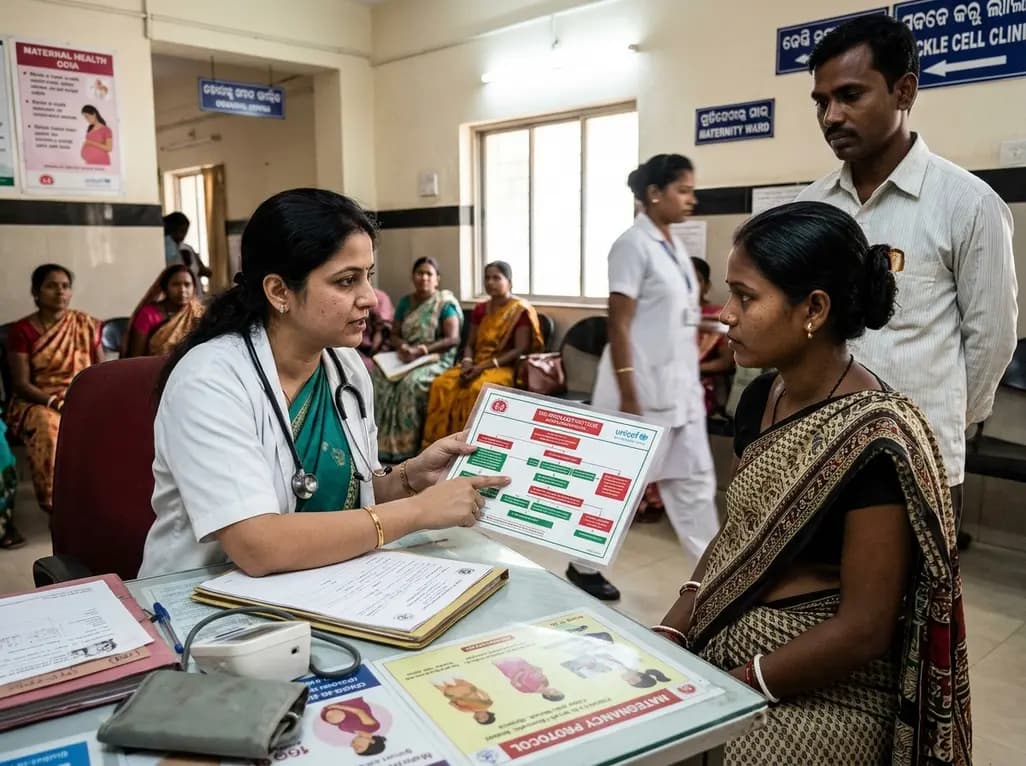
Odisha has established India's first state-level clinical protocol specifically tailored for pregnant women with sickle cell disease. Developed with NHM and UNICEF, the framework provides structured antenatal screening, crisis mitigation, standardized referral pathways, and specialized interdisciplinary care.
Today

India is advancing preventive healthcare by integrating genomics, artificial intelligence, and quantum technologies. With the SANGAM programme sequencing one million Indian genomes, clinicians can unlock personalized therapies, detect cardiometabolic risks early, and curb the burden of diabetes and heart disease.
Today

A randomized controlled trial demonstrates that an eight-week dual-task training intervention significantly improves static and dynamic postural control over standard balance exercises in individuals with chronic ankle instability, addressing critical neurocognitive deficits during athletic and daily activities.
Today

A retrospective cohort study of 7,716 ICU patients from the MIMIC-IV database demonstrates that Gradient Boosting Decision Trees significantly outperform traditional SOFA scores in predicting in-hospital mortality among patients with sepsis and diabetes, with SHAP analysis providing clinical interpretability.
Today
