

Loading, please wait...
Loading, please wait...

Active middle ear implants provide significant rehabilitation for patients with conductive or sensorineural hearing impairment. Successful outcomes with the Vibrant Soundbridge system depend heavily on achieving optimal floating mass transducer coupling. Therefore, surgeons utilize electrophysiological recordings to confirm FMT coupling efficacy before completing the procedure. However, the recent discontinuation of the standard clinical processor has created an urgent need to validate modern replacement devices.
The Vibrant Soundbridge active middle ear implant restores hearing by delivering mechanical vibrations directly to the ossicles or round window. Consequently, functional performance depends on the mechanical interface established during surgery. If the floating mass transducer lacks stable contact with target structures, energy transfer degrades substantially. Patients subsequently experience reduced functional gain and poor speech comprehension. To prevent revision surgeries, otologists perform intraoperative auditory brainstem response recordings to quantify transmission quality in real time. During surgery, the team delivers calibrated acoustic stimuli through a sound processor coupled to the patient's internal receiver. By evaluating evoked neural thresholds, clinicians immediately verify whether surgical coupling provides sufficient acoustic energy transmission. Furthermore, these objective measurements allow surgeons to adjust transducer placement before wound closure. Historically, surgeons relied on the AP 404 processor for this verification protocol. Because manufacturers discontinued this hardware, clinical teams must adopt validated successor devices to ensure reliable intraoperative guidance during implantation.
Because clinicians can no longer obtain the AP 404 processor, researchers evaluated modern alternatives to maintain intraoperative monitoring standards. Specifically, investigators tested two commercial successor devices, the SAMBA 2 Hi and SAMBA 2 Lo, alongside an experimental research tool named AcoustiAP. They compared the electroacoustic transmission properties of all three devices against the AP 404 baseline. To simulate realistic acoustic conditions, the team coupled each device to a two-cubic-centimeter coupler within an Aurical HIT test box. Furthermore, they programmed both SAMBA processors using the DSLv5 prescription targeting a threshold of 25 dB HL. The team presented standardized CE-Chirp stimuli at intensities of 0, 30, and 65 dB nHL to represent baseline noise, soft speech, and typical speech. In addition, researchers recorded an input-output function from 0 to 100 dB nHL for the AcoustiAP. Finally, they calculated high-frequency averages according to DIN EN 60118-7 guidelines. This laboratory setup allowed investigators to analyze noise floors, linearity, and compression ranges under identical parameters.
The technical evaluation demonstrated substantial differences in intrinsic background noise and electroacoustic output levels among the devices. Notably, the SAMBA 2 Lo exhibited the lowest intrinsic high-frequency average noise floor at 12.0 dB SPL. In contrast, the legacy AP 404 produced an intrinsic noise floor of 22.5 dB SPL, whereas AcoustiAP and SAMBA 2 Hi demonstrated noise levels of 25.7 dB SPL and 26.0 dB SPL, respectively. When researchers tested stimulus presentation at 30 dB nHL, the commercial processors generated remarkably consistent output levels. Specifically, the AP 404, SAMBA 2 Hi, and SAMBA 2 Lo produced output levels clustering tightly between 46.5 and 47.0 dB SPL. However, the AcoustiAP tool failed to emerge from its intrinsic noise floor at this level. Consequently, the AcoustiAP signal remained embedded in noise until presentation levels reached approximately 35 dB nHL. Moreover, AcoustiAP saturated prematurely at a maximum level of 70.1 dB SPL. These electroacoustic findings demonstrate that processor architecture profoundly alters stimulus fidelity during evoked response testing.
When evaluating sound processors for intraoperative neurophysiological monitoring, output linearity represents the most crucial electroacoustic requirement for clinical accuracy. In this investigation, the SAMBA 2 Hi demonstrated the most linear input-output response curve across all tested stimulation intensities. Therefore, it reproduces acoustic chirps without unpredictable amplitude distortions, enabling reliable identification of true auditory brainstem response thresholds. Furthermore, SAMBA 2 Hi closely mirrored the transfer function of the original AP 404 device. In contrast, the SAMBA 2 Lo exhibited pronounced dynamic range compression during acoustic testing. Because this compression attenuates higher input intensities, it narrows the output dynamic range during surgery. Nevertheless, SAMBA 2 Lo provides a distinctly lower noise floor and reduced overall acoustic output. Consequently, otologists might utilize SAMBA 2 Lo in patients with milder hearing loss to prevent acoustic overstimulation. However, for universal intraoperative monitoring protocols, the linear transmission and stable output of the SAMBA 2 Hi establish it as the optimal replacement for the retired AP 404.
These empirical findings provide actionable guidance for otolaryngologists and clinical audiologists operating active middle ear implant programs. Surgical teams must recognize that research tools like AcoustiAP currently lack the dynamic performance required for uncorrected intraoperative threshold evaluations. Because AcoustiAP suffers from elevated baseline noise and premature saturation, clinicians cannot obtain reliable auditory thresholds without complex mathematical adjustments. Conversely, integrating the SAMBA 2 Hi into the operating room allows surgical teams to preserve standardized neurophysiological monitoring protocols seamlessly. Clinicians can continue utilizing established threshold interpretation criteria without recalibrating their baseline clinical expectations. In addition, future research should explore personalized processor programming during surgery. Since SAMBA 2 Lo features lower output energy and reduced noise, surgical teams could conceivably tailor intraoperative stimulus parameters to the patient's individual audiogram. Ultimately, validating SAMBA 2 Hi protects patient safety by ensuring accurate real-time assessment of transducer placement. By securing reliable electrophysiological feedback, otologists optimize long-term acoustic coupling and ensure superior hearing outcomes.
Intraoperative monitoring verifies the mechanical coupling quality between the floating mass transducer and middle ear structures before surgical wound closure. Because improper placement drastically impairs energy transfer to the cochlea, real-time auditory brainstem responses allow surgeons to detect suboptimal coupling immediately. Consequently, surgical teams can adjust transducer seating or clip tension during the primary procedure, successfully avoiding poor hearing outcomes and unnecessary revision surgeries.
The SAMBA 2 Hi exhibits exceptional input-output linearity across clinical stimulus intensities, closely mirroring the acoustic performance of the discontinued AP 404 processor. Although it has a slightly higher noise floor than the SAMBA 2 Lo, it avoids aggressive dynamic compression. Therefore, it delivers predictable acoustic chirps without premature signal distortion, enabling clinical audiologists to record robust, reliable evoked auditory thresholds during surgery.
Current evidence indicates that clinicians should not use the AcoustiAP tool for routine threshold measurements without mathematical correction algorithms. Because the system embeds acoustic stimuli within its internal noise floor up to 35 dB nHL, it fails to record low-level responses. Furthermore, the AcoustiAP saturates prematurely at 70.1 dB SPL, which severely restricts the available dynamic range required for accurate intraoperative assessments.
Disclaimer: This content is for informational and educational purposes only. It is not intended to provide medical advice, diagnosis, or treatment. Always consult a qualified healthcare professional regarding any medical condition. Never disregard professional medical advice or delay seeking it because of something you have read here. In emergency situations, seek immediate medical care from hospital emergency services. Medical knowledge and clinical guidelines are continually evolving; while we endeavor to provide accurate information, we cannot guarantee the completeness or timeliness of all content. Refer to the latest local and national guidelines for clinical practice.
References

Read summarized clinical updates, watch expert medical content, and earn CME certifications right from your smartphone.
Open your smartphone camera to scan and install.





A recent comparative study evaluates sound processors for intraoperative ABR monitoring of floating mass transducer coupling in Vibrant Soundbridge surgery, identifying SAMBA 2 Hi as the optimal linear successor to the discontinued AP 404, while highlighting critical limitations of the AcoustiAP system.
Today
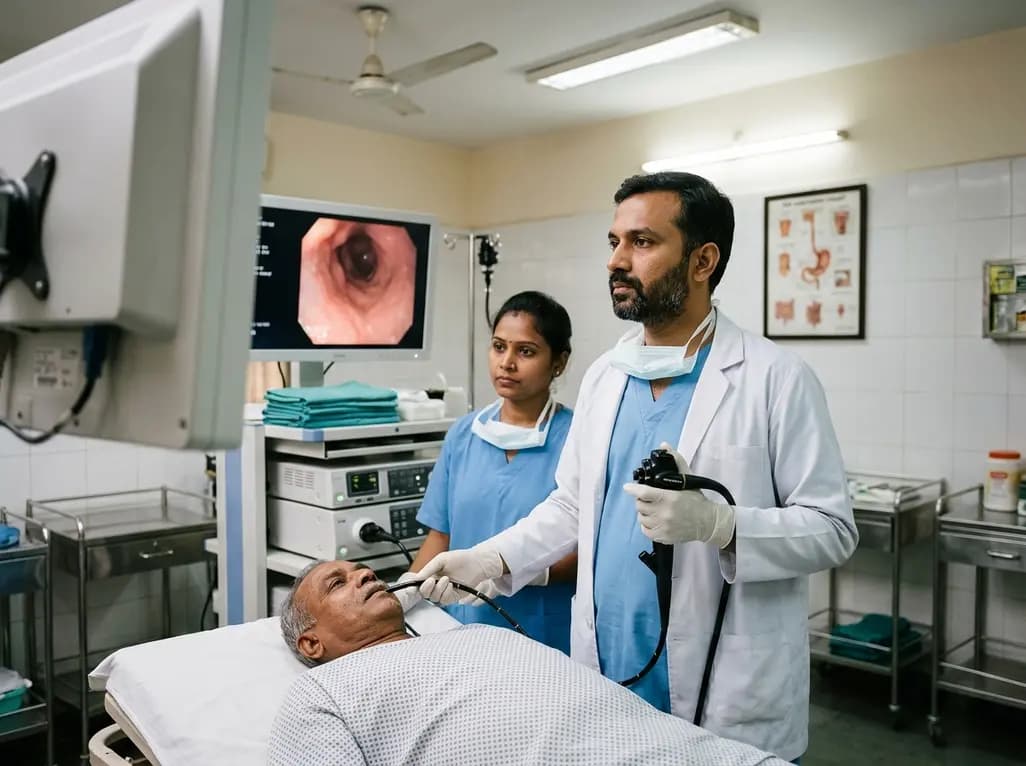
A large cohort study evaluating 1,245 patients demonstrates that unsedated gastroscopy is safe, feasible, and achieves high completion rates, offering an efficient alternative to sedated procedures.
Today

An intracranial EWSR1::CREM fusion sarcoma in a 31-year-old female manifested as a paraneoplastic inflammatory syndrome with anemia and secondary infertility. The dural mass mimicked meningioma, but gross-total resection resolved her systemic inflammation and restored natural fertility within one month.
Today

The DOMINO study protocol presents a multidisciplinary implementation mapping approach to overcome provider, patient, and payer barriers to antiobesity medications, offering vital insights for Indian clinicians managing the growing diabesity burden.
Today

An age-matched cross-sectional study reveals that lower muscle quality and impaired lower-extremity function strongly correlate with an increased fear of falling in older women, highlighting the necessity of targeted resistance training and balance interventions in geriatric care.
Today

Near-infrared autofluorescence provides real-time label-free optical guidance during endoscopic transsphenoidal pituitary surgery. By highlighting stark signal contrasts between normal pituitary gland and adenomas, this technique aids gross-total tumor resection while safeguarding critical endocrine function.
Today
