

Loading, please wait...
Loading, please wait...

Major depressive disorder presents complex pathophysiological challenges, among which repetitive negative thinking remains especially difficult to treat. Clinicians frequently encounter brooding, a maladaptive subtype of rumination where patients passively dwell on dysphoric feelings and abstract self-blame. Investigating advanced neuromodulatory tools such as real-time fMRI neurofeedback in depression offers a transformative window into these stubborn cognitive loops. By tracking time-varying neural synchrony, researchers can now observe and modify the precise functional circuits that sustain depressive rumination.
Brooding represents a core cognitive vulnerability in major depressive disorder. Clinicians recognize that patients who brood frequently exhibit extended depressive episodes and higher relapse rates. Unlike reflective pondering, which fosters active problem-solving, brooding locks patients into rigid self-referential loops. Historically, investigators linked this cognitive pattern to static hyperactivity within the default mode network. However, static neuroimaging fails to capture how quickly depressive thinking fluctuates across minutes.
Recent investigations demonstrate that cognitive states depend on dynamic functional network connectivity. During unconstrained thought, the brain rapidly transitions between diverse configurations. Patients with severe depression, however, often show restricted flexibility between these transient functional states. Specifically, executive control networks struggle to suppress internalizing thoughts generated by default mode regions. Consequently, negative self-evaluations remain uncorrected. Furthermore, aberrant salience processing amplifies distressing thoughts, making them feel acutely urgent and unmanageable. Understanding these dynamic transitions allows psychiatrists to conceptualize rumination not as a fixed lesion, but as a dynamic imbalance. Therefore, tracking temporal network transitions provides vital insight into depressive vulnerability.
To quantify how functional architecture changes during rumination, researchers analyze dynamic functional network connectivity across time. Standard resting-state functional MRI typically averages blood-oxygen-level-dependent signals over several minutes. In contrast, dynamic functional network connectivity uses sliding-window techniques to identify recurrent, transient whole-brain connectivity patterns.
In a recent clinical trial, neuroimaging scientists evaluated thirty-six individuals with major depressive disorder alongside twenty-six healthy control participants. The team recorded functional connectivity while participants engaged in resting conditions and guided brooding tasks. Notably, the mathematical clustering revealed four distinct, recurrent brain states across the entire study cohort. Overall time spent in these four states did not differ significantly between depressed patients and healthy controls during baseline measurements. However, deeper analysis revealed that the duration spent in one specific configuration, designated state 3, correlated inversely with brooding severity. Depressed individuals with severe brooding spent significantly less time visiting this particular state during ruminative prompts. Therefore, this finding indicates that brooding severity relates directly to temporal deficits in specific functional networks rather than generalized connectivity failure.
Researchers identified state 3 as an integrated, anti-brooding network configuration with unique clinical relevance. Unlike states dominated by isolated default mode activity, state 3 features dense, widespread functional connections across multiple distributed systems. Specifically, it coordinates default mode nodes, salience hubs such as the anterior cingulate cortex, and central executive parietal regions. Furthermore, this state integrates sensory, somatomotor, and visual processing networks into a unified communicative matrix.
Clinicians can view this dense cross-network coupling as a neurobiological buffer against repetitive negative thinking. When sensory and attentional networks engage collaboratively with cognitive control areas, the mind maintains contact with external reality. Consequently, the brain resists turning inward toward self-referential dysphoria. In patients with severe depression, this protective integration appears suppressed during emotional distress. As a result, the individual remains trapped in repetitive, distressing internal dialogues without sensory interruption. Moreover, the strong negative correlation between brooding scores and time spent in state 3 suggests that bolstering this configuration could yield therapeutic benefits. Thus, mapping this anti-brooding state provides a concrete neuroimaging biomarker for targeted psychiatric interventions.
Real-time fMRI neurofeedback represents a cutting-edge closed-loop neuromodulation technology. During training, participants receive instantaneous feedback regarding localized blood-oxygenation levels, enabling them to self-regulate targeted brain regions. In the trial, participants with major depression underwent either active neurofeedback training or a sham control intervention.
The therapeutic results proved remarkably selective. Depressed individuals assigned to active neurofeedback showed a statistically significant increase in the duration spent in the anti-brooding state 3 during post-intervention resting scans. In contrast, participants in the sham control arm and healthy volunteers demonstrated no such connectivity shifts. Furthermore, this dynamic enhancement occurred even without ongoing neurofeedback cues during the resting scan. Therefore, the neurofeedback protocol successfully induced neuroplastic stabilization of an adaptive, whole-brain functional state. Clinicians find this outcome compelling because closed-loop training directly engaged and reorganized the distributed architecture underlying depressive brooding. Additionally, active neurofeedback enabled patients to regain cognitive flexibility, allowing their neural systems to revisit adaptive mental states more frequently. Consequently, real-time fMRI neurofeedback in depression demonstrates substantial potential as a mechanistic intervention for treatment-resistant rumination.
Translating these dynamic connectivity findings into everyday clinical practice presents exciting opportunities for neuropsychiatry. In clinical settings across India, psychiatrists frequently encounter patients whose depressive episodes resist standard pharmacotherapy due to intractable brooding. Repetitive dysphoric thought often derails conventional cognitive behavioral therapy, as patients struggle to disengage from rumination during standard sessions.
Although real-time functional neurofeedback currently requires specialized tertiary neuroimaging infrastructure, identifying objective dynamic network targets accelerates neurotechnology translation. For example, clinicians may soon utilize scalp electroencephalography or functional near-infrared spectroscopy neurofeedback protocols calibrated against these functional magnetic resonance imaging targets. Additionally, non-invasive neuromodulation techniques such as repetitive transcranial magnetic stimulation could target key nodes within this anti-brooding network to replicate these connectivity patterns. In the meantime, clinical practitioners can integrate mindfulness-based interventions and structured behavioral activation, which similarly recruit somatosensory and attentional networks to disrupt negative internal loops. Furthermore, monitoring dynamic network targets will enhance clinical trial designs by providing objective surrogate endpoints. Ultimately, combining neuromodulatory innovations with conventional psychiatric care could substantially improve long-term outcomes for patients experiencing debilitating depression.
Clinicians managing major depressive disorder should recognize that cognitive symptoms like brooding have distinct, dynamic neurobiological signatures. Acknowledging that rumination reflects impaired dynamic brain transitions rather than characterological weakness helps reduce patient self-stigma. Furthermore, clinicians can explain these network dynamics to patients to foster engagement with cognitive therapies.
Nevertheless, several study limitations warrant careful clinical interpretation. The reported investigation evaluated a relatively modest sample size, and researchers did not assess active brooding conditions following the neurofeedback sessions. Therefore, larger randomized clinical trials must confirm whether spending increased time in state 3 directly translates into durable reductions in depressive symptoms and lower relapse rates over extended follow-up periods. Additionally, future investigations should determine the optimal number of neurofeedback sessions required to maintain long-lasting neuroplastic changes. In conclusion, dynamic functional connectivity provides an objective window into the pathophysiology of depressive rumination. By demonstrating that targeted neurofeedback can restore adaptive network configurations, this research marks an important step toward personalized circuit-based psychiatry.
Brooding is a maladaptive subtype of depressive rumination where individuals passively and repetitively dwell on dysphoric symptoms, abstract self-blame, and perceived shortcomings. Unlike reflective problem-solving, brooding impairs executive cognitive control, prolongs depressive episodes, and significantly elevates the risk of illness recurrence and suicide in affected patients.
Static functional MRI calculates average functional connectivity across an entire scan duration, potentially masking rapid cognitive transitions. In contrast, dynamic functional network connectivity captures time-varying fluctuations in neural communication across seconds, identifying transient whole-brain connectivity states that correspond directly to fluctuating mental processes like ruminative thoughts and emotional distress.
Real-time neurofeedback allows patients to learn voluntary self-regulation of targeted neural circuits. Recent clinical evidence demonstrates that active neurofeedback significantly increases the time patients spend in a protective, anti-brooding dynamic brain state, offering a promising non-pharmacological strategy for relieving persistent ruminative symptoms in treatment-resistant depression.
Disclaimer: This content is for informational and educational purposes only and does not constitute medical advice, diagnosis, or treatment. Healthcare professionals should exercise their independent clinical judgment when interpreting or applying this information. Clinical decisions must always be tailored to individual patient needs and compliant with institutional protocols, regulatory frameworks, and standard-of-care practices. Refer to the latest local and national guidelines for clinical practice.
References

Read summarized clinical updates, watch expert medical content, and earn CME certifications right from your smartphone.
Open your smartphone camera to scan and install.





A clinical neuroimaging study reveals that real-time fMRI neurofeedback enhances a key anti-brooding dynamic brain state in major depressive disorder. By shifting neural connectivity patterns across sensory, attentional, and cognitive networks, this novel strategy offers new promise for managing treatment resistance.
Today

The DOMINO study protocol presents a multidisciplinary implementation mapping approach to overcome provider, patient, and payer barriers to antiobesity medications, offering vital insights for Indian clinicians managing the growing diabesity burden.
Today

An intracranial EWSR1::CREM fusion sarcoma in a 31-year-old female manifested as a paraneoplastic inflammatory syndrome with anemia and secondary infertility. The dural mass mimicked meningioma, but gross-total resection resolved her systemic inflammation and restored natural fertility within one month.
Today

A real-world cohort study of 6,537 patients from the FOUNTAIN platform demonstrates that initiating finerenone significantly reduces albuminuria by 40.7% with minimal eGFR decline and manageable hyperkalemia risk, confirming its practical effectiveness and safety in diabetic kidney disease.
Yesterday

A comprehensive analysis of MAP therapy resistance in osteosarcoma, examining canonical and non-canonical mechanisms across damage avoidance, enhanced DNA repair, and replication stress tolerance to identify novel vulnerabilities.
Today
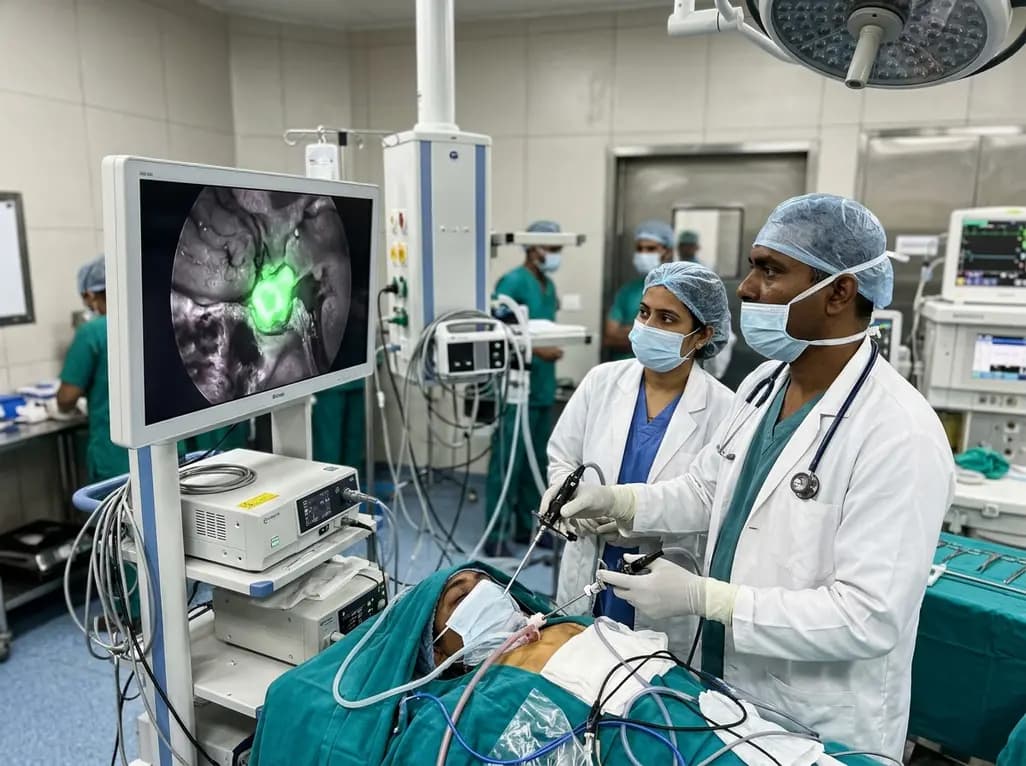
Near-infrared autofluorescence provides real-time label-free optical guidance during endoscopic transsphenoidal pituitary surgery. By highlighting stark signal contrasts between normal pituitary gland and adenomas, this technique aids gross-total tumor resection while safeguarding critical endocrine function.
Today
