.webp&w=384&q=75)

Loading, please wait...
Loading, please wait...
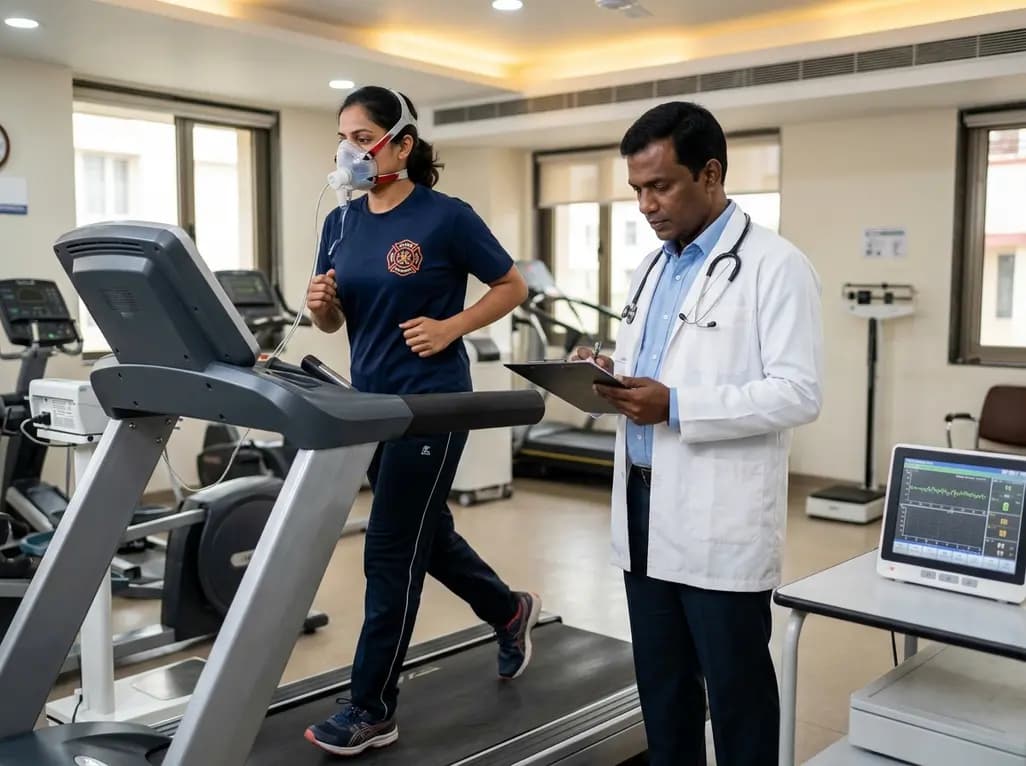
Firefighting remains one of the most physically taxing professions worldwide. While sex-neutral physiological requirements exist, achieving female firefighter physical fitness benchmarks presents unique challenges. A recent scoping review conducted in the UK highlights that despite women making up approximately 9% of the workforce, systematic data regarding their role-specific physiology remains scarce. The review identified that hose running imposes the highest cardiorespiratory load, requiring a mean aerobic capacity of 44.0 ml·kg-1·min-1.
Furthermore, researchers found that the average maximal aerobic capacity for female firefighters is approximately 44.4 ml·kg-1·min-1. However, if we assume a normal distribution, nearly 35% of the female firefighter population might fail to meet the mandatory minimum threshold of 42.3 ml·kg-1·min-1. Consequently, these individuals may struggle with high-intensity operational tasks, as demonstrated by simulation performances that averaged 7.4 seconds slower than required passing standards.
Current occupational policies often rely on data extrapolated from male cohorts. This lack of representative evidence creates a significant gap in our understanding of injury risks and fitness maintenance for women. For instance, there is currently no published research regarding fitness interventions or injury surveillance specifically tailored to female firefighters in the UK. Addressing these gaps is essential for developing inclusive training protocols that ensure both safety and operational efficiency.
Moreover, clinicians must recognize that female-specific physiological considerations, such as musculoskeletal health and thermoregulation, play a vital role in occupational performance. Future research should prioritize expanding the evidence base to inform policies that support the recruitment and retention of female personnel. This approach will help bridge the performance gap while minimizing the risk of overexertion and injury on the fireground.
VO2 max measures the maximum oxygen consumption during intense exercise. It is a key predictor of a firefighter's ability to perform strenuous tasks like casualty evacuation and hose running without premature fatigue.
Barriers include a lack of gender-specific training programs, physiological differences in upper body strength, and the potential for ill-fitting personal protective equipment (PPE) that may hinder movement and increase injury risk.
Departments can implement targeted strength and conditioning programs that focus on common demanding tasks while ensuring that fitness standards are supported by data specific to female physiological responses.
Disclaimer: This content is for informational and educational purposes only. It does not constitute medical advice or a professional opinion. Readers should consult with qualified healthcare professionals regarding specific occupational health concerns. Refer to the latest local and national guidelines for clinical practice.
References
Hart W et al. Scoping review of UK female-firefighters, physical fitness and occupational performance. Occup Med (Lond). 2026 Jun 09. doi: undefined. PMID: 42262765.
Siddall AG et al. Physical and Physiological Performance Determinants of a Firefighting Simulation Test. J Occup Environ Med. 2018;60(7):e337-e343.
Hollerbach BS et al. Current Female Firefighters' Perceptions, Attitudes, and Experiences with Injury. New Solut. 2017;27(3):307-324.

Read summarized clinical updates, watch expert medical content, and earn CME certifications right from your smartphone.
Open your smartphone camera to scan and install.





A scoping review highlights the physiological demands and fitness thresholds for female firefighters, emphasizing the need for representative occupational d...
4 months ago

Novel diimide and hydrazone scaffolds, particularly compound #C4, synergistically reactivate latent HIV-1 when combined with JQ1 or PKC activators. Demonstrating donor-matched proviral transcription ex vivo and non-canonical signaling, these findings advance shock and kill strategies toward reservoir eradication.
Today

A cross-sectional study reveals that maternal RSV vaccination coverage reached only 43.7% in Argentina, with maternal vaccine knowledge being the sole independent predictor of uptake. Clinicians play a crucial role in eliminating informational and structural barriers to optimize infant health.
Today

Review how tailored exercise programs benefit frail older patients with heart failure. Explore pathophysiological mechanisms, individualized training prescriptions, and strategies to overcome adherence barriers in clinical practice.
Yesterday

This comparative study evaluates posterior labral tears with and without glenohumeral instability, highlighting distinct demographic patterns, MRI underestimation in stable shoulders, and successful arthroscopic repair outcomes.
Yesterday

A clinical study demonstrates that early intervention with tocilizumab, either as monotherapy or bridged with corticosteroids, achieves significant proptosis reduction and resolves active inflammation in treatment-naive thyroid eye disease.
Yesterday
