.webp&w=384&q=75)

Loading, please wait...
Loading, please wait...

Timely liberation from invasive life support remains one of the most demanding tasks in critical care management. Clinicians recognize that mechanical ventilation weaning requires precise timing to prevent severe clinical complications. If extubation occurs prematurely, patients risk immediate respiratory failure, emergency reintubation, hemodynamic instability, and heightened mortality. Conversely, unwarranted delays in liberation expose patients to ventilator-associated pneumonia, barotrauma, progressive muscle atrophy, and prolonged hospitalization. Traditional weaning parameters, such as the rapid shallow breathing index, provide basic physiological snapshots but often fail to capture dynamic multi-organ recovery trajectories. Consequently, intensivists frequently struggle with ambiguous clinical presentations during spontaneous breathing trials. Modern intensive care units collect massive volumes of continuous physiological telemetry and laboratory data. Harnessing this information through advanced artificial intelligence models can revolutionize bedside weaning protocols. However, developing robust machine learning algorithms requires vast, diverse datasets from multiple healthcare centers. Because conventional predictive models rely heavily on single-center observations, they frequently lack generalizability when clinicians apply them across different patient populations. Thus, establishing scalable and collaborative predictive architectures represents a critical priority for optimizing ventilator liberation worldwide.
Developing predictive models across multiple healthcare systems historically required pooling raw patient records into a single centralized repository. While centralized learning allows algorithms to identify complex cross-institutional patterns, stringent data governance policies, patient privacy regulations, and competitive institutional barriers severely restrict direct data sharing. Conversely, local learning models protect patient confidentiality by analyzing records exclusively within a single institution. Unfortunately, single-site models often suffer from small sample sizes and fail when applied to external patient cohorts. Cross-silo federated learning offers an innovative solution to this fundamental clinical challenge. In a federated framework, participating intensive care units train machine learning models locally on their own secure servers. Instead of transmitting sensitive patient data, institutions share only model parameters, such as gradient updates and weights, with a central coordination server. The central coordinator aggregates these mathematical parameters into a unified global model and redistributes the optimized algorithm back to the participating sites. Consequently, this collaborative approach preserves institutional data sovereignty while training robust predictive algorithms on diverse, multi-institutional patient cohorts without compromising patient privacy.
A pivotal retrospective study analyzed 24,521 mechanically ventilated patients across five major intensive care databases to assess model performance rigorously. The investigators evaluated the eICU Collaborative Research Database, MIMIC-IV, Universitätsklinikum Augsburg, HiRID, and Amsterdam University Medical Centers. Researchers harmonized clinical variables using the Observational Medical Outcomes Partnership Common Data Model and deployed extreme gradient boosting algorithms. The investigators defined successful weaning as a sustained reduction in positive end-expiratory pressure. The findings demonstrated distinct clinical trade-offs across the three computational strategies. Centralized learning achieved the highest overall performance on pooled test data, demonstrating an area under the receiver operating characteristic curve of 0.81, an area under the precision-recall curve of 0.57, and an F-score of 0.54. Meanwhile, local models achieved superior site-specific accuracy within their own institutions, with AUROC values ranging from 0.68 to 0.84. In comparison, cross-silo federated learning achieved a macroaveraged AUROC of 0.74, an AUPRC of 0.56, and an F-score of 0.52. These results confirm that federated architectures deliver reliable predictive power across disparate clinical environments while successfully avoiding direct patient data transmission.
Intensive care units exhibit substantial variability in clinical workflows, baseline patient demographics, disease severity, and mechanical ventilator protocols. For example, clinical definitions for spontaneous breathing readiness and positive end-expiratory pressure titration vary considerably between American and European academic medical centers. This underlying clinical heterogeneity directly influenced the performance variations observed across local models in the multi-center study. Local models trained on site-specific practices excelled within their home environments but struggled to generalize across external facilities. Standardizing disparate electronic health record data into common data models, such as OMOP, represents a vital prerequisite for multi-center collaborative artificial intelligence. Nevertheless, semantic harmonization alone cannot eliminate variations in clinician treatment patterns, sedation practices, or institutional staffing models. Cross-silo federated learning mitigates these disparities by exposing the global algorithm to diverse patient trajectories across multiple hospitals. As a result, federated models develop a broader physiological understanding of respiratory failure and recovery. Therefore, critical care networks can leverage federated architectures to bridge institutional silos, reconcile clinical heterogeneity, and deliver standardized predictive support without requiring complex cross-border data transfer agreements.
Integrating artificial intelligence into daily intensive care workflows requires rigorous validation and clear clinical communication. Predictive algorithms should not replace comprehensive clinician judgment; instead, they must serve as intelligent decision support tools that complement standard spontaneous breathing trials. When evaluating mechanical ventilation weaning readiness, intensivists synthesize diverse clinical indicators, including oxygenation indices, respiratory mechanics, hemodynamic stability, neurological arousal, and airway secretions. Machine learning models assist this complex cognitive process by identifying subtle physiological trends hours before overt clinical deterioration occurs. For instance, an algorithmic warning regarding imminent weaning failure prompts intensivists to re-evaluate underlying fluid overload, occult bronchospasm, or respiratory muscle fatigue. Furthermore, bedside deployment demands transparent model interpretability. Clinicians must understand why an algorithm generates a specific risk score to trust its guidance during high-stakes extubation decisions. By combining automated physiological surveillance with clinical bedside expertise, intensive care teams can systematically reduce weaning failures, prevent reintubation trauma, and optimize ICU bed utilization across healthcare institutions.
The successful application of federated learning in critical care marks a transformative step toward globally collaborative healthcare intelligence. Future research must expand federated networks to include diverse healthcare ecosystems, especially low- and middle-income clinical environments where intensive care resources face extreme constraints. Incorporating high-frequency streaming telemetry, continuous waveform analysis, and dynamic laboratory markers will further sharpen model sensitivity. Moreover, researchers should investigate hybrid learning architectures that combine federated global base models with site-specific fine-tuning. This dual strategy allows institutions to benefit from shared multi-center intelligence while tailoring the algorithm to unique local patient demographics and clinical practices. Additionally, prospective clinical trials must evaluate whether real-time algorithmic alerts actively reduce mechanical ventilation duration, ventilator-induced complications, and overall hospital costs. As regulatory standards for healthcare data privacy continue to evolve worldwide, privacy-preserving collaborative frameworks like federated learning will serve as the indispensable foundation for safe, scalable, and equitable medical artificial intelligence in critical care medicine.
Cross-silo federated learning is a decentralized machine learning architecture where distinct healthcare organizations train predictive algorithms locally on their own private servers. Instead of pooling sensitive patient medical records into a centralized database, institutions share only mathematical model updates and weights with a coordination server. This framework enables multi-center collaborative artificial intelligence while strictly preserving data governance, complying with privacy regulations, and keeping confidential patient health information secure behind institutional firewalls.
Local learning models exhibit variable performance because individual intensive care units feature distinct patient demographics, admission criteria, and clinical workflows. Differences in ventilator weaning protocols, sedation practices, and class balance between successful and failed weaning attempts directly impact institutional predictive accuracy. Consequently, while a local model excels within its native environment by memorizing site-specific clinical patterns, it frequently struggles to generalize when applied to external medical centers with diverse populations.
Machine learning models assist intensivists by continuously analyzing complex physiological telemetry, ventilator parameters, and laboratory values to predict weaning success. Rather than replacing bedside clinical judgment, these algorithmic tools complement standard spontaneous breathing trials and clinical indices. By identifying subtle physiological indicators of impending respiratory exhaustion early, predictive models help critical care teams prevent premature extubation, avoid unnecessary reintubations, and safely liberate patients from invasive mechanical ventilation.
Disclaimer: This content is for informational and educational purposes only and should not be considered medical advice or a substitute for professional clinical judgment. Treatment decisions must always be made by a qualified healthcare provider based on individual patient assessment and prevailing clinical circumstances. Refer to the latest local and national guidelines for clinical practice.
References

Read summarized clinical updates, watch expert medical content, and earn CME certifications right from your smartphone.
Open your smartphone camera to scan and install.





A multi-center study of 24,521 ICU patients evaluates cross-silo federated learning against centralized and local models for predicting mechanical ventilation weaning success, demonstrating a viable balance between predictive accuracy and data privacy across intensive care units.
last month

Ceftriaxone therapy can lead to biliary sludge and gallstone formation due to calcium-ceftriaxone precipitation. A recent cohort study shows that the noninvasive Fibrosis-4 (FIB-4) index, alongside treatment duration, independently predicts lithogenesis, enabling proactive risk stratification.
Today

A multiparametric MRI approach combining quantitative T2 shading, apparent diffusion coefficient (ADC) measurements, and morphological signs provides superior diagnostic accuracy over subjective evaluation to differentiate ovarian endometriomas from benign hemorrhagic cysts.
Today
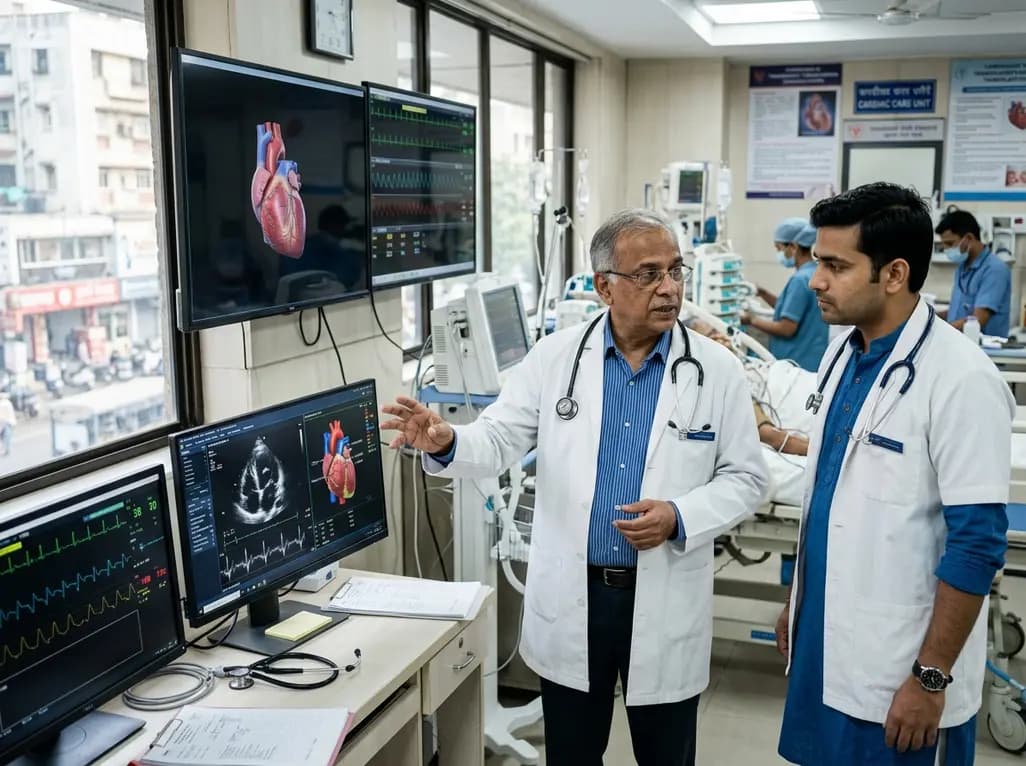
A landmark case report reveals a donor heart beating for a century in a 63-year-old recipient, challenging conventional age limits in cardiac transplantation and offering critical lessons on organ longevity, donor selection, and long-term graft survival.
Today

A propensity-matched analysis reveals that patients undergoing total hip arthroplasty on maintenance dialysis experience significantly higher rates of adverse events, periprosthetic infection, and revision surgery at 90 days, 2 years, and 5 years compared to non-dialysis peers.
Today

New research reveals that M1 macrophage-derived exosomes aggravate diabetic nephropathy by transferring WTAP to stabilize S1PR2 mRNA. Silencing WTAP in these vesicles attenuates endothelial injury and renal fibrosis, pointing toward innovative nanomedicine therapies.
Yesterday
