.webp&w=384&q=75)

Loading, please wait...
Loading, please wait...
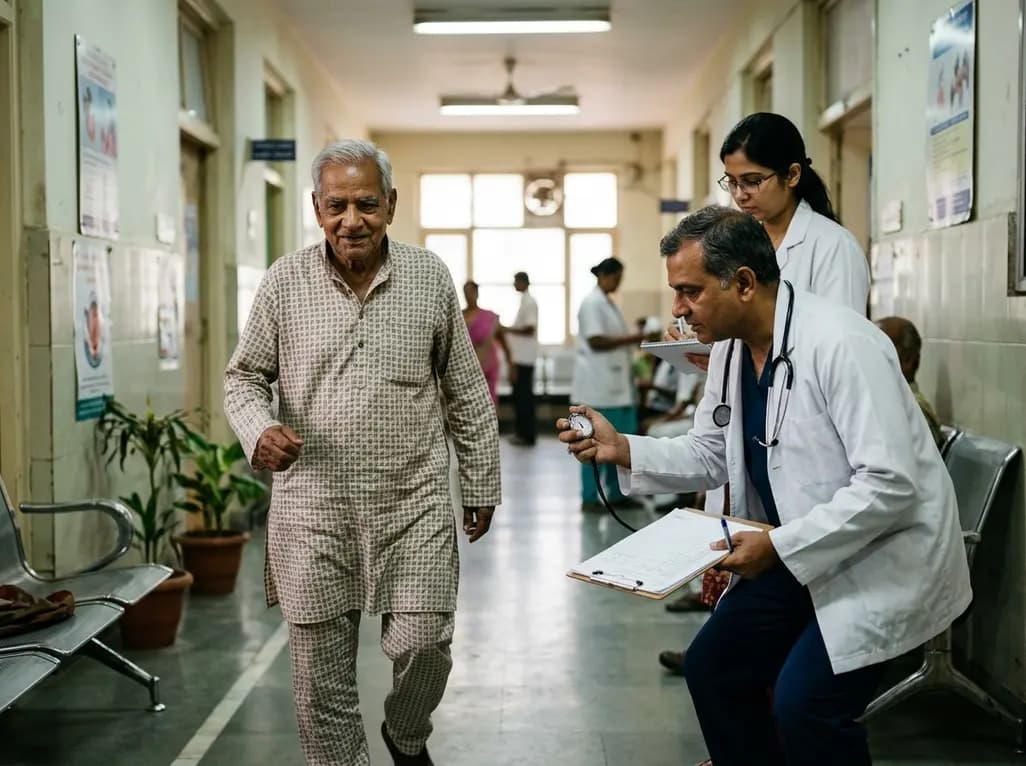
Maintaining physical independence remains a cornerstone of healthy aging across diverse populations. Consequently, clinicians must identify early functional decline before overt disability impairs daily living. Preclinical mobility limitation represents a subtle transitional stage where individuals modify their activity patterns, such as adopting compensatory stair-climbing strategies, without perceiving explicit walking difficulty. Although routine geriatric assessments often measure physical capacity, screening protocols frequently fail to capture these covert neuromuscular impairments. Therefore, implementing sensitive objective biomarkers has become an urgent clinical priority.
Mobility loss does not occur as an abrupt clinical event. Instead, functional reserve deteriorates progressively over years before overt physical disability develops. In this continuum, preclinical mobility limitation designates a crucial phase wherein individuals remain functionally independent but experience covert physiological vulnerability. For instance, middle-aged and older adults frequently modify how they perform demanding physical activities, such as ascending stairs or walking across long corridors. Specifically, they may grip handrails tightly, decrease their cadence, or pause between steps to compensate for underlying musculoskeletal weakness and reduced balance confidence. Because standard activities of daily living often mask these subtle adaptations, traditional clinical evaluations frequently miss early physical decline. Furthermore, untreated mobility limitations inevitably escalate into recurrent falls, diminished autonomy, and institutionalization. Identifying this transitional state enables clinicians to initiate timely lifestyle and physical therapy interventions. However, routine self-reported functional questionnaires often demonstrate poor diagnostic accuracy because patients unconsciously accommodate their limitations. Consequently, healthcare providers require robust, objective functional benchmarks that uncover latent balance and strength deficits during everyday clinical consultations.
Gait speed serves as a recognized vital sign in comprehensive geriatric assessment. Currently, clinical guidelines often recommend both habitual walking speed and fast gait speed to evaluate functional capacity in aging adults. However, comparative evidence regarding which metric offers superior diagnostic discrimination for covert functional decline has remained scarce. Habitual gait speed reflects the self-selected, comfortable walking pace that an individual utilizes during unhurried activities. In contrast, fast gait speed pushes the individual toward their maximum physical envelope. Specifically, maximum walking pace demands heightened recruitment of fast-twitch muscle fibers, rapid sensorimotor integration, and dynamic postural stability. When physiological systems begin to fail, individuals can often maintain a deceptively normal comfortable walking speed by exhausting their functional reserves. Consequently, habitual walking tests may easily overlook mild neuromuscular and cardiovascular impairments. In contrast, demanding a rapid walking pace actively exposes compensatory limitations that comfortable pacing conceals. Therefore, directly comparing habitual and fast walking speeds within clinical cohorts provides invaluable insight into optimal diagnostic strategies for early preventive interventions.
A landmark cross-sectional study evaluated 235 community-dwelling middle-aged and older adults with a mean age of 68 years. The investigators utilized the standardized 4-metre walk test to compare habitual and fast gait speeds directly. In this rigorous trial, researchers classified participants according to their compensatory stair gait strategies to determine the presence of covert mobility limitations. Using multinomial regression models, the investigators observed that reduced walking speeds strongly correlated with increased odds of probable preclinical impairment. Specifically, after adjusting for potential confounders, each interquartile-range reduction in habitual speed produced a 2.6-fold increase in the odds of probable limitation. In comparison, an equivalent reduction in fast gait speed yielded a remarkable 5.8-fold increase in the odds of impairment. Moreover, receiver operating characteristic analysis confirmed that fast walking speed achieved superior discriminative accuracy, demonstrating an area under the curve of 0.80 compared to 0.74 for habitual walking speed. Consequently, these robust findings clearly establish that fast gait testing provides substantially higher diagnostic fidelity when screening community-dwelling older individuals.
Although past literature recognized the value of gait speed, clear empirical thresholds for detecting preclinical impairment remained undefined. Fortunately, this landmark investigation derived precise, empirically grounded cut-points to assist clinical decision-making. Specifically, the study identified an interpretation threshold of 1.24 metres per second for habitual gait speed, with a 95% confidence interval ranging from 1.20 to 1.31 metres per second. Meanwhile, the empirical threshold for fast gait speed stood at 1.67 metres per second, with a confidence interval between 1.61 and 1.78 metres per second. Notably, traditional geriatric cut-points often utilize 1.0 or 0.8 metres per second to diagnose established sarcopenia or overt frailty. However, individuals with early preclinical decline regularly walk much faster than these late-stage thresholds. Therefore, relying solely on traditional frail-oriented cut-offs causes clinicians to miss the critical therapeutic window for early intervention. By adopting these higher, validated thresholds, clinicians can identify vulnerable adults years before overt functional deficits emerge. Consequently, these new interpretation thresholds offer objective benchmarks that transform routine functional physical assessments into truly proactive preventive screenings.
In India, rapid demographic transitions are expanding the proportion of older adults who face substantial risks of functional decline. Furthermore, chronic lifestyle conditions such as type 2 diabetes, sarcopenic obesity, and osteoarthritis often accelerate musculoskeletal deterioration in Indian populations. Unfortunately, busy primary care clinics and public hospitals rarely possess access to complex biomechanical laboratory equipment. Therefore, implementing a simple 4-metre walking corridor represents a practical, low-cost screening modality for resource-constrained clinical settings. Clinicians, nurses, or physiotherapists can easily administer this test using only a stopwatch and standard floor markings. When an individual demonstrates a fast walking speed below 1.67 metres per second, healthcare practitioners should immediately investigate underlying contributors. Specifically, clinicians can evaluate nutritional intake, screen for polypharmacy, and recommend structured progressive resistance training. In addition, integrating targeted balance exercises and protein optimization can reverse early muscular vulnerability before irreversible physical disability occurs. Thus, incorporating fast gait speed screening into routine Indian primary care and wellness visits holds immense potential to preserve independence and alleviate long-term healthcare burdens.
Fast walking demands maximal physiological reserve from neuromuscular, sensory, and cardiorespiratory systems. During habitual walking, individuals frequently compensate for subtle deficits by expending hidden reserves, maintaining an apparently normal pace. However, fast gait testing challenges individuals to reach their functional ceiling, actively exposing musculoskeletal weakness, reduced balance confidence, and motor control deficits. Consequently, fast gait speed reveals latent functional vulnerability far earlier than comfortable, self-selected walking speed.
Clinicians should utilize the newly derived empirical thresholds of 1.24 metres per second for habitual walking speed and 1.67 metres per second for fast walking speed. Notably, traditional frailty thresholds of 0.8 to 1.0 metres per second only identify late-stage disability. Because individuals with early decline easily exceed older frailty benchmarks, applying these higher interpretation thresholds ensures timely detection of subtle functional impairment during routine outpatient consultations.
Practitioners require only a clear 4-metre walkway and a standard digital stopwatch. Clinicians instruct the patient to walk as quickly and safely as possible across the marked distance without running. Timing starts when the patient begins walking and stops when the lead foot crosses the finish line. Dividing four metres by the recorded seconds provides the fast gait speed, offering immediate, objective functional data for clinical evaluation.
Disclaimer: This content is for informational and educational purposes only. It is not intended to provide medical advice or to be a substitute for professional medical assessment, diagnosis, or treatment. Patients should consult a healthcare provider for any health-related concerns. Refer to the latest local and national guidelines for clinical practice.
References

Read summarized clinical updates, watch expert medical content, and earn CME certifications right from your smartphone.
Open your smartphone camera to scan and install.





Recent clinical evidence demonstrates that fast gait speed outperforms habitual walking pace in screening middle-aged and older adults for preclinical mobility limitation. Newly derived empirical thresholds provide actionable diagnostic benchmarks for early geriatric functional assessment and preventive care.
last month

Review how tailored exercise programs benefit frail older patients with heart failure. Explore pathophysiological mechanisms, individualized training prescriptions, and strategies to overcome adherence barriers in clinical practice.
Today

Leucine Rich Bio has introduced South Asia's first comprehensive vaginal microbiome test, BugSpeaks. By profiling microbial dysbiosis, pathogens, and antimicrobial resistance, this next-generation diagnostic platform provides clinicians with deeper insights into recurrent infections, fertility, and reproductive health.
Today

In high-risk pulmonary embolism complicated by severe anemia and active uterine bleeding, systemic thrombolysis is contraindicated. Large-bore aspiration thrombectomy provides rapid hemodynamic rescue without fibrinolysis, supported by inferior vena cava filter placement and multidisciplinary critical care.
Today

This comparative study evaluates posterior labral tears with and without glenohumeral instability, highlighting distinct demographic patterns, MRI underestimation in stable shoulders, and successful arthroscopic repair outcomes.
Today

A clinical study demonstrates that early intervention with tocilizumab, either as monotherapy or bridged with corticosteroids, achieves significant proptosis reduction and resolves active inflammation in treatment-naive thyroid eye disease.
Today
