

Loading, please wait...
Loading, please wait...

Addressing suicidal ideation in physical disability requires an understanding of functional impairment and interpersonal dynamics. Individuals living with motor limitations frequently encounter daily activity restrictions, chronic pain, and significant dependency on caregivers. Consequently, these persistent challenges intensify psychological distress and foster deep feelings of perceived burdensomeness. In many clinical settings, providers prioritize physical rehabilitation while inadvertently overlooking subtle mental health warning signs. However, psychological vulnerability remains markedly high among patients navigating sudden or progressive mobility impairments. Family units often serve as the primary source of emotional solace, economic security, and physical assistance. Therefore, any deterioration within this intimate support structure can severely destabilize an individual's emotional equilibrium. Longitudinal research indicates that interpersonal relationships govern mental well-being far more intensely than physical impairment alone. When household environments turn unsupportive or hostile, patients frequently experience profound alienation and emotional detachment. In addition, persistent domestic conflict accelerates depressive symptoms and heightens vulnerability to self-harm. Primary care clinicians must recognize that physical disability does not exist in an emotional vacuum. By evaluating family dynamics alongside physical functioning, healthcare providers can identify early indicators of distress. Ultimately, supporting domestic cohesion provides a vital safeguard against severe psychiatric crises.
To examine interpersonal patterns over time, researchers analyzed data from the Disability and Life Dynamics Panel between 2018 and 2022. This comprehensive longitudinal study evaluated 3,704 individuals living with physical disabilities across five consecutive years. Investigators tracked family relationship trajectories by classifying participants into four distinct groups. Specifically, these categories included consistently good relationships, relationships improving from poor to good, relationships declining from good to poor, and persistently poor relationships. Furthermore, researchers evaluated suicidal ideation and suicide attempts through self-reported questionnaires. The investigators used a generalized estimating equation model to account for repeated measures and confounding sociodemographic factors. Consequently, the statistical analysis provided robust evidence regarding how evolving family bonds influence suicidal thoughts. Notably, participants whose family relationships deteriorated were 1.63 times more likely to experience suicidal ideation compared to those with stable, positive relationships. In addition, individuals suffering from chronically poor family ties faced a 1.78-fold greater likelihood of suicidal ideation alone. Most significantly, persistent domestic dysfunction increased the odds of combined suicidal ideation and suicide attempts by 2.29-fold. These compelling results confirm that relational decline substantially accelerates psychiatric vulnerability among physically disabled individuals.
Within the multidimensional spectrum of family functioning, family problem-solving ability demonstrated the most potent association with suicidal ideation. When a household's capacity to resolve collective difficulties deteriorated, individual psychological vulnerability increased substantially. Specifically, the data revealed an adjusted odds ratio of 1.34 for suicidal ideation among individuals whose families suffered declining problem-solving capacity. Living with a physical disability introduces complex, daily logistical challenges that demand adaptive problem-solving skills. For instance, families must coordinate accessible transport, manage assistive devices, navigate complicated treatment regimens, and endure economic stress. If family members lack constructive communication strategies, minor household stressors rapidly generate chronic interpersonal friction. In contrast, families that cultivate collaborative conflict-resolution skills protect vulnerable individuals from emotional exhaustion and helplessness. Moreover, persistent domestic hostility reinforces a patient's belief that their physical condition imposes an intolerable burden upon relatives. Consequently, the breakdown of conflict management directly degrades psychological safety. Clinicians must realize that emotional despair does not arise from functional limitations in isolation. Instead, the communicative resilience of the household environment determines whether a patient experiences belonging or severe isolation. Therefore, routine clinical consultations should actively assess household problem-solving abilities.
These striking longitudinal findings carry vital clinical implications for general practitioners, family physicians, and consulting psychiatrists. In typical outpatient practice, medical teams frequently focus on mobility scores, physical rehabilitation, and pharmacotherapy. However, physicians must systematically incorporate social and family assessments into routine patient reviews. Clinicians should screen for domestic discord, caregiver fatigue, and perceived burdensomeness during follow-up visits. Furthermore, healthcare providers must treat sudden deteriorations in family relationships as critical psychiatric risk factors. When relatives express frustration or emotional exhaustion during consultations, medical teams should intervene promptly before interpersonal relationships fracture further. In addition, clinical facilities should offer family-centered counseling to cultivate constructive conflict-resolution skills. Multidisciplinary collaboration between social workers, psychologists, and rehabilitation physicians guarantees comprehensive care for high-risk patients. In countries like India, where families provide the vast majority of daily caregiving, supporting the family unit remains essential. Physicians must facilitate constructive discussions that dismantle internalized guilt and alleviate emotional distress. By monitoring domestic relationships alongside physical recovery, clinicians can prevent psychological crises before suicidal ideation emerges. Proactive intervention ultimately safeguards vulnerable individuals from preventable psychiatric harm.
Addressing suicide risk among individuals with physical limitations also requires comprehensive public health measures to relieve caregiver strain and societal stigma. In many communities, deficient public infrastructure and limited welfare resources force patients into prolonged domestic dependence. Consequently, family members shoulder intensive caregiving tasks without formal training, financial compensation, or emotional respite. Over time, relentless physical exhaustion and financial distress erode marital and intergenerational harmony. Therefore, health systems must implement structured support programs that alleviate chronic caregiver burnout. Providing community-based personal assistance, subsidized physical therapy, and home-based support services can preserve household resilience. Furthermore, mental health professionals must challenge widespread cultural biases that undervalue the lives of persons living with disabilities. When society frames disability as a tragedy rather than a functional variation, individuals internalize severe self-blame. Clinicians can counter this damaging narrative by fostering patient self-advocacy and encouraging participation in peer support groups. Similarly, educating family members about adaptive coping creates an empathetic and supportive home environment. Ultimately, reducing structural inequities diminishes household conflict and protects individuals with physical disabilities from suicidal thoughts.
Individuals with physical disabilities encounter daily functional limitations, chronic pain, and high dependency on caregivers. Consequently, these challenges often induce feelings of perceived burdensomeness and social isolation. When structural barriers and lack of support compound these stressors, psychological distress escalates, significantly increasing vulnerability to suicidal thoughts and despair.
Longitudinal studies demonstrate that deteriorating family relationships amplify emotional distress. When domestic harmony declines from good to poor, the risk of developing suicidal ideation increases by sixty-three percent. Furthermore, chronically dysfunctional family dynamics elevate the risk of suicide attempts, emphasizing that interpersonal stability directly influences psychological outcomes.
Primary care physicians should routinely screen patients with physical disabilities for psychological distress, caregiver strain, and suicidal ideation. Additionally, clinicians ought to evaluate family communication patterns, offer conflict-resolution resources, and connect households with social support services. Multidisciplinary collaboration ensures comprehensive care that addresses both physical impairment and mental health.
Disclaimer: This content is for informational and educational purposes only, and does not constitute medical advice, diagnosis, or treatment. Healthcare professionals should evaluate clinical findings independently and correlate them with comprehensive patient assessments. Refer to the latest local and national guidelines for clinical practice.
References

Read summarized clinical updates, watch expert medical content, and earn CME certifications right from your smartphone.
Open your smartphone camera to scan and install.





A longitudinal panel study reveals that deteriorating family relationship dynamics significantly increase the risk of suicidal ideation and attempts among individuals living with physical disabilities, underscoring the critical need for family-focused psychosocial interventions in routine healthcare.
Today

A new study demonstrates how explainable AI guides transparent fall risk prediction models in older adults. By pairing random survival forests and SHAP with Cox regression, researchers achieved superior accuracy and eliminated unneeded variables, enhancing clinical decision-making and patient safety.
Today

Ascertainment bias in cancer case-control studies inflates odds ratios and penetrance estimates when cases are drawn from high-risk clinics. A landmark modeling study demonstrates substantial bias ranging up to 23.72, highlighting the critical need for ascertainment adjustment in genetic risk counseling.
Today
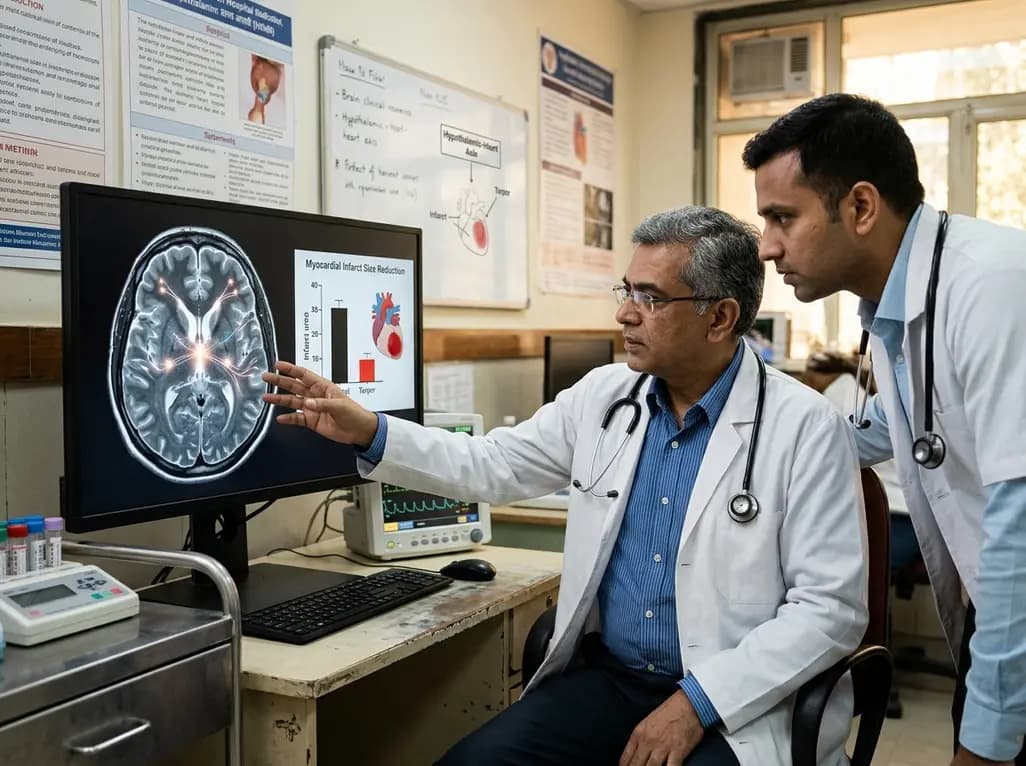
Researchers demonstrate that central induction of synthetic torpor in non-hibernating rats provides striking cardioprotection, reducing myocardial infarct size by ~40% during ischaemia-reperfusion injury through endogenous survival signaling, independent of hypothermia.
Today
A prospective study evaluates DeepSeek for knee osteoarthritis outcomes. While the model excels at baseline diagnosis and clinical scoring, its six-month prognostic predictions fall short of clinicians and simple persistence models, demonstrating high run-to-run variability.
Today

A novel fluorine-functionalized near-infrared copper fluorescent probe selectively illuminates lung tissue, revealing critical links between hyperglycemia, ER stress, and pulmonary malignancy for improved early diagnosis.
Today
