.webp&w=384&q=75)

Loading, please wait...
Loading, please wait...

Repetitive manual material handling presents major ergonomic hazards across expanding courier and e-commerce distribution networks. Daily transport of heavy parcels with manual delivery trolleys significantly heightens the risk of acute strains and chronic work-related musculoskeletal disorders. Clinical practitioners frequently evaluate delivery personnel presenting with persistent lumbosacral pain, cervical tightness, and upper extremity tendinopathies. Consequently, understanding how equipment design and handling methods alter spinal loading and muscle exertion remains clinically crucial. A rigorous investigative study recently quantified the exact biomechanical demands associated with everyday parcel transport.
Delivery personnel constantly encounter diverse terrain, heavy payloads, and demanding transit schedules during last-mile logistics. In this context, manual delivery trolleys serve as vital tools, yet they frequently generate excessive mechanical stresses. Researchers examined twenty-three professional male courier workers under controlled experimental conditions to analyze how different equipment influences physical exertion. The investigators tested three common industrial configurations: a traditional hand truck, a flat platform hand cart, and a rolltainer. Furthermore, the team assessed muscle activation through surface electromyography, tracking postural angles using advanced video motion analysis. Additionally, investigators estimated spinal loads using the three-dimensional static strength prediction program. The objective measurements revealed profound differences in physiological strain across handling modes. Specifically, pulling actions consistently produced higher neuromuscular demand across the upper limbs than pushing maneuvers. Workers displayed noticeably greater flexion of the forearm and neck while pulling loads backwards. Conversely, pushing actions produced higher anterior trunk flexion. Therefore, handling orientation directly dictates which anatomical regions absorb the primary mechanical stresses during parcel delivery.
Equipment architecture markedly alters the biomechanical forces transmitted to the operator's axial skeleton during routine manual transit. Among the three evaluated options, the four-wheeled flat hand cart produced the highest overall muscle activation and the greatest spinal loading. Specifically, pulling a hand cart generated peak lumbar compression forces and substantial shear stress at the L5-S1 junction. This dangerous elevation occurs because pulling requires asymmetric trunk rotation and sustained upper limb tension while maneuvering. In contrast, the two-wheeled hand truck imposed the lowest overall biomechanical demands across nearly all measured parameters. Hand trucks feature optimized lever mechanics, allowing workers to counterbalance payloads with minimal spinal torque. Meanwhile, rolltainers produced intermediate loading profiles, though their tall frames created visual obstruction and awkward wrist angles during sharp turns. Consequently, equipment geometry directly dictates compressive lumbar forces. When workers pull unstable or low-profile carts, the lumbar spine absorbs excessive shear forces that accelerate intervertebral disc degeneration. Therefore, clinicians must emphasize that equipment choice plays a pivotal role in preventing chronic low back injuries.
Handling direction significantly modifies human locomotion and subjective physical discomfort during package delivery operations. During experimental testing, transit velocity ranged between 0.66 and 1.15 meters per second across different conditions. Forward pushing along straight trajectories consistently achieved the fastest movement speeds while maintaining optimal walking biomechanics. In contrast, backward pulling and navigating curved paths noticeably slowed transit velocity. Curved trajectories require continuous lateral adjustments, which amplify asymmetric joint loading and increase metabolic energy expenditure. Furthermore, subjective discomfort scoring revealed distinct anatomical vulnerabilities among courier personnel. Participants reported the most intense subjective discomfort within their arms and forearms, followed closely by the lumbar spine. Surprisingly, the shoulder girdle exhibited the least subjective discomfort during testing. The pronounced distal upper extremity discomfort reflects sustained grip exertion and repetitive forearm flexion required to steer heavy trolleys. Moreover, the simultaneous lumbar discomfort highlights how dynamic shear forces degrade postural stability. Thus, navigating curves while pulling carts represents the most physiologically taxing handling scenario.
Occupational physicians and primary care doctors routinely treat couriers suffering from cumulative trauma disorders and mechanical spine pain. Because courier delivery volumes continue to escalate globally, clinical preventative strategies must address the root biomechanical causes of injury. Clinicians should specifically counsel patients regarding the severe hazards of pulling loaded carts. Pushing allows couriers to utilize their body weight and large lower-extremity muscle groups effectively. In contrast, pulling isolates smaller upper-limb muscles and places the spine under hazardous rotational shear. Furthermore, clinicians can recommend two-wheeled hand trucks over flat platform hand carts for moderate parcel weights. Hand trucks substantially diminish spinal compression and lessen muscular recruitment during standard transport cycles. Additionally, healthcare providers should advocate for structured rest intervals, forearm stretching, and lumbo-pelvic core stabilization exercises. Educating logistics companies about ergonomic trolley designs and safe directional handling will substantially mitigate occupational absenteeism. Therefore, clinical assessments must integrate precise occupational history to tailor individualized rehabilitation and return-to-work protocols.
Modern supply chain management must prioritize ergonomic engineering alongside delivery speed and logistical throughput. Logistics operators frequently provide standardized equipment without considering human biomechanics, directly contributing to high employee turnover and disability claims. Implementing adjustable handle heights on delivery trolleys ensures workers maintain neutral wrist and elbow postures regardless of individual stature. Furthermore, equipping carts with premium low-resistance swivel casters significantly decreases initial breakaway force and rolling friction. Reduced rolling friction directly translates to lower lumbar compressive forces during directional changes. Additionally, logistics managers should reorganize delivery routes to prioritize straight pathways and minimize difficult curved maneuvering in tight architectural corridors. Training programs should systematically teach couriers to push rather than pull whenever operating environments permit. When workers must manage heavy bulk parcels, introducing powered electric-assist trolleys provides an outstanding administrative and engineering control. Consequently, combining advanced trolley design with structured ergonomic training creates a sustainable workplace environment that protects long-term musculoskeletal wellness.
Pulling a delivery trolley significantly increases neuromuscular strain across the upper limbs, neck, and lower back. When workers pull, they must exert substantial grip and forearm tension while rotating the torso, generating hazardous asymmetric shear forces across lumbar vertebrae. Conversely, pushing enables workers to utilize their overall body mass and powerful lower-limb musculature, maintaining a neutral spinal alignment and minimizing compressive loads on the axial skeleton.
According to objective biomechanical evaluations, two-wheeled hand trucks offer superior ergonomic advantages over flat hand carts and tall rolltainers during moderate parcel handling. Hand trucks utilize favorable lever mechanics that allow couriers to balance loads efficiently, resulting in the lowest lumbar compression and minimal muscle activation. In contrast, flat hand carts produce the highest spinal shear and neuromuscular fatigue, especially during backward pulling tasks.
Courier workers can substantially reduce spinal injury risks by consistently pushing rather than pulling manual delivery equipment whenever possible. Workers should select two-wheeled hand trucks for moderate loads, maintain upright postures, and avoid sudden twisting movements around tight corners. Additionally, utilizing trolleys with well-maintained, low-friction wheels and participating in core-strengthening exercises helps workers withstand repetitive physical demands throughout demanding delivery shifts.
Disclaimer: This content is for informational and educational purposes only... Refer to the latest local and national guidelines for clinical practice.
References

Read summarized clinical updates, watch expert medical content, and earn CME certifications right from your smartphone.
Open your smartphone camera to scan and install.





A biomechanical study evaluates how manual delivery trolleys influence spinal loading, muscle activation, and discomfort in courier workers, highlighting ergonomic prevention strategies for work-related musculoskeletal disorders.
Today
Defining an inflammatory myopathies flare remains a critical challenge. This review examines trial-based IMACS and PRINTO criteria versus real-world observational markers, highlights organ-specific discordance in muscle, skin, and lung, and presents a treatment-anchored framework for clinical practice.
Today

A cross-sectional study of 700 college students highlights significant contraceptive knowledge disparities between sexually active and inactive young adults. The findings demonstrate a critical need for proactive, comprehensive sexual health counseling before sexual debut.
Yesterday
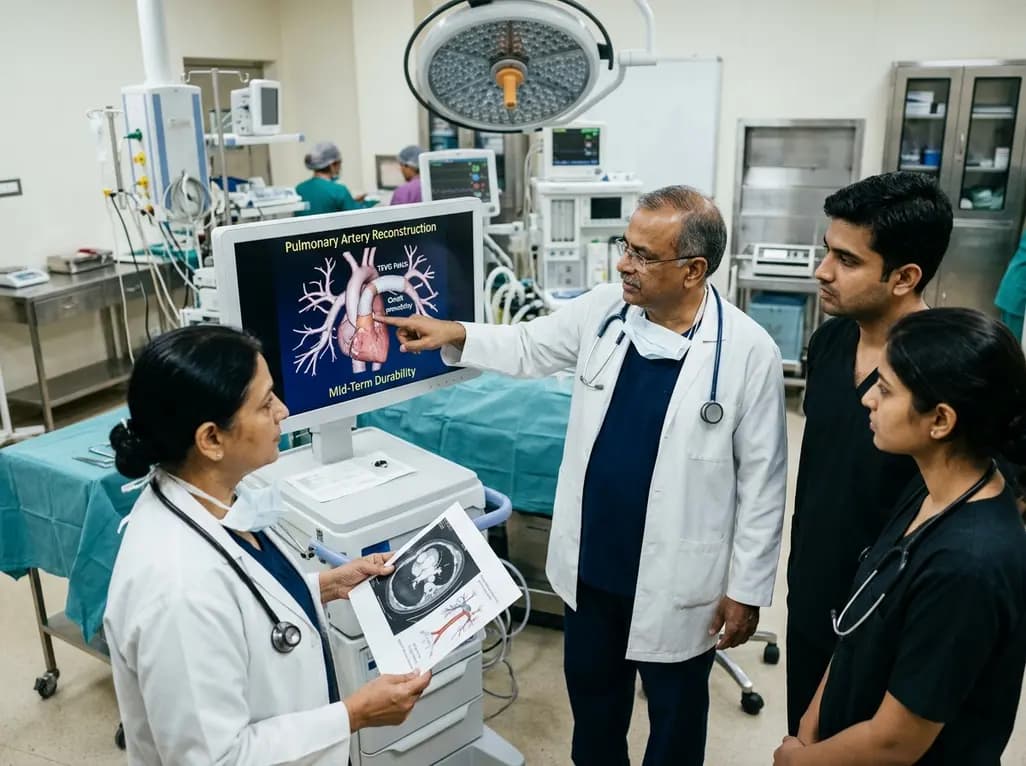
Autologous tissue-engineered vascular graft patches created via in-body tissue architecture show excellent mid-term durability and safety for pulmonary artery reconstruction in congenital heart surgery, particularly for peripheral branch augmentation.
Today
The SED-SEEN-SEEP consensus outlines an Integrated Care Pathway for preclinical type 1 diabetes, structuring target screening, autoantibody confirmation, metabolic staging, and proactive follow-up to prevent diabetic ketoacidosis and facilitate early disease-modifying intervention.
Today
