

Loading, please wait...
Loading, please wait...

Maintaining an unobstructed view during arthroscopic shoulder reconstruction remains a critical determinant of operative success. Arthroscopic surgeons frequently encounter bleeding that obscures anatomical landmarks and prolongs surgical duration. Consequently, achieving pristine rotator cuff repair visualization serves as a primary technical objective during shoulder surgery. Clinicians traditionally use distinct hemostatic interventions, such as diluted vasoconstrictor irrigation or systemic antifibrinolytics, to suppress microscopic bleeding. However, previous investigations into these modalities largely relied on subjective visual scales, introducing observer bias. Recent advances in artificial intelligence now provide objective clarity assessment.
Subacromial bleeding rapidly clouds fluid media during arthroscopy, impairing operative efficiency. Surgeons routinely employ either topical diluted epinephrine irrigation or systemic tranexamic acid to mitigate visual obscurity. Epinephrine functions through direct local alpha-1 adrenergic vasoconstriction, thereby reducing capillary ooze within subacromial tissues. In contrast, tranexamic acid stabilizes hemostatic clots by competitively inhibiting plasminogen activation. Both agents provide distinct pharmacological benefits, yet orthopedists historically debated their comparative clinical efficacy. Diluted epinephrine delivers immediate local action inside the joint space, whereas systemic tranexamic acid addresses diffuse microvascular oozing. Furthermore, arthroscopic pump pressure management directly interacts with these pharmacological interventions. Elevating infusion pump pressure can clear visual obstruction, but sustained hydrostatic pressures risk soft tissue fluid extravasation and muscular edema. Consequently, surgical teams prefer chemical hemostatic stabilization over excessive pump pressures whenever possible. Despite widespread clinical adoption of both therapies, empirical head-to-head comparisons remained rare until recently. Previous clinical studies typically depended on retrospective surgeon grading scales, which frequently introduced recall bias. Therefore, developing objective metrics has become essential to clarify whether local vasoconstrictors or systemic antifibrinolytics provide superior optical clarity during shoulder reconstruction.
To address subjective limitations, investigators conducted a secondary analysis of a prospective randomized controlled trial comprising eighty-two patients undergoing rotator cuff reconstruction. The research team randomized participants in an equal ratio to receive either 0.33 milligrams per liter of epinephrine irrigation or preoperative intravenous tranexamic acid dosed at 15 milligrams per kilogram. Additionally, the investigators divided the entire surgical procedure into three chronological stages: diagnostic intra-articular assessment, subacromial debridement, and definitive rotator cuff repair. To evaluate visual clarity objectively, researchers implemented an advanced, pretrained deep learning computer vision model. This neural network analyzed surgical video frames across all procedural phases using a standardized three-point grading scale. Furthermore, the protocol captured real-time irrigation pump pressure measurements at each consecutive stage to quantify hydrostatic demands. Concurrently, the surgical and anesthesia teams actively monitored all participants for hypotensive bradycardic events and postoperative adverse complications. By replacing subjective surgeon surveys with continuous neural network assessments, this investigation established an automated standard for surgical clarity measurement. Consequently, the methodology eliminated observer bias and ensured rigorous, reproducible quantification of intraoperative bleeding and visual interference.
The trial demonstrated that diluted epinephrine irrigation provided significantly superior overall visual clarity compared to systemic tranexamic acid. Deep learning model evaluations confirmed a statistically significant mean clarity advantage favoring the epinephrine cohort across surgical procedures. Specifically, the topical vasoconstrictor showed pronounced benefits during subacromial debridement and final tendon anchor fixation, where vascularized soft tissues bleed easily. Although intravenous tranexamic acid stabilized clot formation, it failed to match the immediate optical clarity achieved by localized vasoconstrictive irrigation. Moreover, patients receiving epinephrine irrigation required lower median irrigation pump pressures to maintain an adequate arthroscopic view. This pressure difference reached clinical significance during subacromial bursectomy, effectively reducing unnecessary fluid extravasation into surrounding deltoid tissues. Importantly, neither cohort showed an increased incidence of severe hypotensive bradycardic events, confirming the hemodynamic safety of low-dose epinephrine irrigation. In addition, postoperative complication rates remained equivalent between both arms, with no reported deep vein thromboses or surgical infections. Therefore, the findings substantiate that topical vasoconstriction effectively controls arthroscopic bleeding without elevating systemic cardiovascular risk. These objective results demonstrate clear procedural superiority for local vasoconstrictive irrigation.
These clinical findings provide valuable pragmatic insights for sports medicine specialists, orthopedic surgeons, and operating theater teams. In surgical settings, visual obscuration increases operative time and surgeon fatigue, which can compromise anchor placement accuracy. Because subacromial debridement and cuff fixation present the highest bleeding risk, utilizing epinephrine-infused saline ensures steady visualization during critical procedural steps. Furthermore, keeping irrigation pump pressures low protects patients from massive tissue extravasation, post-repair shoulder stiffness, and prolonged postoperative swelling. In addition, adopting low-dose epinephrine irrigation offers a straightforward, cost-effective intervention readily available in high-volume orthopedic centers. Surgical teams do not need complex pre-administration timing protocols, unlike intravenous antifibrinolytics that require scheduled intravenous infusions prior to incision. However, clinicians must maintain collaborative vigilance with anesthesia colleagues to ensure accurate cardiac monitoring throughout the procedure. Although systemic absorption of diluted irrigation remains minimal, patients with severe unstable coronary artery disease still require tailored assessment. Overall, integrating low-dose topical epinephrine into standard arthroscopic irrigation fluid provides an accessible, robust solution to enhance visualization while maintaining safety across shoulder reconstructive operations in clinical practice.
The successful application of neural network image analysis highlights an evolving paradigm in surgical quality evaluation. Historically, clinical research in arthroscopic surgery relied almost entirely on subjective visual analog scales completed hours after operation. Such human-dependent evaluations inherently suffer from cognitive biases, operative fatigue, and varying personal thresholds for clarity. In contrast, deep learning models analyze thousands of video frames continuously, generating granular clarity scores without human prejudice. Moreover, these automated systems allow researchers to evaluate how distinct surgical techniques, power tools, and radiofrequency ablation devices influence visualization in real time. As computer vision technology matures, real-time feedback loops could dynamically alert surgical teams when visualization dips below safe operational thresholds. Consequently, automated systems may soon adjust pump pressures or recommend targeted hemostasis automatically during challenging procedures. Furthermore, objective clarity data facilitate standardized surgical training by allowing residency programs to evaluate trainees' bleeding management skills objectively. Therefore, integrating artificial intelligence into surgical assessment not only validates pharmacological interventions like epinephrine irrigation, but also accelerates clinical quality assurance across modern arthroscopic surgery.
Diluted epinephrine acts locally by inducing rapid alpha-adrenergic vasoconstriction in capillary beds surrounding the subacromial space. This immediate local vascular response prevents bleeding before blood enters the visual field. Conversely, intravenous tranexamic acid acts systemically to inhibit fibrinolysis and stabilize existing clots, but it does not prevent immediate capillary oozing. Consequently, continuous local vasoconstriction with epinephrine ensures a clearer visual field during high-vascularity stages like subacromial debridement and cuff anchor placement.
Current clinical trial data demonstrate that low-dose epinephrine irrigation does not significantly increase hypotensive bradycardic events when compared to systemic tranexamic acid. Because clinicians dilute epinephrine to a low concentration of 0.33 milligrams per liter, systemic absorption through intact articular tissues remains minimal. However, surgical and anesthesia teams must maintain routine hemodynamic monitoring, particularly when patients sit in the upright beach-chair position, to detect unexpected vagal reflexes or cardiovascular fluctuations promptly.
Deep learning computer vision models evaluate thousands of arthroscopic video frames objectively using standardized multi-point visual grading scales. Unlike traditional surgeon-reported questionnaires that suffer from subjective recall bias and inter-observer variability, neural networks provide reliable, reproducible, and continuous assessment throughout every surgical stage. Consequently, artificial intelligence enables precise quantification of intraoperative bleeding and fluid clarity, establishing a dependable benchmark for evaluating pharmacological and technical interventions in arthroscopic orthopedic research.
Disclaimer: This content is for informational and educational purposes only... Refer to the latest local and national guidelines for clinical practice.
References

Read summarized clinical updates, watch expert medical content, and earn CME certifications right from your smartphone.
Open your smartphone camera to scan and install.





A secondary analysis of a randomized controlled trial using deep learning models shows that diluted epinephrine irrigation achieves superior visual clarity and requires lower pump pressure compared to intravenous tranexamic acid during arthroscopic rotator cuff repair, with equivalent safety profiles.
Today

A retrospective study evaluates contrast-associated acute kidney injury (CA-AKI) incidence in oncology patients receiving active chemotherapy with preserved renal function, highlighting low overall risk and timing considerations.
Today
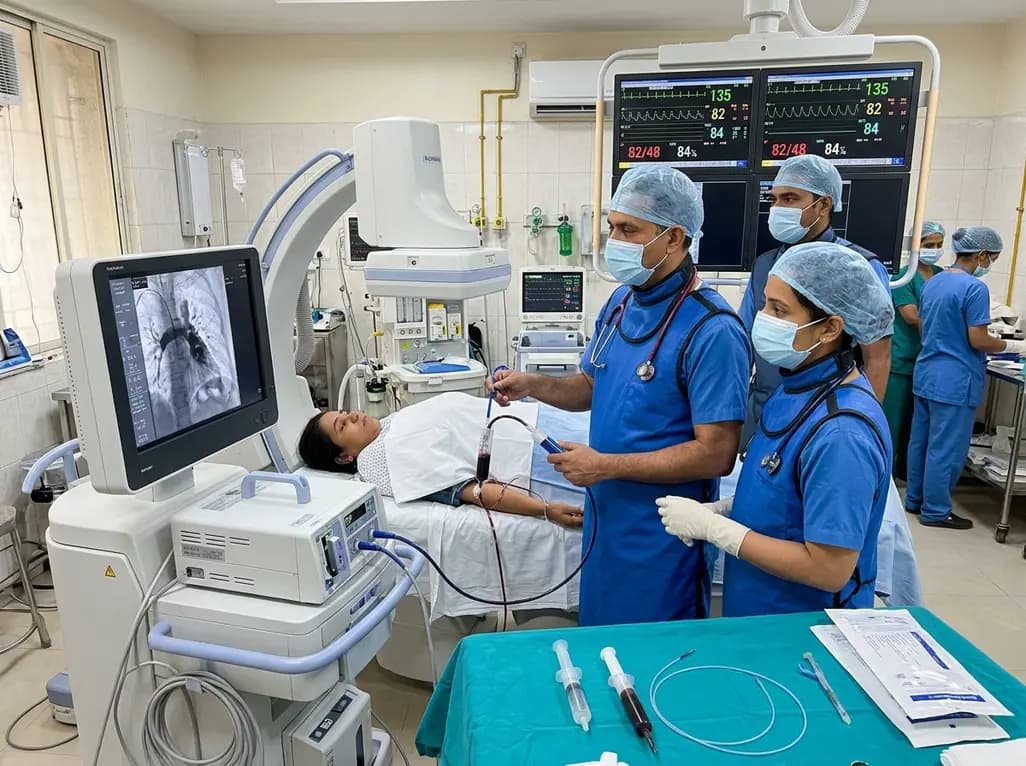
In high-risk pulmonary embolism complicated by severe anemia and active uterine bleeding, systemic thrombolysis is contraindicated. Large-bore aspiration thrombectomy provides rapid hemodynamic rescue without fibrinolysis, supported by inferior vena cava filter placement and multidisciplinary critical care.
Today

A cross-sectional study in Zanzibar reveals that 46.5% of adults with type 2 diabetes experience multidomain autonomic dysfunction on the COMPASS-31 tool, primarily orthostatic intolerance, while 45.9% exhibit cardiovascular autonomic neuropathy, highlighting the urgent need for structured clinical screening.
Today

A recent case-control study reveals that urinary clusterin provides superior diagnostic performance for early diabetic kidney disease detection in pediatric type 1 diabetes mellitus, identifying tubular damage before conventional microalbuminuria occurs.
Today
