.webp&w=384&q=75)

Loading, please wait...
Loading, please wait...

While the retardation of fetal growth by environmental contaminants is a well-established concern in clinical toxicology, the coordinated advancement of embryonic developmental timing has historically received less attention. However, premature acceleration of developmental milestones can pose significant risks to an organism's long-term health. Recently, researchers introduced a novel strategy called Suspect List-Guided High-Throughput Screening (SLIG-HTS). This approach identifies environmental substances that specifically alter the pace of embryonic growth across a broad chemical spectrum.
Specifically, the study integrated literature-informed suspect lists with stage-resolved endpoint evaluations to screen over 9,300 toxicity records. Consequently, the team curated 46 substances linked to changes in developmental milestones. When they validated these compounds using zebrafish models, the results confirmed that nearly 59% of the substances significantly affected morphological endpoints. These milestones included critical processes such as epiboly progression, somite formation, and yolk sac dynamics. Notably, common sulfonamide antibiotics, such as sulfadiazine (SDZ) and sulfamethoxazole (SMZ), demonstrated pronounced effects even at environmentally relevant concentrations.
Furthermore, exploratory transcriptomic analyses revealed that these substances do not merely cause overt toxicity. Instead, they trigger coordinated pathway-level responses. These responses primarily affect neuromuscular and cardiovascular development. Therefore, the exposure appears to shift the overall embryonic developmental timing, leading to premature maturation of specific systems. Additionally, the research highlighted that eight other sulfonamides produced comparable effects. This suggests a potential class-wide phenomenon that warrants further regulatory and clinical scrutiny.
Moreover, the study emphasizes that even low concentrations (ranging from ng/L to low μg/L) can influence these developmental shifts. For healthcare providers in regions with high antibiotic residue in water sources, understanding these non-lethal but developmentally significant alterations is crucial. Thus, this integrated screening approach provides a vital tool for identifying ecological and human health risks that traditional toxicity assays might overlook.
SLIG-HTS stands for Suspect List-Guided High-Throughput Screening. It is a methodology that combines existing literature with stage-specific biological observations to identify chemicals that alter developmental rates in embryos.
Although faster development might seem beneficial, it often involves uncoordinated maturation of the neuromuscular and cardiovascular systems. This can lead to functional deficits, increased vulnerability to stressors, and long-term health complications.
The study specifically highlighted sulfonamide antibiotics, including sulfadiazine and sulfamethoxazole, as significant drivers of advanced developmental timing at low environmental concentrations.
Disclaimer: This content is for informational and educational purposes only. It does not constitute medical advice or a substitute for professional healthcare. Refer to the latest local and national guidelines for clinical practice.
References
Wang P et al. Suspect List-Guided High-Throughput Screening (SLIG-HTS) Identifies Environmental Substances Associated with Advanced Embryonic Developmental Timing. Environ Sci Technol. 2026 Feb 12. doi: 10.1021/acs.est.5c15424. PMID: 41678263.
Huo X et al. Sulfonamides (SAs) exposure causes neurobehavioral toxicity at environmentally relevant concentrations (ERCs) in early development of zebrafish. Aquat Toxicol. 2023 Aug;261:106614. doi: 10.1016/j.aquatox.2023.106614.
"
Read summarized clinical updates, watch expert medical content, and earn CME certifications right from your smartphone.
Open your smartphone camera to scan and install.





This study uses a new screening strategy to identify environmental contaminants, specifically sulfonamides, that can prematurely advance embryonic developme...
8 months ago

Recent epidemiological data reveals a dramatic surge in summer heat mortality driven by human-induced climate warming. This analysis explores the pathophysiological impacts on cardiac and renal systems, diagnostic dilemmas in death certification, and essential emergency cooling protocols for acute clinical care.
Today

Odisha has established India's first state-level clinical protocol specifically tailored for pregnant women with sickle cell disease. Developed with NHM and UNICEF, the framework provides structured antenatal screening, crisis mitigation, standardized referral pathways, and specialized interdisciplinary care.
Today

India is advancing preventive healthcare by integrating genomics, artificial intelligence, and quantum technologies. With the SANGAM programme sequencing one million Indian genomes, clinicians can unlock personalized therapies, detect cardiometabolic risks early, and curb the burden of diabetes and heart disease.
Today
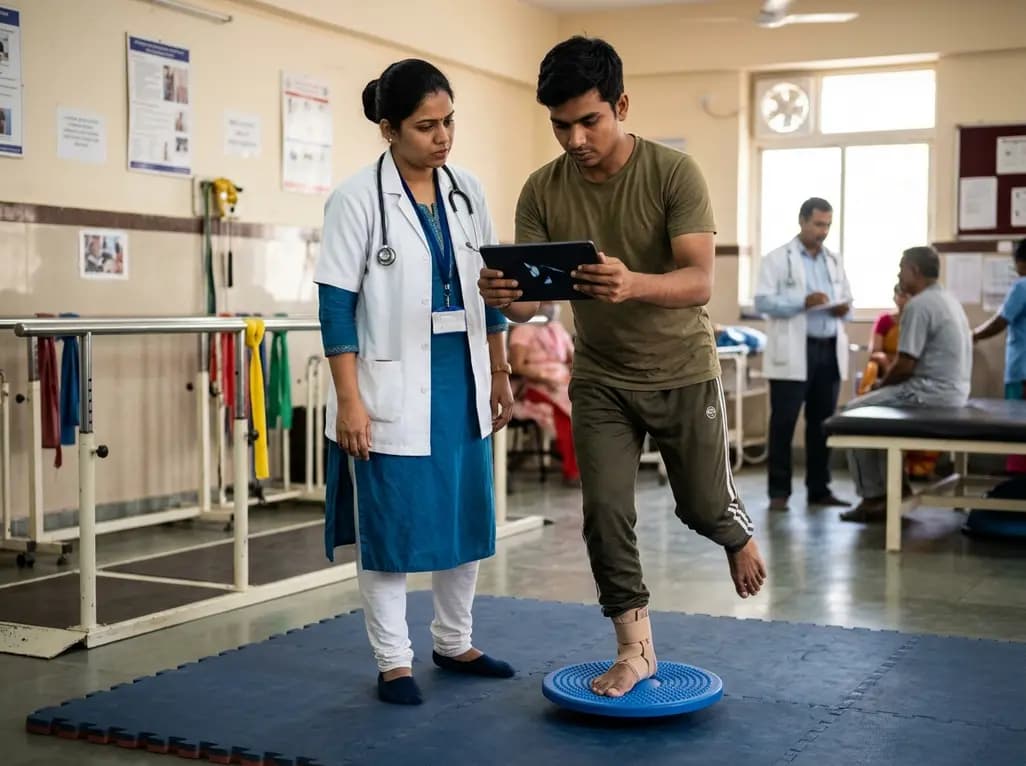
A randomized controlled trial demonstrates that an eight-week dual-task training intervention significantly improves static and dynamic postural control over standard balance exercises in individuals with chronic ankle instability, addressing critical neurocognitive deficits during athletic and daily activities.
Today

A retrospective cohort study of 7,716 ICU patients from the MIMIC-IV database demonstrates that Gradient Boosting Decision Trees significantly outperform traditional SOFA scores in predicting in-hospital mortality among patients with sepsis and diabetes, with SHAP analysis providing clinical interpretability.
Today
