.webp&w=384&q=75)

Loading, please wait...
Loading, please wait...

Acute healthcare systems encounter severe patient surges, persistent departmental crowding, and rising readmission rates. Consequently, hospital administrators actively explore multidisciplinary staffing innovations to safeguard patient flow and clinical quality. Integrating emergency department physiotherapy represents a promising frontline paradigm designed to support acute triage and discharge planning. Clinicians frequently evaluate whether frontline allied health assessments can safely manage urgent cases without triggering unscheduled hospital returns. Recently, an extensive systematic review provided rigorous evidence regarding 30-day hospital re-presentations following acute physical therapy interventions.
Emergency departments routinely manage heterogeneous patient populations, ranging from acute medical crises to non-emergent musculoskeletal complaints. Therefore, acute care systems require adaptable workflows that optimize stretcher turnover while rigorously preserving clinical safety. Modern hospital facilities increasingly integrate physical therapists directly into initial emergency consultation zones. In this setting, therapists deliver immediate diagnostic evaluations, functional mobility screenings, and targeted non-pharmacological care. Furthermore, they facilitate rapid ambulation assessments and organize safe discharge pathways for functionally vulnerable patients. However, medical administrators historically questioned whether primary physical therapy discharge could increase missed diagnoses or prompt early readmissions. Consequently, investigators initiated a comprehensive systematic review compiling international evidence from randomised controlled trials, observational cohorts, and clinical audits. Specifically, researchers evaluated re-presentation outcomes among patients managed by emergency physiotherapists compared with traditional emergency physicians. In addition, study quality and risk of bias were systematically assessed using Newcastle-Ottawa and GRADE frameworks. Ultimately, their comprehensive inquiry resolved persistent uncertainties regarding patient safety across diverse acute clinical environments.
The comprehensive systematic review identified sixteen relevant studies, with ten investigations providing pooled quantitative data on 30-day re-presentations. Overall, the pooled meta-analysis demonstrated that emergency physiotherapy yielded a relative risk of 1.04 compared to conventional emergency physician management. Thus, patients evaluated by emergency physiotherapists exhibited no statistically significant increase in return visits within 30 days. Furthermore, meta-regression analyses indicated consistent equivalence regardless of hospital setting, geographical location, or study design. Consequently, the findings confirm that physical therapy represents a clinically safe alternative or adjunct to routine physician-led acute care. In addition, patient satisfaction surveys across multiple included cohorts demonstrated consistently high patient confidence and positive experiences. Nevertheless, the authors assigned low-quality GRADE certainty to the overall pooled estimate due to observational study designs and clinical heterogeneity. Therefore, although global re-presentation rates remained statistically neutral, detailed subgroup analyses uncovered vital distinctions across presenting clinical complaints. As a result, researchers conducted deeper investigations focusing on specific diagnostic categories upon emergency admission.
Subgroup stratification by presenting pathology revealed profound clinical advantages for patients presenting after accidental falls. Specifically, older adults receiving emergency physical therapy achieved a remarkable 34 percent reduction in 30-day hospital re-presentation risk compared to physician care alone. Consequently, the pooled relative risk for fall presentations dropped to 0.66, with a tight 95 percent confidence interval of 0.59 to 0.74. This substantial decrease highlights the immense diagnostic and therapeutic value of focused functional assessments in older fallers. While emergency physicians expertly exclude intracranial hemorrhages and acute fractures, they frequently lack the time to assess gait instability or dynamic balance. Conversely, physical therapists methodically identify underlying biomechanical balance deficits, review situational hazards, and verify bedside transfer safety. Furthermore, they supply appropriate mobility aids, instruct patients on safe movement strategies, and coordinate targeted outpatient balance therapy. Therefore, this proactive interdisciplinary intervention disrupts the vicious cycle of recurrent mechanical falls. Ultimately, emergency physiotherapy protects vulnerable geriatric patients from subsequent trauma and avoidable readmissions.
In contrast to fall-related visits, musculoskeletal presentations demonstrated complete clinical equivalence between physical therapy and emergency physician management. Specifically, the pooled relative risk for musculoskeletal conditions was 1.17, with wide confidence intervals spanning 0.61 to 2.22. Thus, emergency physical therapists effectively evaluated acute sprains, strains, and spinal symptoms without increasing unscheduled return visits. Similarly, general emergency presentations also maintained comparable re-presentation rates, demonstrating a favorable relative risk of 0.93. Consequently, emergency clinicians can confidently entrust non-operative soft-tissue and mechanical injuries to qualified physical therapy practitioners. In addition, physical therapists deliver comprehensive patient education, active rehabilitation exercises, and non-opioid pain strategies during initial consultation. Therefore, patients acquire practical self-management tools without developing dependency on sedative medications. Moreover, managing ambulatory orthopedic injuries within dedicated therapy tracks frees emergency physicians to focus on critical resuscitations. Hence, this collaborative staffing strategy promotes high-quality acute care while maximizing departmental efficiency.
Translating these meta-analytic findings into real-world hospital practice requires deliberate operational and institutional planning. First, hospital leadership should introduce validated screening tools at emergency triage to rapidly flag older fallers. Consequently, triage staff can promptly initiate early physical therapy consultations alongside standard medical workups. Second, healthcare institutions must ensure emergency departments maintain immediate access to standard mobility aids, including walkers, canes, and joint braces. Thus, therapists can fit and dispense necessary assistive devices before discharging patients home. Third, hospital administrators should establish structured transitional pathways connecting emergency physiotherapists with community-based outpatient fall clinics. Furthermore, close communication between emergency physicians, geriatricians, and allied health staff ensures safe and confident discharge dispositions. In addition, introducing dedicated emergency physiotherapy shifts during peak operational hours can significantly reduce boarding bottlenecks. Ultimately, adopting these evidence-based strategies empowers hospitals to reduce recurrent admissions, relieve department crowding, and deliver patient-centered acute care.
Emergency department physiotherapy markedly lowers 30-day re-presentations among fall patients by evaluating functional mobility, postural stability, and environmental hazards before discharge. Physical therapists provide rapid gait retraining, fit appropriate ambulatory devices, and teach compensatory movement techniques at the bedside. Furthermore, they arrange direct referrals to community-based balance clinics. Consequently, this multifactorial intervention addresses underlying mechanical deficits, effectively mitigating recurrent fall episodes and preventing catastrophic secondary injuries among vulnerable geriatric individuals.
Yes, global clinical evidence indicates that emergency physiotherapists manage acute musculoskeletal conditions with high diagnostic accuracy and clinical safety comparable to emergency physicians. The systematic review revealed equivalent 30-day hospital re-presentation rates between both provider groups. Furthermore, physical therapists excel at conservative soft-tissue management, tailored exercise prescription, and non-pharmacological analgesia. Consequently, integrating allied health practitioners for non-operative sprains and fractures safely unburdens emergency physicians without compromising patient outcomes or care quality.
Successfully integrating emergency department physiotherapy requires dedicated staffing, defined triage screening algorithms, and accessible mobility supplies directly within acute assessment zones. Emergency facilities must stock standardized assistive walking aids, braces, and patient education materials. Furthermore, hospital administrators should implement streamlined digital referral protocols connecting emergency therapists with outpatient geriatric and orthopedic networks. Consequently, smooth interdisciplinary collaboration ensures rapid functional assessments, safe community discharge planning, and sustained reductions in emergency department re-presentation rates.
Disclaimer: This content is for informational and educational purposes only and should not be considered as medical advice. Always consult with a qualified healthcare professional regarding any medical condition or treatment. Refer to the latest local and national guidelines for clinical practice.
References

Read summarized clinical updates, watch expert medical content, and earn CME certifications right from your smartphone.
Open your smartphone camera to scan and install.





A systematic review demonstrates that emergency department physiotherapy safely matches physician care for 30-day re-presentations while reducing geriatric fall readmissions by 34%.
Today
A landmark multi-ethnic study of 40,132 participants demonstrates that risk-weighted apoB (RW-apoB) captures coronary risk beyond measured apoB. By integrating the atherogenic potency of triglyceride-rich lipoproteins and Lp(a), RW-apoB improves cardiovascular risk discrimination across diverse populations.
Today

A Belgian study highlights maternal desires and healthcare provider perspectives on breastfeeding in women living with HIV. While viral suppression reduces transmission risk below 1%, significant clinical training and policy gaps remain, highlighting the urgent need for multidisciplinary counseling protocols.
Today
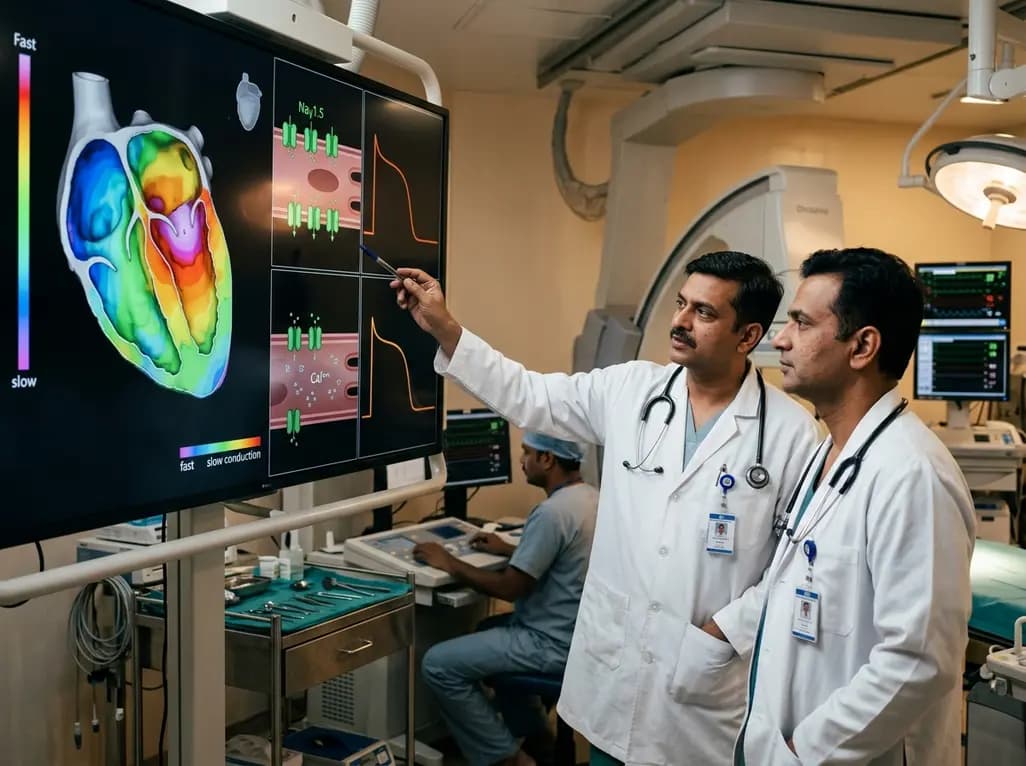
New research reveals that non-ablative radiotherapy suppresses ventricular tachycardia by increasing conduction velocity via NaV1.5 upregulation and action potential prolongation. However, sustained sodium current elevation and depressed calcium handling highlight the need for careful clinical translation.
Today

A cross-sectional study reveals that elevated BMI in type 2 diabetes correlates with reduced skeletal muscle mass, handgrip weakness, impaired walking capacity, balance deficits, and poor quality of life, highlighting the need for targeted rehabilitation.
Today
