.webp&w=384&q=75)

Loading, please wait...
Loading, please wait...
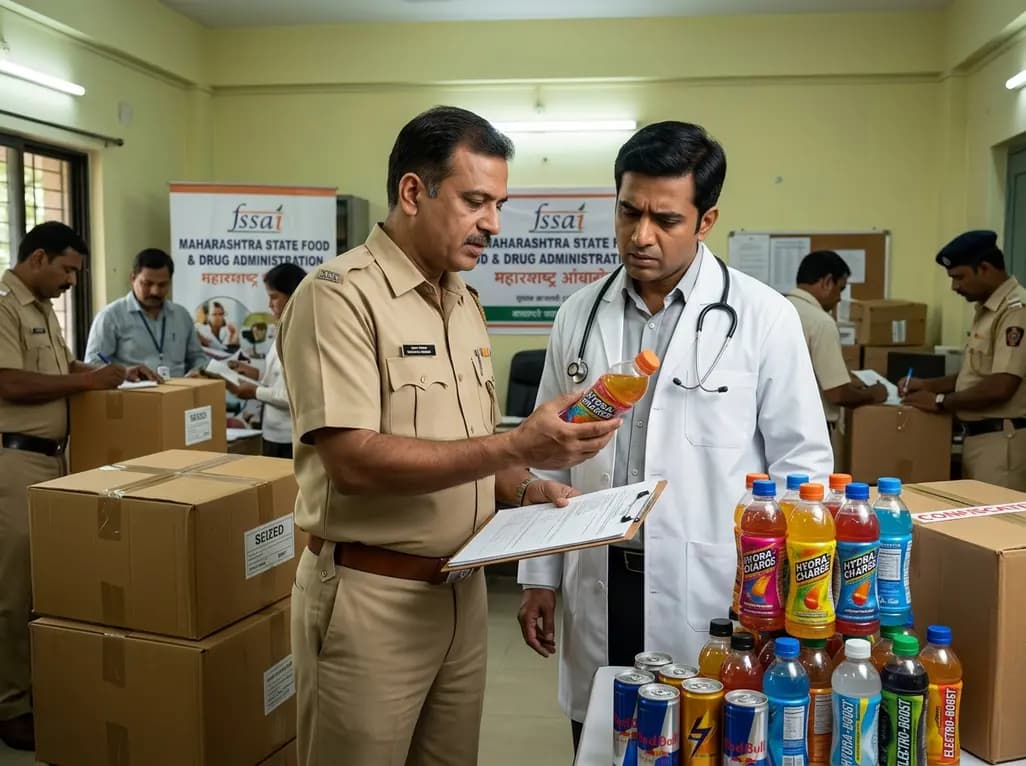
The Maharashtra Food and Drug Administration (FDA) recently executed a significant enforcement action against deceptive health drink marketing. Specifically, officials seized energy drink stock worth over Rs 56 lakh from storage facilities in Waluj and Karodi. This action followed a severe case of electrolyte drink misbranding by a prominent pharmaceutical and consumer healthcare firm.
The Food Safety and Standards Authority of India (FSSAI) previously sent a directive warning the manufacturer about their violations. However, the firm continued to market the product using prohibited terms. In fact, companies cannot use words like \"electrolyte\" or \"electrolyte drink\" in the absence of a prescribed standard. Consequently, the FDA initiated raids under the guidance of Commissioner Tukaram Mundhe to halt these deceptive practices.
In addition to misusing the electrolyte label, the manufacturer made unauthorized therapeutic claims. The product packaging promised recovery from dehydration, fever, vomiting, and general weakness. Furthermore, these claims directly violate the provisions of the Food Safety and Standards Act of 2006. Medical practitioners rely on precise formulations for patient recovery. Therefore, commercial energy drinks containing high sugar and inadequate salt levels can compromise patient health if patients consume them as substitutes for clinical oral rehydration salts (ORS).
Moreover, the FDA launched parallel crackdowns in other districts to combat food adulteration. For instance, officials in Chhatrapati Sambhajinagar seized cow ghee worth Rs 18,150 over suspected adulteration. Additionally, in Parbhani, the department confiscated bakery products and loose edible oil worth Rs 3.5 lakh. Subsequently, Beed district officials destroyed a large volume of lassi that contained expired ingredients. These rapid enforcement actions highlight a state-wide campaign to secure food quality and protect public health.
Healthcare professionals must actively educate patients about the difference between standard beverages and clinical rehydration therapies. Specifically, many commercial sports drinks contain excess sugar which may exacerbate gastrointestinal symptoms like diarrhea. Consequently, doctors should advise patients to look for WHO-compliant ORS formulations during illnesses. Additionally, clinicians can prevent treatment delays by emphasizing these regulatory distinctions.
Q1: Why did the Maharashtra FDA seize the energy drink stock?
The Maharashtra FDA seized the energy drink stock because the manufacturer used unauthorized terminology like \"electrolyte\" without meeting prescribed FSSAI standards and made misleading therapeutic claims about treating dehydration and vomiting.
Q2: Can non-medical energy drinks use \"ORS\" or \"electrolyte\" labels in India?
No. FSSAI regulations strictly prohibit food and beverage products from using the term \"ORS\" or claiming therapeutic electrolyte rehydration benefits unless they comply with WHO-approved medical formulations.
Disclaimer: This content is for informational and educational purposes only. It does not constitute medical advice or replace professional judgment. Refer to the latest local and national guidelines for clinical practice.
References

Read summarized clinical updates, watch expert medical content, and earn CME certifications right from your smartphone.
Open your smartphone camera to scan and install.





Maharashtra FDA seized Rs 56 lakh of energy drinks due to illegal electrolyte claims and unauthorized medical recovery advertising, violating FSSAI norms....
4 months ago

Review how tailored exercise programs benefit frail older patients with heart failure. Explore pathophysiological mechanisms, individualized training prescriptions, and strategies to overcome adherence barriers in clinical practice.
Today

Leucine Rich Bio has introduced South Asia's first comprehensive vaginal microbiome test, BugSpeaks. By profiling microbial dysbiosis, pathogens, and antimicrobial resistance, this next-generation diagnostic platform provides clinicians with deeper insights into recurrent infections, fertility, and reproductive health.
Today

In high-risk pulmonary embolism complicated by severe anemia and active uterine bleeding, systemic thrombolysis is contraindicated. Large-bore aspiration thrombectomy provides rapid hemodynamic rescue without fibrinolysis, supported by inferior vena cava filter placement and multidisciplinary critical care.
Today

This comparative study evaluates posterior labral tears with and without glenohumeral instability, highlighting distinct demographic patterns, MRI underestimation in stable shoulders, and successful arthroscopic repair outcomes.
Today

A clinical study demonstrates that early intervention with tocilizumab, either as monotherapy or bridged with corticosteroids, achieves significant proptosis reduction and resolves active inflammation in treatment-naive thyroid eye disease.
Today
