.webp&w=384&q=75)

Loading, please wait...
Loading, please wait...
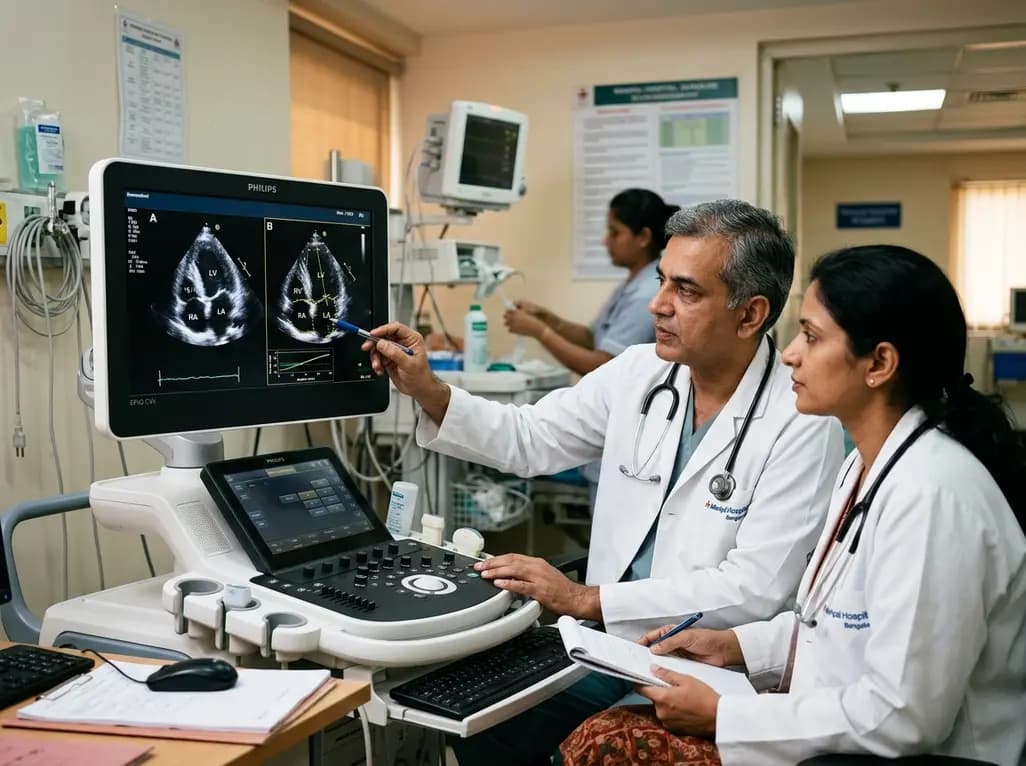
Evaluating cardiac morphology requires precise probe orientation during transthoracic examinations. Clinicians depend extensively on the apical four-chamber view to assess chamber geometry and valvular competence. However, subtle transducer rotations frequently cause off-axis imaging planes. Consequently, proper assessment of echocardiographic rotational alignment represents a critical prerequisite for accurate chamber quantification. When sonographers inadvertently twist the probe away from the true apical axis, geometric distortion occurs immediately. These rotational errors distort left ventricular volume measurements, ejection fraction estimates, and longitudinal strain values. Therefore, identifying rotational alignment deviations safeguards diagnostic accuracy across serial patient evaluations.
Standard scanning guidelines state that the ultrasound beam must bisect the apex and mitral annulus cleanly. In high-volume clinics, sonographers routinely encounter atypical chest anatomy and difficult acoustic windows. Consequently, operators encounter substantial difficulty maintaining uniform probe orientation across different patients. Historically, clinical teams relied on subjective visual inspection to assess scan quality. However, manual audits consume valuable physician time and introduce substantial inter-observer disagreement. Automated quality assessment systems offer a scalable solution for this clinical challenge. By providing objective feedback during scanning, automated tools help sonographers maintain strict diagnostic fidelity.
Machine learning models increasingly support image analysis in modern echocardiography laboratories. Traditionally, researchers trained neural networks using conventional pointwise regression frameworks. Under this pointwise scheme, human experts assign an absolute numerical quality grade to each individual ultrasound recording. The neural network then learns to predict that single numerical score directly from the image pixels. However, assigning absolute numerical values to subtle rotational shifts creates substantial cognitive friction for human experts. Clinicians naturally evaluate image alignment in relative terms rather than isolated numbers. Consequently, pointwise grading schemes introduce considerable observer noise into training databases.
Furthermore, conventional regression models struggle to capture the continuous nature of probe rotation. Transducer alignment exists along a continuous physical spectrum moving clockwise or anticlockwise from the true anatomical plane. Pointwise models compress this continuous trajectory into rigid, isolated targets. As a result, standard regression architectures show high sensitivity to inter-expert grading differences. When clinical algorithms face novel patient cohorts, this lack of relative structure hampers predictive stability. In addition, standard models struggle when evaluating ambiguous border cases. Therefore, medical artificial intelligence requires ranking architectures that mirror human comparative reasoning directly.
To resolve the limitations of pointwise scoring, researchers established a shared-weight pairwise learning framework. Instead of assigning arbitrary absolute values, human experts performed multi-image ranking tasks. Cardiologists compared pairs of apical four-chamber recordings along a defined rotational continuum. This relative ordering process allowed experts to establish robust consensus rankings without forcing arbitrary numerical scores. Furthermore, the shared-weight neural network received two distinct echocardiograms simultaneously during training. The system subsequently predicted the signed rotational difference separating the two images. Consequently, the algorithm learned the continuous spatial structure underlying expert clinical judgment.
In addition, this pairwise formulation ensures mathematical symmetry and robust feature representation. The twin neural pathways share identical weights, forcing the network to extract uniform anatomical features regardless of presentation order. When two images display identical alignment, the model predicts zero difference. Conversely, when views display divergent orientations, the network predicts an appropriate signed discrepancy. Moreover, this relative approach reflects how sonographers adjust probes during active clinical examinations. By benchmarking images against each other, pairwise learning models human perceptual strategies with exceptional mathematical fidelity. Thus, the system captures true anatomical continuity reliably.
Rigorous comparative experiments demonstrated clear advantages for the pairwise learning approach over standard regression. Specifically, pairwise learning increased the mean pairwise agreement from 74.86% to 84.29% across independent test sets. Furthermore, the mean Spearman correlation rose from 67.74% to 85.43% when benchmarked against expert consensus. The highest performing pairwise network reached an agreement rate of 87.81% and a Spearman correlation of 91.23%. These quantitative gains confirm that relative training structures retain vital directional information that pointwise models discard. Consequently, the proposed architecture provides superior fidelity for grading rotational alignment.
Importantly, comprehensive robustness analyses validated the stability of the neural network. The researchers performed leave-one-expert-out evaluations, confirming that no single clinician skewed model predictions. In addition, cycle-consistency assessments revealed minimal circular ordering errors across independent validation triads. Saliency visualization maps offered further insights into model reasoning. Specifically, the attention maps demonstrated that the network evaluated anatomically crucial regions, including the ventricular septum, apex, and mitral leaflets. Thus, the system based its predictions on authentic cardiac geometry rather than uninformative imaging artifacts. Furthermore, this anatomical grounding reassures practicing clinicians during technology adoption.
Implementing automated view quality assessment holds vital clinical value for healthcare delivery in India. High patient volumes in government hospitals and private diagnostic centers place intense operational demands on cardiologists. Moreover, cardiology trainees and general sonographers frequently perform bedside point-of-care ultrasound under severe time constraints. In these fast-paced environments, unintentional probe rotation causes off-axis recordings and misleading clinical metrics. Automated pairwise quality assessment provides immediate feedback to novice operators during live examinations. Therefore, bedside clinicians can correct transducer orientation before recording definitive diagnostic loops.
Additionally, standardized image acquisition protects the integrity of downstream artificial intelligence systems. Contemporary cardiac software increasingly utilizes automated segmentation algorithms to measure ejection fraction, myocardial strain, and chamber dimensions. However, these downstream algorithms produce inaccurate calculations when given misaligned or foreshortened input views. Pairwise alignment models serve as an essential automated filter to ensure image quality before automated functional quantification. Furthermore, automated validation facilitates tele-echocardiography programs linking rural clinics with tertiary cardiac centers. Ultimately, deploying reliable quality control tools strengthens diagnostic confidence, standardizes echocardiographic protocols, and improves cardiovascular patient outcomes nationwide.
Rotational alignment ensures that the ultrasound plane accurately sections the true anatomical long axis of the heart without foreshortening. When an operator rotates the transducer away from the standard apical four-chamber plane, cardiac structures become distorted. Consequently, rotational misalignment leads to underestimation of ventricular volumes and inaccurate ejection fraction calculations. Standardizing rotational alignment ensures high diagnostic precision, minimizes inter-operator variability, and provides reliable data for longitudinal cardiac disease monitoring.
Traditional pointwise regression models require human experts to assign arbitrary numerical quality scores to isolated images. Because human perception naturally operates through comparison, individual scores exhibit substantial inconsistency. In contrast, pairwise learning evaluates two images simultaneously to predict their relative signed difference. This relative framework reflects expert consensus accurately, prevents annotator bias, and significantly improves agreement and Spearman correlation across diverse independent clinical datasets.
In high-volume or resource-limited healthcare environments, non-specialist clinicians often perform point-of-care cardiac ultrasound examinations. Real-time automated quality assessment guides less experienced operators by identifying rotational errors during live scanning. Therefore, bedside operators can adjust transducer orientation immediately before acquiring clinical measurements. This automated oversight reduces repetitive examinations, avoids downstream diagnostic errors, and elevates the overall quality of cardiac care in rural and underserved communities.
Disclaimer: This content is for informational and educational purposes only... Refer to the latest local and national guidelines for clinical practice.
References

Read summarized clinical updates, watch expert medical content, and earn CME certifications right from your smartphone.
Open your smartphone camera to scan and install.





A multi-expert study shows pairwise deep learning accurately assesses echocardiographic rotational alignment in apical four-chamber views, outperforming pointwise regression. This technique improves automated image quality control and standardizes functional cardiac assessment.
Today
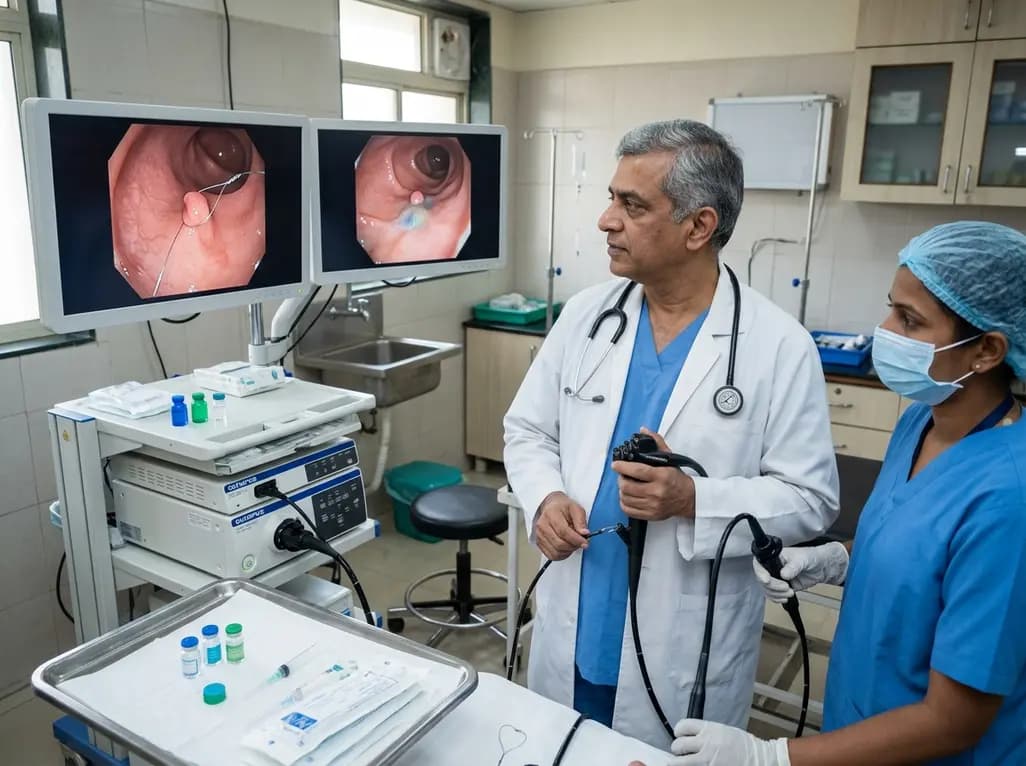
A randomized controlled trial compared conventional cold snare polypectomy with submucosal injection for 3-9 mm polyps. Both techniques demonstrated exceptionally low incomplete resection rates, though injection lowered the need to convert to endoscopic mucosal resection when forced pull was avoided.
Today

Maternal anaemia contributes to nearly half of pregnancy-related fatalities across India. To prevent complications, Uttar Pradesh has added single-dose parenteral iron to its essential medicines list. This clinical transition aims to restore haemoglobin rapidly and protect high-risk mothers across rural facilities.
Today

A longitudinal study of 1,055 chronic low back pain patients reveals that higher patient activation fosters constructive pain medication attitudes, reduces disability, and decreases short- and long-term opioid use through collaborative, multimodal care.
Today

A landmark cross-sectional study in Asian adults with type 2 diabetes identifies novel urinary metabolites linked to mild cognitive impairment. Elevated urinary sucrose and altered metabolites highlight non-invasive pathways for early cognitive risk stratification and targeted metabolic management.
Today
