.webp&w=384&q=75)

Loading, please wait...
Loading, please wait...
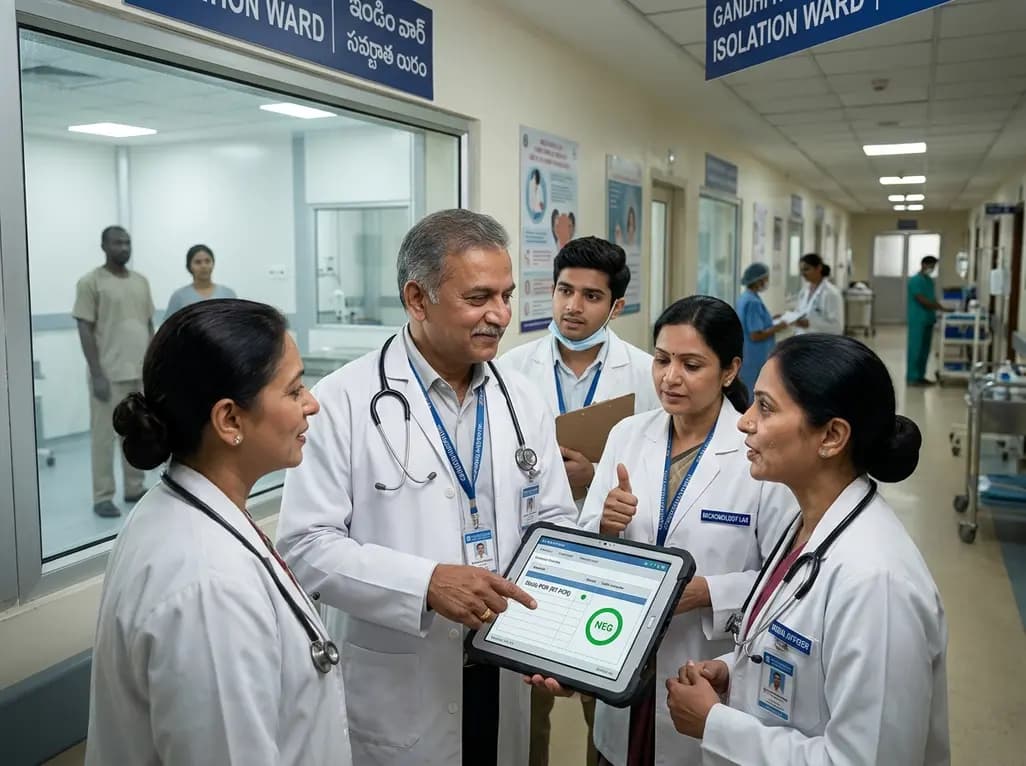
Recently, health authorities in India stepped up vigilance to prevent the entry of high-risk pathogens. Consequently, the state health department initiated strict Ebola screening in Hyderabad at the international airport. Subsequently, officials quarantined two Sudanese nationals showing symptoms of fever. Fortunately, medical reports confirmed that both patients tested negative for the virus.
To begin with, health workers isolated a 35-year-old traveler who arrived for a planned knee surgery. Meanwhile, they found his elevated temperature during routine thermal screening at the Rajiv Gandhi International Airport. Therefore, the medical team immediately shifted him to the state-run Gandhi Hospital. Although he exhibited a fever upon arrival, his clinical symptoms resolved quickly. As a result, his confirmatory test results returned negative from the National Institute of Virology.
Furthermore, a second Sudanese national, who is a student in his 20s, required medical observation. Initially, a private healthcare facility referred this patient to the infectious disease ward because he developed a fever. Fortunately, his symptoms also improved rapidly while he remained in isolation. Additionally, authorities advised his close contact to practice home quarantine. Consequently, subsequent tests ruled out Ebola for this patient as well, which relieved local health concerns.
Indeed, the Telangana government established a dedicated 10-bed isolation ward at Gandhi Hospital to manage potential risks. In addition, the Directorate General of Civil Aviation issued detailed guidelines for monitoring international arrivals. Specifically, these rules target travelers transiting through high-risk Ebola regions like Uganda and the Democratic Republic of the Congo. Moreover, incoming passengers must complete a Self-Declaration Form before they deboard. Ultimately, these preemptive steps demonstrate the state's robust public health infrastructure.
Q1: Why did authorities isolate the Sudanese travelers in Hyderabad?
The medical staff isolated them as a precaution because they exhibited fever symptoms during thermal airport screening and quarantine. Since they recently arrived from regions near Ebola outbreaks, they received diagnostic tests to rule out the virus.
Q2: What are the current guidelines for passengers arriving from high-risk Ebola regions?
Specifically, passengers transiting through affected countries like Uganda must undergo strict thermal screening. In addition, they must complete a Self-Declaration Form before deboarding their flights.
Disclaimer: This content is for informational and educational purposes only. It does not constitute medical advice or replace professional judgment. Refer to the latest local and national guidelines for clinical practice.
References

Read summarized clinical updates, watch expert medical content, and earn CME certifications right from your smartphone.
Open your smartphone camera to scan and install.





Health officials at Gandhi Hospital confirmed that two isolated Sudanese travellers tested negative for Ebola following screening at Hyderabad airport....
4 months ago

Novel diimide and hydrazone scaffolds, particularly compound #C4, synergistically reactivate latent HIV-1 when combined with JQ1 or PKC activators. Demonstrating donor-matched proviral transcription ex vivo and non-canonical signaling, these findings advance shock and kill strategies toward reservoir eradication.
Today
A cross-sectional study reveals that maternal RSV vaccination coverage reached only 43.7% in Argentina, with maternal vaccine knowledge being the sole independent predictor of uptake. Clinicians play a crucial role in eliminating informational and structural barriers to optimize infant health.
Today

Review how tailored exercise programs benefit frail older patients with heart failure. Explore pathophysiological mechanisms, individualized training prescriptions, and strategies to overcome adherence barriers in clinical practice.
Yesterday

This comparative study evaluates posterior labral tears with and without glenohumeral instability, highlighting distinct demographic patterns, MRI underestimation in stable shoulders, and successful arthroscopic repair outcomes.
Yesterday

A clinical study demonstrates that early intervention with tocilizumab, either as monotherapy or bridged with corticosteroids, achieves significant proptosis reduction and resolves active inflammation in treatment-naive thyroid eye disease.
Yesterday
