.webp&w=384&q=75)

Loading, please wait...
Loading, please wait...

The landscape of Indian healthcare is undergoing a radical shift. Digital transformation in hospitals is no longer a futuristic concept but a present-day necessity for operational productivity. As healthcare facilities strive to enhance service delivery, understanding the critical success factors (CSFs) becomes paramount. Recent research utilizing the Technological-Organizational-Environmental (TOE) framework has identified the specific drivers that ensure a smooth transition to digital-first care.
Successful implementation requires a balanced approach across technology, organization, and environment. Researchers in India recently interviewed healthcare experts to pinpoint exactly what makes these initiatives succeed. Consequently, they found that technology alone cannot bridge the gap. Instead, the organizational culture and external partnerships play a far more significant role than previously assumed.
Leadership commitment emerged as the most critical driver for digital transformation in hospitals. Without a clear mandate from the top, digital initiatives often stall. Leaders must not only provide the necessary funding but also champion the vision of a connected ecosystem. Furthermore, public-private partnerships are becoming essential. These collaborations allow hospitals to leverage external expertise and infrastructure, which is particularly vital in the resource-constrained settings of many Indian regions.
Change management and organizational behavior are often the biggest hurdles to overcome. Employees may resist new systems if they perceive them as burdensome or complex. Therefore, hospitals must prioritize training and inclusive communication. By involving clinical and administrative staff early in the process, organizations can foster a culture that embraces innovation. This human-centric approach ensures that technology simplifies care rather than adding layers of complexity.
Healthcare managers can use these findings as a strategic guide. To ensure a future-ready transformation, they should prioritize initiatives that align with broader sustainability objectives. Focusing on operational efficiency through integrated data systems can reduce documentation burdens. This, in turn, allows clinicians to spend more time on direct patient care, ultimately improving health outcomes across the board.
The TOE framework evaluates the technological, organizational, and environmental factors that influence how a hospital adopts and implements new digital innovations.
Leadership provides the strategic vision and resource allocation necessary to sustain long-term digital projects and overcome institutional inertia.
Yes, by reducing manual errors, improving data accessibility, and enabling real-time monitoring, digital tools significantly enhance patient safety standards.
Disclaimer: This content is for informational and educational purposes only and does not constitute medical advice or a recommendation for a specific institutional policy. Digital implementation strategies vary based on local infrastructure and regulatory requirements. Refer to the latest local and national guidelines for clinical practice.
References
Korpal S et al. Navigating critical factors for successful adoption of digital transformation in hospitals through technological-organizational-environmental framework. J Health Organ Manag. 2026 Feb 06. doi: 10.1108/JHOM-05-2025-0286. PMID: 41649864.
Grant Thornton Bharat. Digital transformation in Indian healthcare. 2024.
Philips Future Health Index. Seven key success factors for digital transformation. 2022.
"
Read summarized clinical updates, watch expert medical content, and earn CME certifications right from your smartphone.
Open your smartphone camera to scan and install.





New research identifies leadership and change management as the primary drivers for successful digital transformation in Indian hospitals....
8 months ago
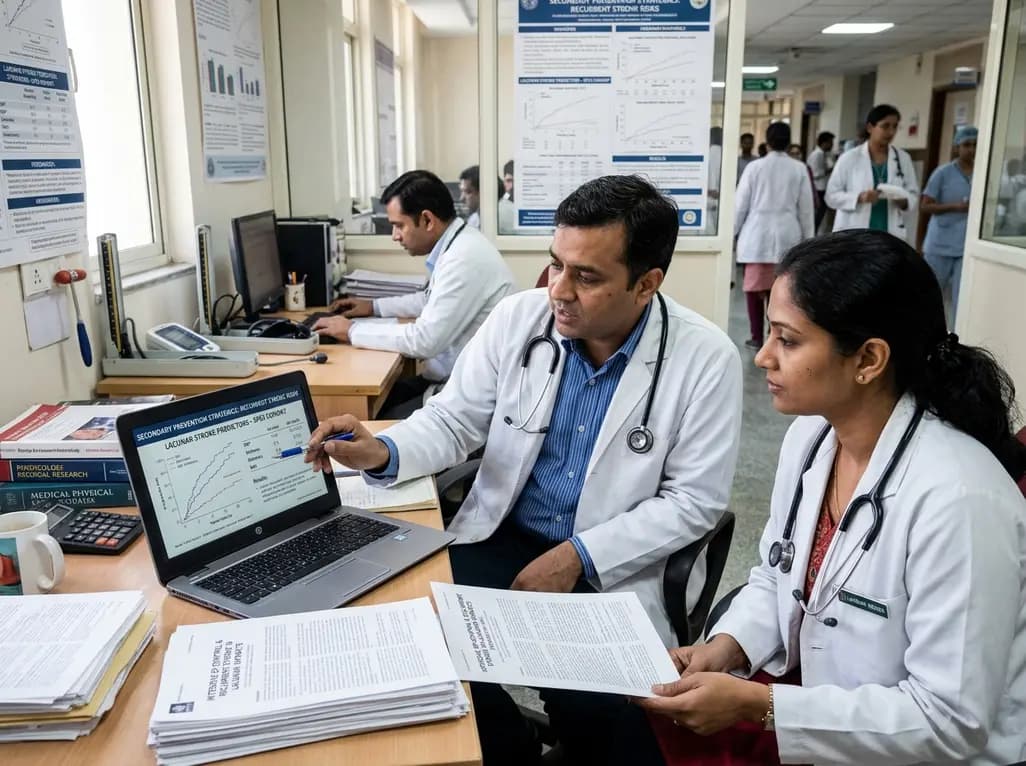
Explore vital recurrent stroke predictors in lacunar stroke patients managed with intensive blood pressure lowering. This analysis examines trial findings from SPS3 to uncover residual vascular risks, metabolic factors, and targeted secondary prevention strategies for high-risk neurological patients.
Today

A comprehensive scoping review synthesises evidence linking prenatal maternal mental health to long-term offspring neurodevelopment, evaluating neuroendocrine, inflammatory, and epigenetic pathways while highlighting clinical screening and future research priorities.
Today

The Directorate General of Health Services directs Indian states to halt the hazardous reuse and reprocessing of single-use medical devices. Discover regulatory implications under the Drugs and Cosmetics Act, critical infection risks, legal liabilities, and operational changes required across clinical specialties.
Today
Mitochondria-targeted nanoparticles self-assembled from EGCG and L-glutamic acid effectively restore mitochondrial homeostasis, suppress synovial inflammation, and attenuate chondrocyte senescence in osteoarthritis, offering a promising disease-modifying nanotherapy.
Today

India is advancing preventive healthcare by integrating genomics, artificial intelligence, and quantum technologies. With the SANGAM programme sequencing one million Indian genomes, clinicians can unlock personalized therapies, detect cardiometabolic risks early, and curb the burden of diabetes and heart disease.
Today
