

Loading, please wait...
Loading, please wait...

Major depressive disorder often presents a persistent risk of recurrence, even after individuals attain full clinical remission. Consequently, understanding the neurobiological markers of depression relapse vulnerability remains an essential objective for clinicians and neuroscientists. Interoception, which involves the central representation of internal somatic sensations, plays a pivotal role in maintaining emotional stability. Functional neuroimaging studies demonstrate that acute stress triggers the inhibition of sensorimotor regions during remission. However, structural changes in interoceptive gray matter networks have remained poorly understood until recently.
Clinical psychiatry has historically viewed structural brain deficits in depression through the lens of tissue atrophy. Specifically, previous investigations frequently identified reduced gray matter volume in frontal and limbic circuits during acute depressive episodes. Nevertheless, research examining remitted outpatients reveals a far more complex structural topography. In a secondary analysis involving eighty-five remitted outpatients, investigators tracked cortical thickness across prophylactic psychotherapy and a prospective two-year follow-up period. Participants received either Cognitive Behavioral Therapy or Mindfulness-Based Cognitive Therapy to mitigate future depressive episodes. The researchers used high-resolution magnetic resonance imaging to capture structural alterations at baseline and following the eight-week treatment window. Furthermore, mixed-effects statistical models evaluated relationships between cortical thickness, time, and therapeutic intervention type while adjusting for key covariates. Rather than showing generalized tissue loss, patients exhibiting higher relapse risk displayed localized gray matter alterations across distinct cortical regions. Therefore, these prospective findings highlight how structural variations persist well into remission, providing an objective window into illness trajectory. Ultimately, structural neuroimaging allows clinicians to move beyond self-reported recovery by uncovering silent anatomical vulnerabilities.
The neuroimaging analysis yielded striking observations regarding interoceptive circuits and relapse vulnerability. Specifically, prospective depressive relapse was consistently linked to greater cortical thickness in the left superior circular sulcus of the insula and the left anterior occipital sulcus. The insula serves as an indispensable hub for processing viscero-sensory information, subjective feelings, and bodily signals. Therefore, structural enlargement within this interoceptive network suggests an anomalous processing style rather than healthy functional preservation. Additionally, residual depressive symptoms correlated significantly with increased cortical thickness in the left insula and right precentral regions. When individuals constantly monitor internal bodily signals with heightened distress, these neural circuits experience persistent activation. Consequently, chronic somatosensory hyper-vigilance might induce regional neuroplastic hypertrophy. Furthermore, decentering, which represents observing thoughts objectively without judgment, correlated with reduced thickness in middle temporal and inferior parietal regions. This structural divergence underscores the profound connection between cognitive-affective processing styles and regional cortical morphology. Thus, depression relapse vulnerability reflects distinct structural signatures within networks responsible for bodily awareness and self-referential cognition.
Conventional neurobiological paradigms often associate increased cortical thickness with superior cognitive performance and neuroprotection. However, the study findings challenge this simplistic view by linking greater cortical thickness in sensory and prefrontal areas to clinical vulnerability. The investigators suggest that depression relapse vulnerability may reflect maladaptive skill acquisition. When patients experience repeated depressive episodes, they frequently rehearse maladaptive cognitive and emotional habits, such as rumination and somatic brooding. Consequently, repeatedly engaging these negative internal surveillance pathways can strengthen localized neural circuits through activity-dependent neuroplasticity. Much like mastering a musical instrument thickens specific motor regions, repeatedly rehearsing depressogenic thinking might expand regional gray matter. Therefore, thicker cortex in sensory processing hubs does not necessarily indicate resilience. Instead, it likely marks deeply entrenched patterns of heightened somatic focus and distress amplification. In contrast, patients who successfully develop decentering exhibit reduced cortical volume in regions tied to repetitive self-referential evaluation. Consequently, understanding cortical thickness through the framework of maladaptive learning provides clinicians with a novel conceptual framework for psychiatric recurrence.
Both Cognitive Behavioral Therapy and Mindfulness-Based Cognitive Therapy provide established protection against recurrent mood disorders. Nevertheless, the trial demonstrated unique neuroplastic changes associated specifically with mindfulness training. Patients randomly assigned to Mindfulness-Based Cognitive Therapy exhibited significantly greater cortical thickness increases in the right superior temporal gyrus across the intervention. The superior temporal gyrus plays an essential role in auditory processing, social cognition, and speech perception, as well as emotion processing. Moreover, this region facilitates communicative understanding and receptive awareness during structured contemplative practices. In contrast, Cognitive Behavioral Therapy primarily modifies conscious cognitive appraisals and behavioral activation routines without driving identical anatomical shifts in this temporal locus. The selective structural growth observed after mindfulness practice suggests that sustained attention to present experience actively remodels cortical substrate. Furthermore, these morphological changes demonstrate that eight weeks of intensive mindfulness practice can induce measurable structural brain remodeling. Clinicians can therefore appreciate that different psychological modalities engage divergent neurobiological mechanisms to achieve long-term relapse prophylaxis.
These neuroimaging findings provide meaningful implications for everyday psychiatric management and patient psychoeducation. First, clinicians must recognize that achieving symptom remission does not equal complete neurobiological normalization. Even when outpatients appear euthymic, altered interoceptive networks and lingering somatic reactivity can perpetuate latent vulnerability. Therefore, monitoring residual bodily symptoms remains vital during routine maintenance consultations. Second, integrating mindfulness-based approaches helps patients cultivate decentering, which directly interrupts maladaptive bodily hyper-awareness. By teaching individuals to relate differently to distressing internal sensations, therapists prevent the habitual reinforcement of depressogenic neural circuits. Additionally, identifying anatomical markers of recurrence may pave the way for objective, imaging-based risk stratification in clinical settings. Although routine structural magnetic resonance imaging is not yet standard for psychiatric prognosis, these data validate the biological reality of psychological recurrence. Furthermore, educating patients that depressive habits physically sculpt brain networks can validate their struggles while fostering hope. Ultimately, structured psychotherapeutic interventions harness neuroplasticity to remodel aberrant networks and protect vulnerable patients from devastating depressive episodes.
Interoceptive networks process bodily signals and visceral sensations. When these networks demonstrate aberrant structural enlargement, patients often experience heightened somatic hyper-awareness and distress amplification. Consequently, this persistent somatic focus reinforces negative emotional habits, leaving remitted depressed individuals more vulnerable to subsequent clinical relapse following acute stress.
Mindfulness-Based Cognitive Therapy uniquely promotes cortical thickness increases within the right superior temporal gyrus over an eight-week period. This structural expansion reflects enhanced social cognition, receptive awareness, and sensory monitoring cultivated during mindfulness practice. In contrast, Cognitive Behavioral Therapy primarily restructures cognitive appraisals without producing this specific temporal neuroplastic change.
Increased cortical thickness often indicates maladaptive skill acquisition rather than resilience. When patients frequently rehearse depressive rumination and visceral self-monitoring, activity-dependent neuroplasticity thickens localized sensory and prefrontal regions. Therefore, this structural growth marks the entrenchment of pathological cognitive-affective routines that destabilize mood regulation and precipitate depressive relapse.
Disclaimer: This content is for informational and educational purposes only and should not be considered medical advice. Clinical decisions must rely on independent clinical evaluation. Refer to the latest local and national guidelines for clinical practice.
References
Wu LC et al. Depression vulnerability and gray matter integrity of interoceptive networks in remitted depressed outpatients. J Affect Disord. 2025 Jul 01. doi: 10.1016/j.jad.2025.03.106. PMID: 40122253.
Farb NA, Anderson AK, Segal ZV. The trial of mindfulness: investigating the neural correlates of mindfulness-based cognitive therapy in preventing depressive relapse. J Affect Disord. 2012;139(3):330-340.
Kuyken W, Warren FC, Taylor RS, et al. Efficacy of mindfulness-based cognitive therapy in prevention of depressive relapse: an individual patient data meta-analysis from randomized trials. JAMA Psychiatry. 2016;73(6):565-574.

Read summarized clinical updates, watch expert medical content, and earn CME certifications right from your smartphone.
Open your smartphone camera to scan and install.





A secondary analysis of remitted depressed outpatients links relapse vulnerability to greater cortical thickness in interoceptive brain regions like the insula. While heightened thickness reflects maladaptive skill learning, mindfulness-based cognitive therapy fosters neuroplastic growth in the temporal gyrus.
Today

The DOMINO study protocol presents a multidisciplinary implementation mapping approach to overcome provider, patient, and payer barriers to antiobesity medications, offering vital insights for Indian clinicians managing the growing diabesity burden.
Today

An intracranial EWSR1::CREM fusion sarcoma in a 31-year-old female manifested as a paraneoplastic inflammatory syndrome with anemia and secondary infertility. The dural mass mimicked meningioma, but gross-total resection resolved her systemic inflammation and restored natural fertility within one month.
Today

A real-world cohort study of 6,537 patients from the FOUNTAIN platform demonstrates that initiating finerenone significantly reduces albuminuria by 40.7% with minimal eGFR decline and manageable hyperkalemia risk, confirming its practical effectiveness and safety in diabetic kidney disease.
Yesterday

A comprehensive analysis of MAP therapy resistance in osteosarcoma, examining canonical and non-canonical mechanisms across damage avoidance, enhanced DNA repair, and replication stress tolerance to identify novel vulnerabilities.
Today
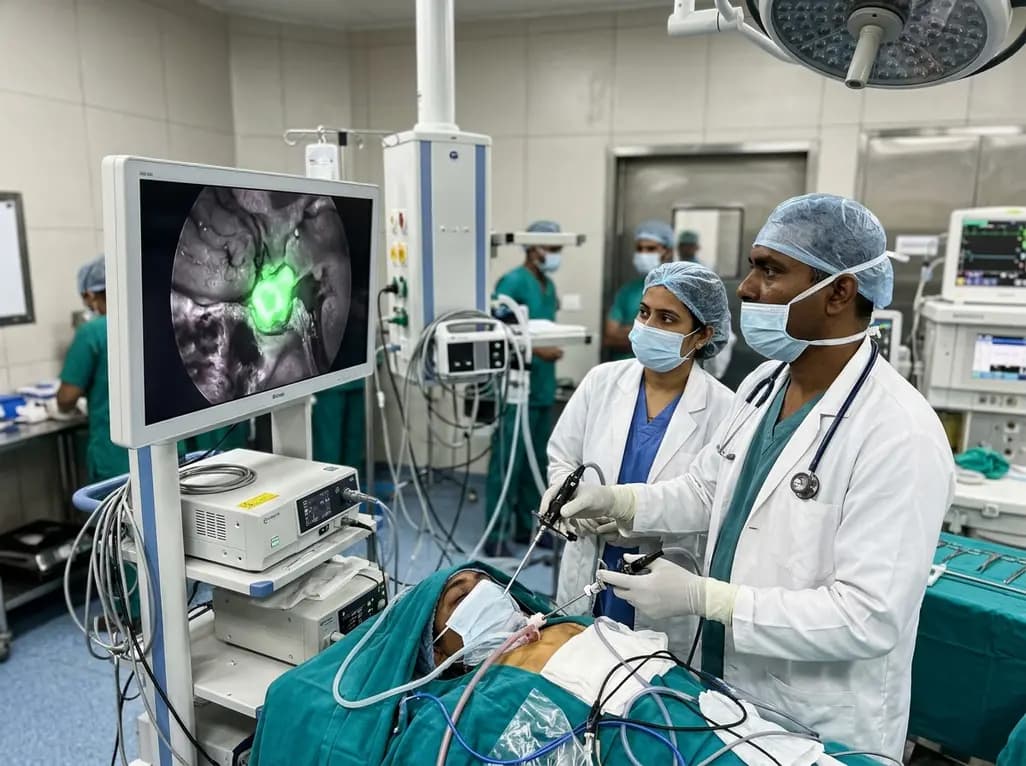
Near-infrared autofluorescence provides real-time label-free optical guidance during endoscopic transsphenoidal pituitary surgery. By highlighting stark signal contrasts between normal pituitary gland and adenomas, this technique aids gross-total tumor resection while safeguarding critical endocrine function.
Today
