.webp&w=384&q=75)

Loading, please wait...
Loading, please wait...
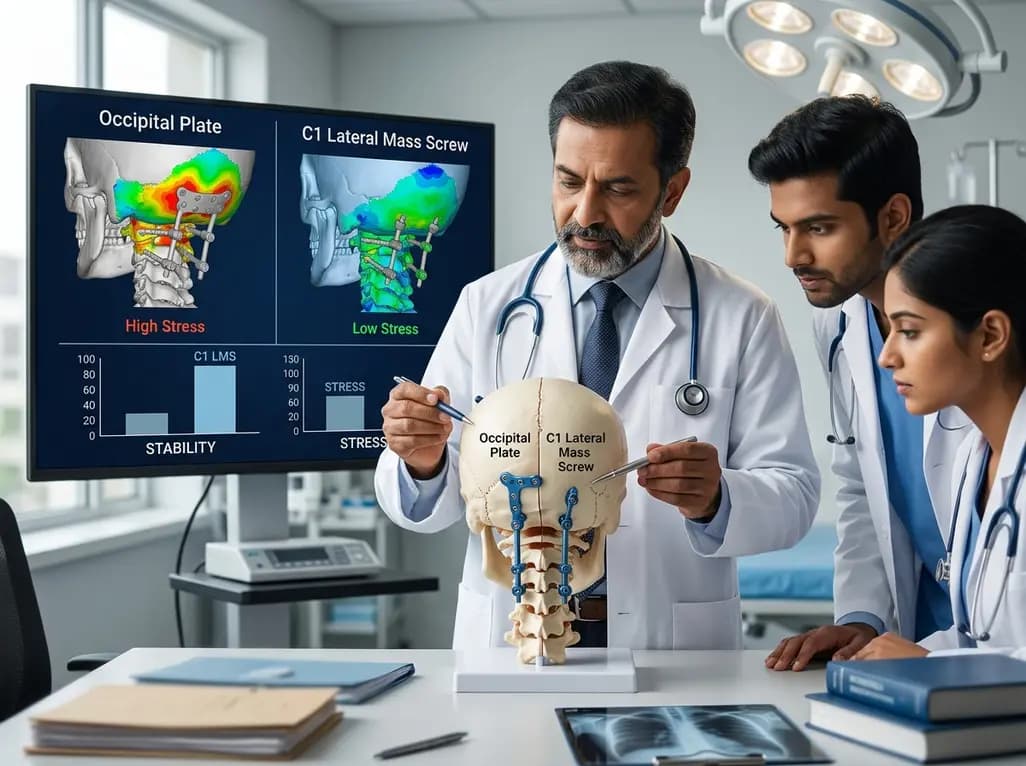
Surgeons often encounter complex anatomical variations when treating craniovertebral junction anomalies. Achieving stable craniocervical malformation fixation remains a primary clinical objective for these high-risk procedures. This recent finite element analysis (FEA) study specifically compared the biomechanical performance of occipital plate (OP) fixation against a modified C1 lateral mass screw (C1LMS) technique. Researchers utilized precise CT data to construct validated models of Basilar Invagination (AOZ-BI) and Atlantoaxial Dislocation (AOZ-AAD).
The results revealed distinct biomechanical differences between the two instrumentation strategies. In both pathological models, the modified C1LMS demonstrated superior stability during flexion and extension. Furthermore, the analysis showed that C1LMS significantly reduced the peak Von Mises stress on the internal fixation components. This reduction suggests a lower risk of hardware failure compared to the longer-lever occipital plate system. Consequently, clinicians might prefer the C1LMS approach to enhance construct longevity.
Additionally, the study highlighted that the modified C1LMS approach preserves more occipital bone. This preservation is vital for patients with poor bone quality. However, the complexity of C1 screw placement requires high surgical precision. Therefore, surgeons must weigh these biomechanical benefits against the technical challenges of the modified screw trajectory. Ultimately, these findings provide a reliable guide for personalized surgical decision-making in complex craniocervical cases.
FEA is a computerized simulation tool that allows researchers to predict how spinal implants and bone structures respond to various physical forces. It helps surgeons evaluate biomechanical stability without needing cadaveric tissue.
The modified C1 lateral mass screw uses a shorter lever arm compared to occipital plates. This design significantly reduces mechanical stress on the screws and rods, leading to improved construct stability in complex malformation models.
Disclaimer: This content is for informational and educational purposes only. It does not constitute professional medical advice, diagnosis, or treatment. Always seek the advice of your physician or other qualified health provider with any questions regarding a medical condition. Refer to the latest local and national guidelines for clinical practice.
References
Dong C et al. Biomechanical differences between occipital plate and modified C1 lateral mass screw in the treatment of complex craniocervical malformations: a finite element analysis. Eur Spine J. 2026 Jun 04. doi: 10.1007/s00586-026-10055-7. PMID: 42237045.
Goel A. Craniovertebral Junction Anomalies: The Role of Atlantoaxial Stabilization. J Craniovertebr Junction Spine. 2015;6(2):49-50.
Harms J, Melcher RP. Posterior C1–C2 Fusion with Polyaxial Screw and Rod Fixation. Spine. 2001;26(22):2467-2471.

Read summarized clinical updates, watch expert medical content, and earn CME certifications right from your smartphone.
Open your smartphone camera to scan and install.





Biomechanical analysis shows modified C1 lateral mass screws offer superior stability and reduced stress in craniocervical malformation fixation vs plates....
4 months ago

Novel diimide and hydrazone scaffolds, particularly compound #C4, synergistically reactivate latent HIV-1 when combined with JQ1 or PKC activators. Demonstrating donor-matched proviral transcription ex vivo and non-canonical signaling, these findings advance shock and kill strategies toward reservoir eradication.
Today

A cross-sectional study reveals that maternal RSV vaccination coverage reached only 43.7% in Argentina, with maternal vaccine knowledge being the sole independent predictor of uptake. Clinicians play a crucial role in eliminating informational and structural barriers to optimize infant health.
Today

Review how tailored exercise programs benefit frail older patients with heart failure. Explore pathophysiological mechanisms, individualized training prescriptions, and strategies to overcome adherence barriers in clinical practice.
Yesterday

This comparative study evaluates posterior labral tears with and without glenohumeral instability, highlighting distinct demographic patterns, MRI underestimation in stable shoulders, and successful arthroscopic repair outcomes.
Yesterday

A clinical study demonstrates that early intervention with tocilizumab, either as monotherapy or bridged with corticosteroids, achieves significant proptosis reduction and resolves active inflammation in treatment-naive thyroid eye disease.
Yesterday
