.webp&w=384&q=75)

Loading, please wait...
Loading, please wait...

Lumbar spinal stenosis is the most frequent indication for spinal surgery among older individuals globally. Spine surgeons and hospital administrators regularly debate the economic value of tubular vs open laminectomy for neural decompression. While both operative approaches achieve comparable one-year functional outcomes, their long-term cost-effectiveness has remained controversial. A rigorous Markov state-transition model evaluated a simulated cohort of ten thousand patients over ten years. The investigation revealed that minimally invasive tubular decompression dominates open laminectomy by delivering superior clinical quality-adjusted life years at significantly lower cumulative healthcare expenditures.
Lumbar spinal stenosis causes progressive neurogenic claudication and functional disability in elderly populations. Consequently, surgical decompression becomes essential when structured nonoperative care fails. Traditional open laminectomy requires wide paraspinal muscle detachment, spinous process excision, and extensive laminar resection. Conversely, minimally invasive tubular decompression accesses the spinal canal through sequential dilators. This muscle-preserving dilation avoids collateral soft tissue destruction, intraoperative hemorrhage, and posterior element destabilization.
However, modern healthcare systems must evaluate procedural innovation alongside fiscal responsibility. Large clinical registries confirm that both surgical approaches yield comparable symptom relief and functional recovery at one year. Therefore, healthcare decision-makers require long-term health economic models to determine if specialized tubular instrumentation justifies widespread implementation. To resolve this question, researchers developed a five-state Markov model simulating ten thousand sixty-five-year-old patients across a ten-year horizon. The model evaluated pure lumbar stenosis without spondylolisthesis, instability, or previous spine surgery. Ultimately, this economic simulation provides clear data regarding long-term surgical value.
To ensure methodological rigor, the investigators built the Markov state-transition framework upon validated empirical data. They derived health utility values from the Spine Patient Outcomes Research Trial using EuroQol-5D questionnaires. Furthermore, perioperative complication parameters reflected the established Nerland propensity-matched registry cohort. In that benchmark analysis, minimally invasive tubular decompression achieved a 10.6% complication rate versus 14.6% for traditional open laminectomy. This demonstrated an absolute complication risk difference of 4.1 percentage points favoring the tubular approach.
Additionally, researchers applied a standardized three percent annual discount rate to all economic costs and health benefits. The model equalized postoperative recurrence, late revision rates, and perioperative mortality across both cohorts. This conservative assumption prevented bias and isolated the direct clinical consequences of surgical access techniques. Direct medical costs included the initial hospital admission, outpatient post-acute care, and complication management over three-month cycles. Consequently, this rigorous modeling framework provided an accurate, unbiased platform to evaluate pure decompressive spine surgery.
The base-case economic evaluation demonstrated decisive financial and clinical advantages favoring tubular decompression over open laminectomy. Over the ten-year simulation, minimally invasive decompression generated 5.95 quality-adjusted life years at a total cost of $26,283 per patient. Meanwhile, open laminectomy yielded 5.91 quality-adjusted life years at an average cost of $30,450 per patient. Thus, tubular surgery saved $4,167 per patient while delivering superior cumulative health utility.
In formal health economics, an intervention that simultaneously improves outcomes and reduces healthcare costs is termed dominant. Tubular decompression achieved economic dominance primarily through lower index procedural expenditures and reduced perioperative complications. Adverse surgical events after open laminectomy frequently necessitate extended hospitalization, revision debridement, and expensive supportive pharmacotherapy. In contrast, tubular decompression preserves spinal architecture and enables earlier hospital discharge. Furthermore, even when investigators completely eliminated the complication difference, tubular decompression still saved $3,454 per patient with identical quality-adjusted life years. Therefore, procedural cost efficiency drives substantial savings regardless of complication rates.
To address clinical and financial uncertainty, researchers conducted extensive one-way, threshold, and probabilistic sensitivity analyses. In probabilistic sensitivity testing, tubular decompression was cost-effective in 81% of iterations at an acceptability threshold of $50,000 per quality-adjusted life year. Furthermore, under wide-uncertainty sampling across the full 95% confidence interval for complication differences, cost-effectiveness persisted in 82% to 88% of simulations.
Additionally, threshold analysis revealed impressive resilience against changing clinical variables. Minimally invasive tubular decompression remained highly cost-effective up to a willingness-to-pay threshold of $100,000 per quality-adjusted life year, unless complication rates exceeded 17.5%. Because high-volume surgical literature consistently reports tubular complication rates below 11%, exceeding this threshold is clinically improbable. Consequently, these findings confirm that the economic dominance of tubular surgery does not depend upon exceptional clinical performance. Instead, cost-effectiveness persists across diverse clinical environments and varied surgeon experience levels.
These health economic findings offer immediate clinical relevance for spinal surgery practice in India. Lumbar spinal canal stenosis represents a leading cause of mobility loss among older Indian citizens. Although open laminectomy remains common across public and secondary hospitals, minimally invasive tubular techniques provide substantial economic benefits. Indian tertiary hospitals face persistent bed shortages, making rapid surgical turnover and shorter postoperative stays essential.
Furthermore, out-of-pocket medical payments remain common for Indian households. Because surgical complications cause severe financial distress for families, adopting safer minimally invasive techniques provides crucial financial protection. Tubular decompression significantly decreases surgical site infections, muscle necrosis, and post-discharge nursing requirements. Moreover, elderly Indian patients regain independence faster, reducing indirect caregiver burdens on working family members. As health insurance penetration and government schemes expand, healthcare administrators should recognize that investing in tubular equipment reduces overall episode expenditures. Therefore, medical institutions must prioritize tubular surgical training to modernize spine care across India.
Tubular decompression achieves economic dominance because it generates higher quality-adjusted life years while lowering total direct medical costs. The technique reduces paraspinal muscle dissection, intraoperative bleeding, and postoperative wound complications. Consequently, patients experience shorter inpatient stays and fewer readmissions. Furthermore, even when complication rates are artificially equalized in health economic models, lower index hospitalization costs ensure that tubular surgery saves thousands of dollars per patient over a ten-year horizon.
Clinical trials show that tubular decompression and open laminectomy produce comparable long-term symptomatic relief and functional mobility. Both techniques effectively relieve neural compression and resolve neurogenic claudication. However, minimally invasive tubular approaches inflict significantly less structural trauma on healthy spinal stabilizers. As a result, patients encounter fewer perioperative complications and enjoy faster functional recovery. The modest gain in quality-adjusted life years stems primarily from avoided surgical morbidity rather than differences in neural decompression efficacy.
Sensitivity analysis indicates that tubular decompression maintains superior cost-effectiveness across wide variations in complication rates. Specifically, the technique remains cost-effective at standard economic thresholds unless its perioperative complication rate rises above 17.5%. Because established spine surgery literature reports tubular complication rates between 8% and 11%, the procedure easily remains well within safe economic boundaries. Moreover, its lower baseline index procedural costs protect healthcare payers against adverse financial risk even in complex patients.
Disclaimer: This content is for informational and educational purposes only... Refer to the latest local and national guidelines for clinical practice.
References

Read summarized clinical updates, watch expert medical content, and earn CME certifications right from your smartphone.
Open your smartphone camera to scan and install.





A 10-year Markov state-transition model shows minimally invasive tubular decompression dominates open laminectomy for pure lumbar spinal stenosis, yielding 5.95 vs 5.91 QALYs and saving $4,167 per patient through reduced complications and lower index costs.
Today
A preclinical study demonstrates that naringin-loaded phytosomes significantly enhance oral bioavailability and provide neuroprotective efficacy in diabetic neuropathy by dampening inflammation, reducing oxidative stress, and relieving neuropathic pain.
Today

An independent clinical evaluation from Assam confirms the excellent safety profile of CERVAVAC, India's indigenous HPV vaccine. Evaluating 3,800 doses administered to 2,000 young girls, researchers documented zero serious adverse events, providing critical real-world evidence to resolve vaccine hesitancy.
Today

Maharashtra FDA Commissioner Tukaram Mundhe warns that widespread non-compliance with food standards is driving a surge in non-communicable diseases. Healthcare professionals must bridge clinical practice with nutritional vigilance, recognizing dietary quality as a primary driver of premature cardiometabolic conditions.
Today
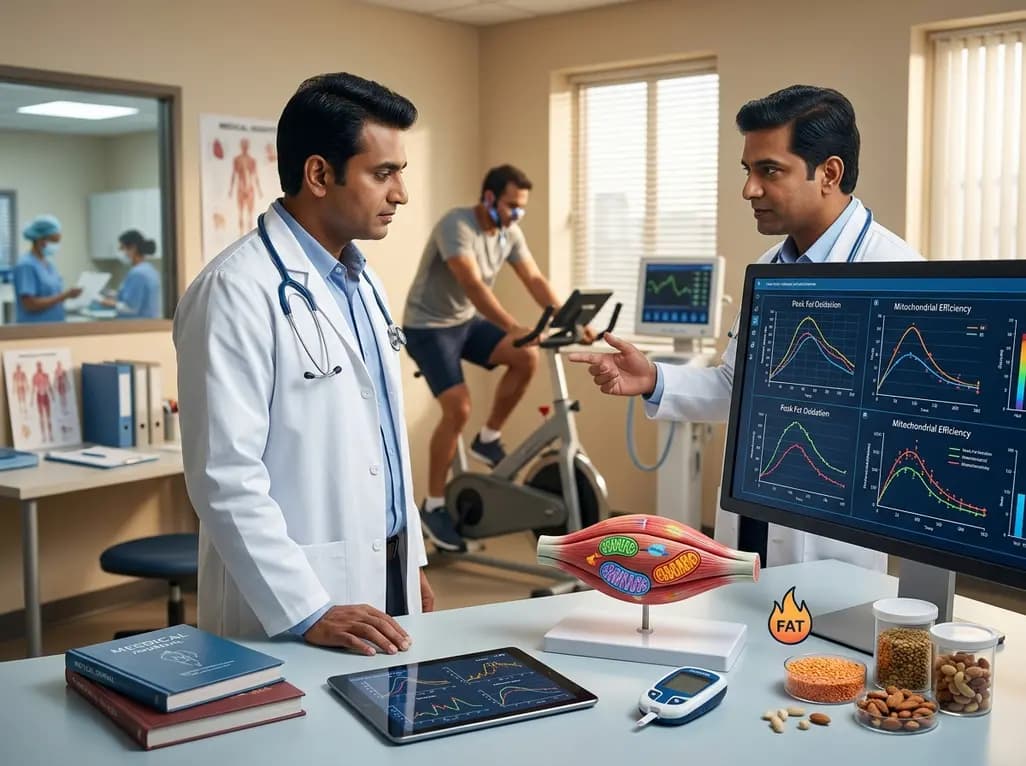
A randomized crossover study reveals that exercise-induced glycogen depletion combined with a low-carbohydrate diet significantly enhances peak fat oxidation without impairing skeletal muscle mitochondrial coupling control or efficiency in healthy trained men.
Today
