.webp&w=384&q=75)

Loading, please wait...
Loading, please wait...

Hands-on examination remains a vital cornerstone of contemporary orthopedic and physical rehabilitation care. However, clinicians often face skepticism regarding manual diagnostic findings. Modern physical medicine demands rigorous scientific precision during routine musculoskeletal assessment. Historical controversies frequently treat manual tests as competing proprietary techniques rather than structured measurements. A groundbreaking conceptual paradigm now reframes these tactile evaluations through formal measurement science. By adopting established instrument development standards, clinicians can transform subjective touch into an accountable diagnostic process.
For decades, healthcare providers have debated the therapeutic and diagnostic validity of manual therapy schools. Consequently, clinicians frequently argue over specific palpation maneuvers rather than examining the underlying measurement process. Research literature has compounded this confusion by producing conflicting reliability statistics. Many studies tested examiners without defining clear clinical targets or establishing standardized training protocols. As a result, poor inter-rater agreement often reflected flawed study methodology rather than the failure of manual touch. When researchers evaluate uncalibrated examiners, they simply measure noise within the sensory system. Therefore, manual examination requires a fundamental conceptual overhaul. Healthcare professionals must view manual examination as a measurement instrument instead of an ideological tradition. This perspective shifts clinical focus away from sectarian technique disputes and toward reproducible diagnostic performance. Furthermore, treating hands-on palpation as a formal instrument demands strict accountability for tactile observations. Clinicians collect sensory signals, analyze tissue resistance, and synthesize findings into functional judgments. Thus, reframing manual contact as an objective data gathering mechanism establishes a solid foundation for musculoskeletal assessment.
The Hands-On Data Acquisition and Analysis framework, termed HODA-A, introduces a structured model for physical evaluation. Specifically, this theoretical model conceptualizes musculoskeletal examination as an active sensorimotor measurement process. Under HODA-A, the clinician functions as an embodied measurement tool rather than an external observer. Tactile information does not exist as passive data on the body surface. Instead, examiners actively acquire complex mechanical signals through controlled touch, movement, and joint loading. The human hand senses tissue compliance, temperature differences, and movement restrictions through specialized mechanoreceptors. Subsequently, the practitioner processes these sensory inputs through cortical cognitive pathways to formulate a clinical diagnosis. Because clinical judgments arise from clinician perception, HODA-A classifies hands-on assessment as a clinician-reported outcome measure. However, human perception remains vulnerable to cognitive biases and fluctuating attention. Without structured operating procedures, these biological variations compromise diagnostic fidelity. The HODA-A framework addresses these vulnerabilities by establishing explicit criteria for tactile data acquisition. Clinicians must recognize how hand placement, pressure magnitude, and movement speed influence incoming data streams. Consequently, systematic observation replaces intuitive guesswork during routine clinical consultations.
To establish scientific legitimacy, manual assessment must adhere to rigorous international measurement guidelines. The Consensus-based Standards for the selection of health Measurement Instruments, known as COSMIN, provide this essential methodological blueprint. Researchers historically designed COSMIN standards to evaluate patient-reported outcome measures, such as pain questionnaires and functional scales. Nevertheless, the core psychometric principles of COSMIN apply directly to clinician-reported outcome instruments. Clinical touch poses distinct challenges because practitioners deal with subjective sensory data streams rather than discrete numerical survey responses. Despite these complexities, COSMIN principles offer the structural rigor required to validate manual assessment tools. The framework requires investigators to demonstrate content validity, structural validity, reliability, measurement error, and responsiveness. Moreover, COSMIN demands complete transparency regarding how clinicians capture and interpret physical findings. By adopting these international standards, manual therapy moves beyond traditional empirical debates into mainstream clinical epidemiology. Clinicians worldwide can finally evaluate manual techniques using the same scientific scrutiny applied to diagnostic imaging. Therefore, adapting COSMIN principles provides the gold standard roadmap for legitimizing hands-on clinical examination.
The HODA-A model highlights construct definition as the absolute first step in measurement validation. Historically, researchers evaluated reliability before defining the specific physiological construct under investigation. For instance, testing spinal joint stiffness without defining tissue properties inevitably produces contradictory results. When clinicians fail to define the construct, they cannot determine whether tests measure joint hypomobility, muscle guarding, or pain provocation. Consequently, COSMIN mandates content validity and construct definition before inter-examiner reliability testing occurs. Furthermore, HODA-A emphasizes that examiner calibration must precede clinical outcome trials. If clinicians possess variable tactile sensitivity, researchers cannot determine whether discrepancies reflect patient anatomy or examiner inconsistency. Instrument calibration represents standard protocol for laboratory equipment, yet researchers frequently neglect calibration for human examiners. By calibrating assessors through standardized pressure training and tissue simulators, healthcare teams dramatically minimize measurement error. Examiners learn to apply precise compression force, vector alignment, and movement amplitude. In addition, calibrated examiners demonstrate far superior diagnostic concordance during patient examinations. Thus, rigorous construct clarity paired with systematic examiner training ensures reliable diagnostic reproducibility across diverse clinical environments.
Evaluating clinician-reported manual tests requires a departure from traditional gold standard diagnostic models. In hands-on assessment, the primary measurement construct represents the clinician's synthesized diagnostic judgment itself. Because human tissue compliance lacks an infallible external reference standard, classical criterion validity cannot evaluate every manual test. Instead, investigators must assess construct validity through structured hypothesis testing. For example, researchers can hypothesize that manual joint resistance correlates directly with radiological degenerative changes or symptom intensity. When study results confirm these predefined hypotheses, the manual assessment tool demonstrates robust construct validity. Furthermore, researchers must differentiate between relative reliability and absolute measurement error. High correlation coefficients alone do not guarantee clinical utility if the standard error of measurement remains excessive. Clinicians also require evidence regarding instrument responsiveness to detect meaningful clinical change following therapeutic interventions. When patients receive treatments, the manual instrument should detect subtle alterations in tissue resistance and mobility. Therefore, implementing COSMIN hypothesis testing clarifies what manual tests actually measure. This scientific clarity empowers musculoskeletal practitioners to make defensible, evidence-based management decisions.
The Hands-On Data Acquisition and Analysis framework conceptualizes manual musculoskeletal examination as an active, clinician-reported measurement process rather than an isolated manual technique. Specifically, the framework views the clinician as a biological measurement instrument who gathers and interprets tactile sensory data streams. By defining the underlying construct and standardizing palpation procedures, HODA-A establishes a rigorous scientific foundation for evaluating the validity, reliability, and clinical utility of manual physical examinations.
COSMIN standards provide transparent, internationally recognized criteria for evaluating health measurement instruments. Although researchers originally created COSMIN for patient surveys, the core measurement principles apply directly to clinician-reported outcomes. Manual examination generates complex tactile data that requires formal psychometric validation. Therefore, applying COSMIN guidelines enables researchers to assess construct definition, examiner calibration, measurement error, and hypothesis testing systematically. This rigorous approach replaces endless anecdotal technique debates with objective, reproducible clinical evidence.
Examiner calibration trains clinicians to apply consistent force, speed, and spatial orientation during manual physical assessment. Because human sensory perception varies widely across practitioners, uncalibrated examiners introduce substantial noise into diagnostic findings. Structured calibration aligns sensory interpretation across different clinicians, which dramatically reduces random measurement error. Consequently, calibrated practitioners achieve higher inter-rater agreement and diagnostic accuracy. This standardization ensures that physical findings accurately reflect true tissue pathology rather than individual examiner variability.
Disclaimer: This content is for informational and educational purposes only... Refer to the latest local and national guidelines for clinical practice.
References

Read summarized clinical updates, watch expert medical content, and earn CME certifications right from your smartphone.
Open your smartphone camera to scan and install.





A novel theoretical framework reframes hands-on musculoskeletal assessment as a clinician-reported outcome measurement instrument using COSMIN principles. This approach emphasizes construct clarity, examiner calibration, and structured validation over historical technique debates.
Today
Neural repair therapies represent a critical paradigm shift in stroke recovery by targeting surviving brain circuits beyond the acute therapeutic window. This review analyzes behavioral, biological, pharmacological, and neuromodulatory advances shaping modern poststroke rehabilitation.
Today

New evidence from Karolinska Institutet shows women vaccinated against HPV prior to conception have significantly lower rates of preterm birth and major perinatal complications. Clinicians in India can leverage these findings to strengthen adolescent immunisation and reproductive health advocacy.
Today
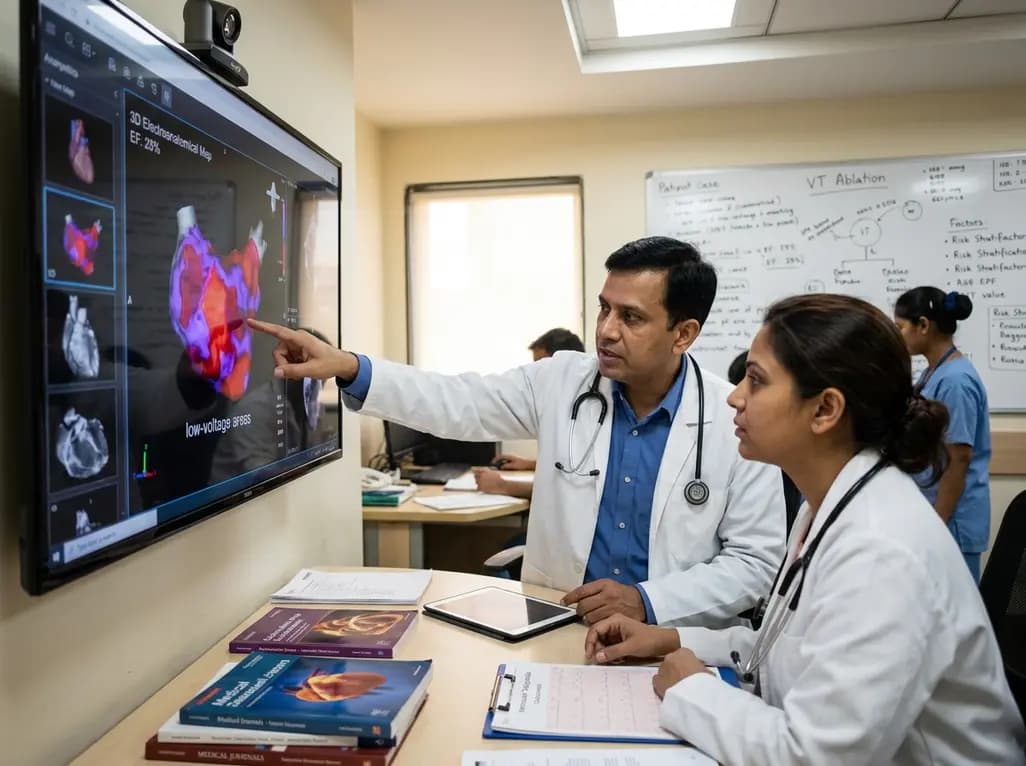
Combining left ventricular low-voltage area with ejection fraction significantly improves risk stratification for end-stage heart failure following ventricular tachycardia ablation in non-ischemic cardiomyopathy, guiding timely multidisciplinary intervention.
Today

A breakthrough study reveals that loss of SELENOT in hypothalamic POMC neurons triggers premature cellular senescence, ATF6α stress activation, and ER calcium depletion, linking neuroendocrine decay to metabolic disease.
Today
