.webp&w=384&q=75)

Loading, please wait...
Loading, please wait...

The integration of foundation models into healthcare workflows has accelerated rapidly, yet unquantified hallucinations continue to challenge clinical adoption. Medical professionals require dependable statistical assurances when artificial intelligence assists in differential diagnosis, triage, or clinical documentation. To address these critical vulnerabilities, researchers are increasingly turning to conformal prediction methods to establish mathematically rigorous error bounds. By converting raw generative outputs into reliable confidence sets, this statistical framework offers unprecedented transparency for clinical decision support systems worldwide.
Large language models generate fluent natural language, but they often present erroneous medical information with unyielding confidence. Consequently, clinicians cannot readily distinguish between verifiable facts and misleading hallucinations. Conformal prediction addresses this issue by replacing single-point predictions with rigorously calibrated prediction sets that guarantee coverage at a target significance level. Therefore, instead of receiving a single uncertain diagnosis, a medical team receives a bounded set containing the true condition with ninety-five percent statistical confidence.
Furthermore, this mathematical guarantee operates without requiring strict parametric assumptions regarding underlying data distributions. In clinical environments, patient populations vary considerably across demographic and geographic boundaries. As a result, distribution-free statistical tools provide crucial robustness against dataset shift and unexpected clinical variability. By incorporating conformal prediction methods into hospital documentation tools and triage algorithms, healthcare systems can deploy automated assistance while maintaining strict safeguards for patient safety and regulatory compliance.
A recent scoping review systematically examined over one hundred and six studies, categorising contemporary literature into six distinct methodological groups. This comprehensive taxonomy distinguishes between classification tasks, closed-book medical examination benchmarks, structured entity extraction, and open-ended clinical generation. Moreover, the review highlights critical trends in model selection, benchmarking datasets, and uncertainty estimation strategies across modern healthcare AI research.
Specifically, the operational taxonomy reveals substantial disparities in how researchers measure model reliability. Many historical studies focused exclusively on multiple-choice medical examinations, which fail to reflect nuanced real-world patient encounters. In contrast, emerging conformal frameworks now evaluate complex generative tasks, including clinical summarisation and automated discharge drafting. In addition, researchers are expanding their focus to evaluate both proprietary commercial systems and open-source foundation models. By categorising these disparate techniques, the taxonomy provides a structured blueprint for developers building reliable medical decision aids that meet rigorous clinical benchmarks.
Traditionally, uncertainty quantification in deep learning relied on softmax logits and token-level output probabilities. However, the scoping review reveals that logit-free methods consistently outperform logit-based techniques across diverse generative benchmarks. Notably, logit-free approaches achieve lower mean absolute coverage error while maintaining smaller, more informative prediction set sizes. This empirical advantage proves particularly pronounced in open-ended clinical generation tasks where conventional token calibration fails.
Moreover, logit-based calibration suffers from several severe limitations in medical applications. Proprietary models frequently mask internal token logits, preventing external audit and verification. Furthermore, arbitrary tokenisation schemes and idiosyncratic decoding strategies often distort raw probabilistic calibration. Conversely, logit-free techniques leverage black-box signals such as semantic clustering, self-consistency sampling, and linguistic stability across iterative prompts. Consequently, these methods evaluate true conceptual stability rather than superficial token statistics. As a result, clinicians receive more dependable uncertainty metrics when consulting artificial intelligence for complex patient assessments.
The application of conformal prediction to multimodal architectures, such as large vision-language models, reveals distinct behavioral patterns. In medical practice, these vision models analyze diagnostic imaging, histopathology slides, and dermatological lesions alongside textual patient histories. Interestingly, the scoping analysis demonstrates that vision-language models exhibit higher overcoverage error compared to text-only language models, alongside virtually non-existent undercoverage error.
Consequently, multimodal models demonstrate exceptionally conservative behavior during uncertainty calibration. While this excessive caution ensures that the true diagnostic entity is rarely omitted from the prediction set, it introduces a pronounced coverage-informativeness trade-off. For instance, an imaging model might generate an excessively broad differential diagnosis set to satisfy the nominal confidence threshold. Therefore, radiologists and clinicians must evaluate multiple potential conditions, which increases cognitive workload. As multimodal foundation models proliferate across diagnostic departments, refining this balance between safety guarantees and diagnostic precision remains an essential priority for medical AI engineers.
The deployment of artificial intelligence in India's healthcare ecosystem presents unique challenges and remarkable opportunities. Indian tertiary hospitals, district healthcare facilities, and rural primary health centres manage immense patient volumes with varying resource constraints. Furthermore, regional epidemiological variations and linguistic diversity complicate automated clinical documentation. Applying robust conformal prediction methods allows Indian health systems to implement AI triage and diagnostic assistants with verifiable mathematical guarantees.
Moreover, distribution-free conformal calibration can mitigate disparities arising from regional clinical data imbalances. When foundation models encounter underrepresented Indian patient demographics or diverse vernacular medical transcripts, conformal monitors identify heightened uncertainty immediately. Consequently, the automated workflow can automatically flag ambiguous cases and route them directly to senior consultants for manual review. This selective triage mechanism optimizes clinical efficiency across overburdened outpatient departments while preserving strict diagnostic standards. Thus, conformal prediction serves as an indispensable bridge between innovative foundation models and practical healthcare delivery in India.
To ensure safe integration into clinical workflows, developers and healthcare institutions must address ongoing methodological gaps in uncertainty estimation. First, researchers must expand evaluation benchmarks beyond standardised medical exams to include genuine electronic health records and real-world multi-institutional cohorts. Additionally, developers must design intuitive user interfaces that present conformal prediction sets clearly to practicing physicians without inducing alarm fatigue.
Furthermore, future research must improve the efficiency of logit-free sampling techniques to enable real-time clinical deployment. Standard self-consistency generation requires multiple inference passes, which increases latency and operational compute costs in busy hospital environments. Developing lightweight semantic uncertainty metrics will therefore accelerate bedside adoption. By uniting rigorous statistical guarantees with practical clinical workflows, conformal prediction will empower medical professionals to harness artificial intelligence safely and effectively.
Standard calibration adjusts predicted probabilities to align with long-term empirical accuracy across an entire cohort. However, it cannot offer explicit instance-level safety guarantees. Conformal prediction constructs finite-sample prediction sets containing the ground truth with a user-defined statistical confidence level. Consequently, clinicians receive mathematically guaranteed bounds on diagnostic uncertainty. This transparent bounding enables doctors to recognize ambiguous clinical outputs immediately and adjust therapeutic workflows accordingly.
Logit-based uncertainty scoring relies heavily on raw token probabilities that proprietary language models frequently distort or conceal. Furthermore, complex decoding strategies and vocabulary tokenisation often impair raw probability calibration. In contrast, logit-free methods utilize semantic consistency, sampling diversity, and linguistic stability across repeated generations. As a result, these black-box signals directly evaluate conceptual meaning, yielding smaller prediction sets and significantly lower coverage errors during complex clinical queries.
Large vision-language models frequently demonstrate conservative behavior during multimodal diagnostic evaluations. Research indicates that conformal frameworks applied to multimodal networks produce higher overcoverage error with minimal undercoverage error. Therefore, these systems often generate broad prediction sets to avoid missing pathological findings. While this cautious approach prevents diagnostic omissions, it reduces overall clinical informativeness, requiring practitioners to verify wider ranges of candidate differential diagnoses manually.
Disclaimer: This content is for informational and educational purposes only and does not constitute medical advice, diagnosis, or treatment. Healthcare professionals must exercise independent clinical judgement when evaluating artificial intelligence tools or managing patient care. Refer to the latest local and national guidelines for clinical practice.
References
Ashby AE et al. Uncertainty-aware large language models: a scoping review of conformal prediction methods. Philos Trans A Math Phys Eng Sci. 2026 Aug 27. doi: undefined. PMID: 42656162.
Angelopoulos AN, Bates S. A gentle introduction to conformal prediction and distribution-free uncertainty quantification. arXiv. 2021; arXiv:2107.07511.
Rajpurkar P, Chen E, Banerjee O, Topol EJ. AI in health and medicine. Nat Med. 2022;28(1):31-38.

Read summarized clinical updates, watch expert medical content, and earn CME certifications right from your smartphone.
Open your smartphone camera to scan and install.





A comprehensive scoping review evaluates conformal prediction methods for large language models, demonstrating how logit-free uncertainty quantification enhances clinical reliability and diagnostic safety.
last month

With post-monsoon dengue surges threatening South Asian health systems, physicians must refine triage and management. This guide covers vital warning signs, plasma leakage detection, crystalloid titration, and vector containment strategies to prevent mortality during seasonal arboviral epidemics.
Today

Findings from Project Viva indicate that sustained postpartum weight retention, rather than excessive gestational weight gain alone, directly worsens women's mid-life cardiovascular health, degrading blood pressure and glycemic parameters decades after delivery.
Today
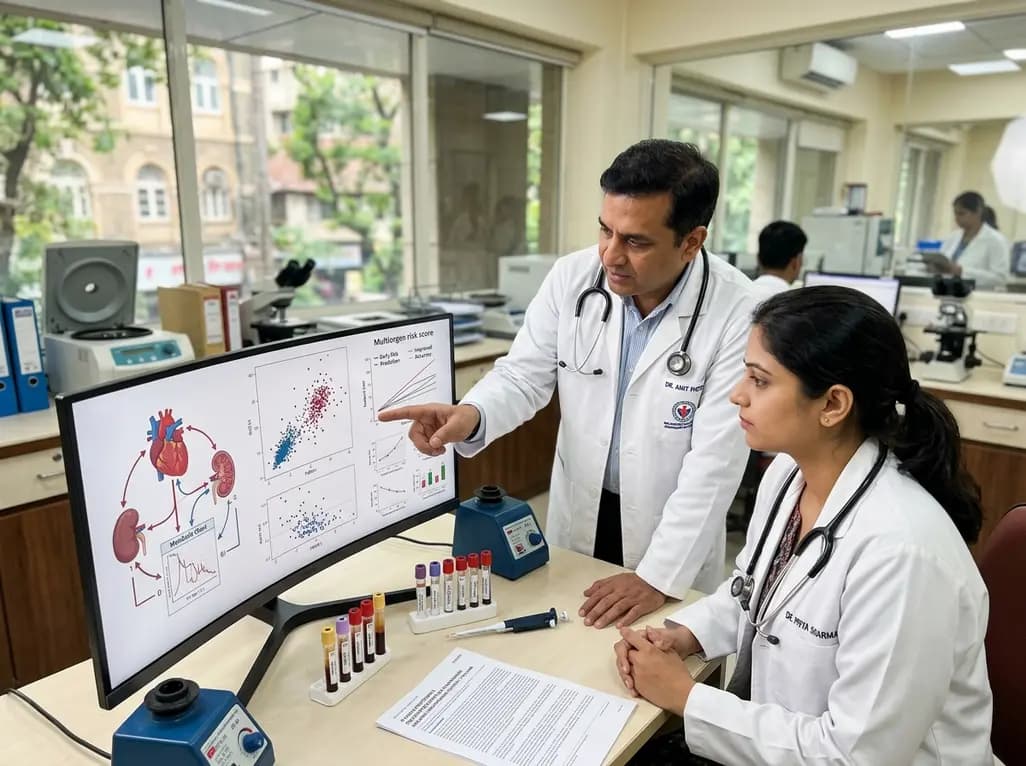
A large UK Biobank study reveals that plasma proteomic signatures capture preclinical organ damage and improve multiorgan risk prediction across early CKM syndrome stages 0 to 2 beyond traditional PREVENT clinical models.
Today

A retrospective CBCT study reveals that superior TMJ space asymmetry correlates moderately with occipital condyle-atlas-axis asymmetry in unilateral TMJ osteoarthritis, highlighting an imaging correlate between jaw biomechanics and upper cervical alignment rather than a standalone diagnostic marker.
Today

A Bayesian multilevel meta-analysis reveals that aerobic training combined with moderate carbohydrate restriction modestly lowers HbA1c in type 2 diabetes. However, sparse data and very low certainty leave incremental benefits over exercise or diet alone unproven, highlighting the need for individualized care.
Today
