.webp&w=384&q=75)

Loading, please wait...
Loading, please wait...
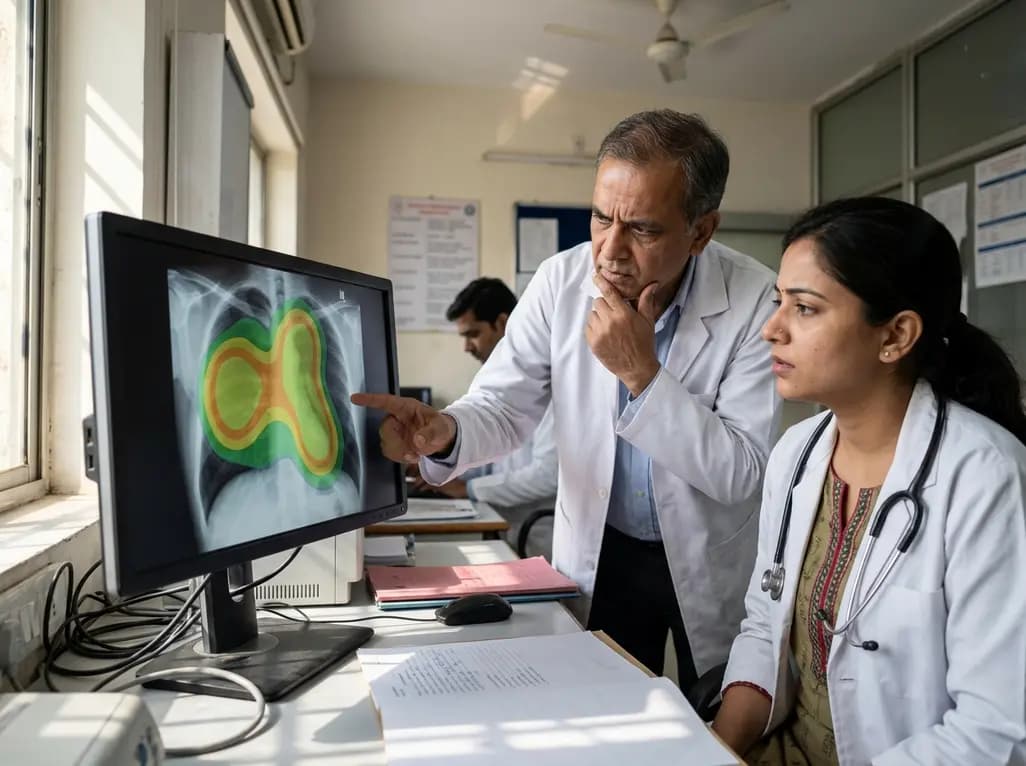
Machine learning (ML) is rapidly transforming modern healthcare delivery across India and the world. However, safe clinical decisions demand highly reliable uncertainty estimates. Standard ML models often fail to provide these necessary safeguards. Consequently, Conformal Prediction in Healthcare has emerged as a promising solution to this problem. This tool converts standard model predictions into reliable sets of labels. These sets contain the true answer with a specific, user-defined probability. Specifically, practitioners use it to ensure that an AI's confidence actually matches its accuracy.
Conformal prediction (CP) relies on a calibration sample to function effectively. Traditionally, many experts believed that CP works for samples of any size. This flexibility makes it very attractive for medical domains where patient data is often scarce. Nevertheless, new research highlights a significant gap in this promise. Although the statistical math remains valid for any size, small sets cause practical problems. Researchers recently analyzed how calibration size affects real-world AI utility. They found that smaller calibration samples lead to highly variable results that may not help a physician in a high-stakes environment.
When calibration sets are too small, the uncertainty regions generated by the AI may become too wide for clinical use. Therefore, a doctor might receive a list of too many possibilities for a single diagnosis. This increase in the size of the prediction set makes the AI advice much less helpful. For instance, in medical image classification, an overly broad prediction set might include several unrelated diseases. Consequently, the clinician must still do the bulk of the work to rule out incorrect options. The practical utility of these tools depends heavily on having a sufficiently large and representative calibration set.
The study used various medical image classification tasks to prove these limitations. Results clearly showed that practical utility depends on data volume more than theoretical guarantees suggest. Furthermore, practitioners should not rely solely on the math behind CP. Instead, they must evaluate the actual precision and size of the uncertainty sets before deploying them. In addition, larger datasets remain the gold standard for creating reliable AI systems. Ultimately, medical AI requires both robust mathematical frameworks and sufficient clinical evidence to be considered truly safe.
It provides a mathematical guarantee that the AI\'s prediction set includes the correct diagnosis a certain percentage of the time, such as 95% of the cases.
While the theory works for small sets, the results become too vague or variable to be useful if the calibration sample size is insufficient.
Yes, but the resulting prediction sets may be too large to offer specific diagnostic value, making large-scale data collection still necessary.
Disclaimer: This content is for informational and educational purposes only and does not constitute medical advice or a professional relationship. Always seek the advice of a qualified healthcare provider for any medical condition or treatment. Refer to the latest local and national guidelines for clinical practice.
References
1. Kladny KR et al. A critical perspective on finite sample conformal prediction theory in medical applications. Artif Intell Med. 2026 Jun 01. doi: undefined. PMID: 42224800.
2. Mehrtens H et al. Pitfalls of Conformal Predictions for Medical Image Classification. arXiv preprint arXiv:2506.18162. 2025.
3. Lu C et al. Fair Conformal Predictors for Applications in Medical Imaging. AAAI Conference on Artificial Intelligence. 2023.
"
Read summarized clinical updates, watch expert medical content, and earn CME certifications right from your smartphone.
Open your smartphone camera to scan and install.





A recent study critiques the use of conformal prediction in medical AI, highlighting that practical utility depends heavily on calibration sample size....
4 months ago

Review how tailored exercise programs benefit frail older patients with heart failure. Explore pathophysiological mechanisms, individualized training prescriptions, and strategies to overcome adherence barriers in clinical practice.
Today

Leucine Rich Bio has introduced South Asia's first comprehensive vaginal microbiome test, BugSpeaks. By profiling microbial dysbiosis, pathogens, and antimicrobial resistance, this next-generation diagnostic platform provides clinicians with deeper insights into recurrent infections, fertility, and reproductive health.
Today

In high-risk pulmonary embolism complicated by severe anemia and active uterine bleeding, systemic thrombolysis is contraindicated. Large-bore aspiration thrombectomy provides rapid hemodynamic rescue without fibrinolysis, supported by inferior vena cava filter placement and multidisciplinary critical care.
Today

This comparative study evaluates posterior labral tears with and without glenohumeral instability, highlighting distinct demographic patterns, MRI underestimation in stable shoulders, and successful arthroscopic repair outcomes.
Today

A clinical study demonstrates that early intervention with tocilizumab, either as monotherapy or bridged with corticosteroids, achieves significant proptosis reduction and resolves active inflammation in treatment-naive thyroid eye disease.
Today
