

Loading, please wait...
Loading, please wait...

Epidemiologists have long recognized unexplained health disparities in psychiatric cohorts. However, the shared biological etiology connecting CNS disease and cancer remained enigmatic for decades. Historically, clinicians assumed that lifestyle habits, adverse health behaviors, and psychotropic medications entirely drove altered tumor rates. Fortunately, modern statistical genetics offers sophisticated methodologies to investigate shared germline architecture. A landmark genome-wide investigation has now clarified the genetic overlap and causal relationships linking central nervous system disorders with multiple common malignancies. By evaluating global correlations, pleiotropic loci, and Mendelian randomization, this research reveals fundamental biological mechanisms linking psychiatric illness with cancer predisposition.
For many years, clinicians observed complex patterns of malignancy among individuals with severe psychiatric conditions. Nevertheless, observational studies struggled to account for environmental factors like smoking, socioeconomic adversity, and unequal medical access. To resolve these limitations, investigators analyzed extensive genome-wide association study datasets spanning ten central nervous system disorders and fourteen cancers. Consequently, this rigorous statistical approach minimized classical behavioral confounders to assess underlying germline architecture accurately.
Importantly, the findings demonstrated substantial global genetic correlations linking particular mental health conditions to specific tumors. Schizophrenia showed significant positive genetic correlations with both lung cancer and breast cancer, especially estrogen receptor-positive breast cancer subtypes. Furthermore, the analysis revealed strong genetic correlations between neuroticism and both lung cancer and ovarian cancer, including serous ovarian carcinoma. These correlations demonstrate that psychiatric conditions and neoplastic diseases share intrinsic biological vulnerabilities. Therefore, physicians should no longer view psychiatric illnesses as isolated brain disorders. Instead, inherited genomic pathways influence cellular regulation throughout the entire body. As a result, these findings provide a vital biological foundation connecting mental health with oncological risk in clinical medicine.
Observational correlations do not necessarily demonstrate direct causation between comorbid conditions. Therefore, researchers applied bidirectional Mendelian randomization to determine whether genetic liability to psychiatric disorders directly increases cancer risk. This statistical methodology uses inherited genetic variants as instrumental variables, effectively simulating a lifelong clinical trial. Consequently, Mendelian randomization circumvents reverse causation and traditional environmental confounding effectively.
Notably, the results confirmed that genetic liability to schizophrenia causally increases lung cancer risk, showing an odds ratio of 1.14. Additionally, the analysis established a significant causal association between schizophrenia and breast cancer, with an odds ratio of 1.05. Furthermore, rigorous sensitivity analyses confirmed that horizontal pleiotropy did not distort these causal estimates. Thus, elevated malignancy rates in schizophrenia patients do not solely arise from heavy tobacco use, poor diet, or metabolic side effects. Instead, inherited genetic variations directly modify cellular susceptibility to malignant transformation. Consequently, clinical teams must recognize this biological vulnerability early in patient management. By understanding these causal connections, healthcare providers can design targeted cancer prevention programs tailored to psychiatric patients across healthcare settings.
While genome-wide correlations offer valuable overviews, they often mask intricate regional chromosomal interactions across complex genomes. Therefore, investigators partitioned the entire human genome into discrete linkage disequilibrium blocks to examine local genetic relationships. Consequently, this detailed genomic partitioning discovered significant local correlations between schizophrenia, lung cancer, and breast cancer across fourteen distinct genomic regions. These chromosomal hotspots highlight specific genomic neighborhoods where shared biological mechanisms operate.
Moreover, a comprehensive cross-trait meta-analysis successfully identified twenty-four pleiotropic loci shared between these joint phenotypes. Through summary-data-based Mendelian randomization, researchers mapped these loci to eight functional shared genes. These pivotal genes coordinate essential biological processes, including cell cycle checkpoints, DNA damage repair, transcriptional activity, and epigenetic modifications. Accordingly, perturbations within these shared molecular switches simultaneously elevate susceptibility to neuropsychiatric dysfunction and malignant cellular growth. Furthermore, these identified genes provide promising targets for novel drug development and biomarker research. By pinpointing these shared genetic loci, molecular scientists can explore interventions that target common biochemical pathways across oncology and psychiatry effectively.
Identifying the specific tissues and cell types where shared genes express is essential for therapeutic translation and clinical insight. Remarkably, the investigation demonstrated significant enrichment of single-nucleotide polymorphism heritability for both schizophrenia and lung cancer within human T lymphocytes. This shared cellular enrichment strongly implicates systemic immune dysfunction in the pathophysiology of both conditions.
Indeed, adaptive immunity and chronic inflammation play decisive roles in neurodevelopmental pathways and oncogenesis. Defective T-cell surveillance prevents the effective eradication of abnormal cells, thereby facilitating neoplastic proliferation. Simultaneously, persistent inflammatory signaling impairs neural connectivity and cerebral neuroplasticity. Furthermore, neuroendocrine dysregulation linked to psychiatric distress alters immune cell signaling and promotes a protumorigenic environment. As a result, an aberrant immunological milieu connects psychiatric vulnerability with tumor initiation. Consequently, monitoring circulating immune biomarkers could help clinicians assess joint disease vulnerability in the future. Ultimately, uniting neurobiology and tumor immunology provides critical insights into how systemic immunopathology drives seemingly disparate illnesses across patients.
These genetic findings carry urgent clinical implications for medical practice, especially in resource-constrained healthcare environments. Historically, psychiatric patients have experienced pervasive diagnostic overshadowing, where medical providers dismiss early somatic symptoms as psychogenic manifestations. Consequently, cancer diagnoses in psychiatric cohorts frequently occur at advanced, incurable stages, resulting in elevated mortality rates.
Therefore, oncologists, psychiatrists, and primary care physicians must build structured multidisciplinary care pathways. In particular, healthcare providers should prioritize proactive cancer surveillance for individuals diagnosed with schizophrenia and related conditions. For example, clinicians must ensure regular screening through low-dose thoracic computed tomography and screening mammography. Moreover, physicians must monitor metabolic and immune parameters when administering psychotropic regimens. While addressing lifestyle risk factors like tobacco use remains critical, clinicians must recognize that intrinsic genetic liability exacerbates malignancy risks. By integrating preventive cancer surveillance into community mental healthcare, clinical teams can detect tumors earlier, eliminate healthcare disparities, and save lives across vulnerable patient populations.
Schizophrenia causally increases lung cancer risk through shared genomic loci, single-nucleotide polymorphisms enriched in T lymphocytes, and impaired immune surveillance. While heavy smoking remains a frequent behavioral confounder, Mendelian randomization confirms that inherited genetic variants directly alter cellular repair mechanisms and heighten susceptibility to neoplastic transformation independently of lifestyle behaviors.
Genome-wide association studies demonstrate significant global genetic correlation between neuroticism and ovarian cancer, particularly serous ovarian carcinoma. Summary-data-based Mendelian randomization identified functional genes shared across these conditions. These shared genetic factors modulate systemic stress pathways, neuroendocrine signaling, and cellular homeostasis, which collectively create a biological environment susceptible to ovarian carcinogenesis.
Clinicians should implement proactive, multidisciplinary screening programs tailored to high-risk psychiatric cohorts. Rather than waiting for symptomatic presentations, healthcare teams must ensure adherence to routine mammography, cervical cytology, and thoracic low-dose computed tomography. Overcoming diagnostic overshadowing and addressing metabolic side effects ensures earlier malignancy detection and substantially improves overall survival.
Disclaimer: This content is for informational and educational purposes only and does not constitute medical advice, diagnosis, or treatment. It is intended to support, not replace, the relationship between clinicians and their patients. Always seek the advice of a qualified healthcare provider with any questions regarding a medical condition. Refer to the latest local and national guidelines for clinical practice.
References

Read summarized clinical updates, watch expert medical content, and earn CME certifications right from your smartphone.
Open your smartphone camera to scan and install.





A genome-wide study reveals shared genetic architecture and causal links between CNS diseases and cancers. Findings show schizophrenia causally increases lung and breast cancer risk, with pleiotropic loci and T-cell heritability highlighting the need for multidisciplinary screening.
Today

The DOMINO study protocol presents a multidisciplinary implementation mapping approach to overcome provider, patient, and payer barriers to antiobesity medications, offering vital insights for Indian clinicians managing the growing diabesity burden.
Today

An intracranial EWSR1::CREM fusion sarcoma in a 31-year-old female manifested as a paraneoplastic inflammatory syndrome with anemia and secondary infertility. The dural mass mimicked meningioma, but gross-total resection resolved her systemic inflammation and restored natural fertility within one month.
Today

A real-world cohort study of 6,537 patients from the FOUNTAIN platform demonstrates that initiating finerenone significantly reduces albuminuria by 40.7% with minimal eGFR decline and manageable hyperkalemia risk, confirming its practical effectiveness and safety in diabetic kidney disease.
Yesterday

A comprehensive analysis of MAP therapy resistance in osteosarcoma, examining canonical and non-canonical mechanisms across damage avoidance, enhanced DNA repair, and replication stress tolerance to identify novel vulnerabilities.
Today
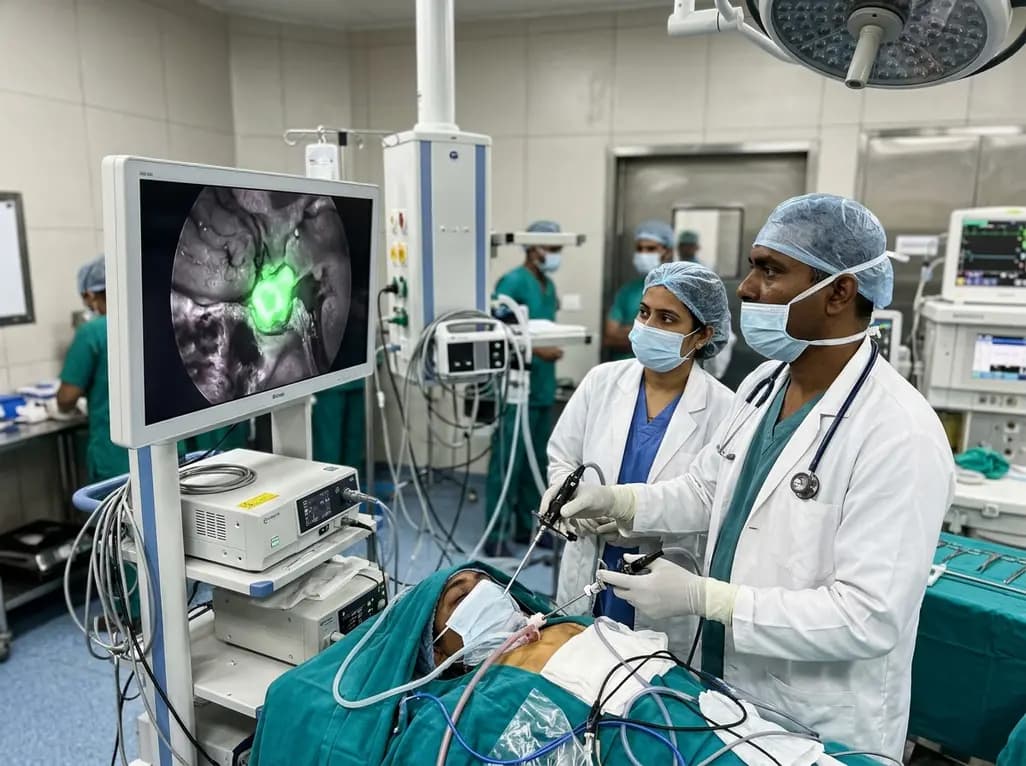
Near-infrared autofluorescence provides real-time label-free optical guidance during endoscopic transsphenoidal pituitary surgery. By highlighting stark signal contrasts between normal pituitary gland and adenomas, this technique aids gross-total tumor resection while safeguarding critical endocrine function.
Today
