.webp&w=384&q=75)

Loading, please wait...
Loading, please wait...

Esophageal squamous cell carcinoma (ESCC) remains a formidable challenge due to its aggressive nature and limited therapeutic options. Recent research has identified a significant driver of this malignancy: the novel protein circVEGFC-182aa in ESCC. This 182-amino acid secretory protein, which circular RNA encodes, plays a pivotal role in remodeling the tumor microenvironment. Therefore, understanding this mechanism is crucial for developing better clinical strategies.
Scientists found that circVEGFC is significantly more abundant in ESCC tissues than in healthy samples. Consequently, patients with high expression levels often face advanced tumor stages and lower survival rates. The research team used mass spectrometry and Western blotting to identify the protein in cell supernatants. Because the protein is secretory, it can travel through the microenvironment to influence neighboring immune cells.
The protein interacts directly with tumor-associated macrophages. Specifically, it binds to transforming growth factor-beta receptor II (TGF-βRII) on the macrophage surface. This binding activates the Smad2/3 signaling pathway, which forces the macrophages to adopt an M2-polarized phenotype. These M2 macrophages then actively support tumor progression instead of fighting the malignancy.
This cellular shift promotes several malignant behaviors, including increased cell migration and invasion. In addition, the study showed that circVEGFC-182aa triggers the epithelial-mesenchymal transition in ESCC cells. Furthermore, mouse models confirmed that the protein significantly accelerates lung metastasis and overall tumor growth. However, researchers noted that inhibiting the TGF-β signaling pathway could successfully halt these aggressive processes.
This protein is unique because a circular RNA (circRNA) encodes it, a process previously thought to be rare. Its secretory nature allows it to remodel the immune microenvironment directly. This makes it a powerful driver of cancer progression and a potential prognostic biomarker for clinicians.
The protein induces M2 polarization in macrophages through the TGF-β pathway. These specialized immune cells then release factors that enhance ESCC cell invasion and trigger the epithelial-mesenchymal transition. This mechanism leads to increased spread to distant organs, such as the lungs.
Disclaimer: This content is for informational and educational purposes only. It does not constitute medical advice or a professional relationship. Refer to the latest local and national guidelines for clinical practice.
References
Wang Y et al. A novel secretory protein, circVEGFC-182aa, promotes esophageal squamous cell carcinoma progression by inducing M2 polarization of tumor-associated macrophages via regulating the TGF-β pathway. J Transl Med. 2026 May 29. doi: 10.1186/s12967-026-08362-0. PMID: 42216222.
Li Y et al. Transcriptomics based multi-dimensional characterization and drug screen in esophageal squamous cell carcinoma. EBioMedicine. 2021;70:103510. doi: 10.1016/j.ebiom.2021.103510.
Chu LY et al. Blood-based biomarkers for early detection of esophageal squamous cell carcinoma. World J Gastroenterol. 2020;26(15):1708-1725. doi: 10.3748/wjg.v26.i15.1708.

Read summarized clinical updates, watch expert medical content, and earn CME certifications right from your smartphone.
Open your smartphone camera to scan and install.





Research identifies circVEGFC-182aa as a novel secretory protein that promotes ESCC progression by inducing M2 macrophage polarization via TGF-β signaling....
4 months ago
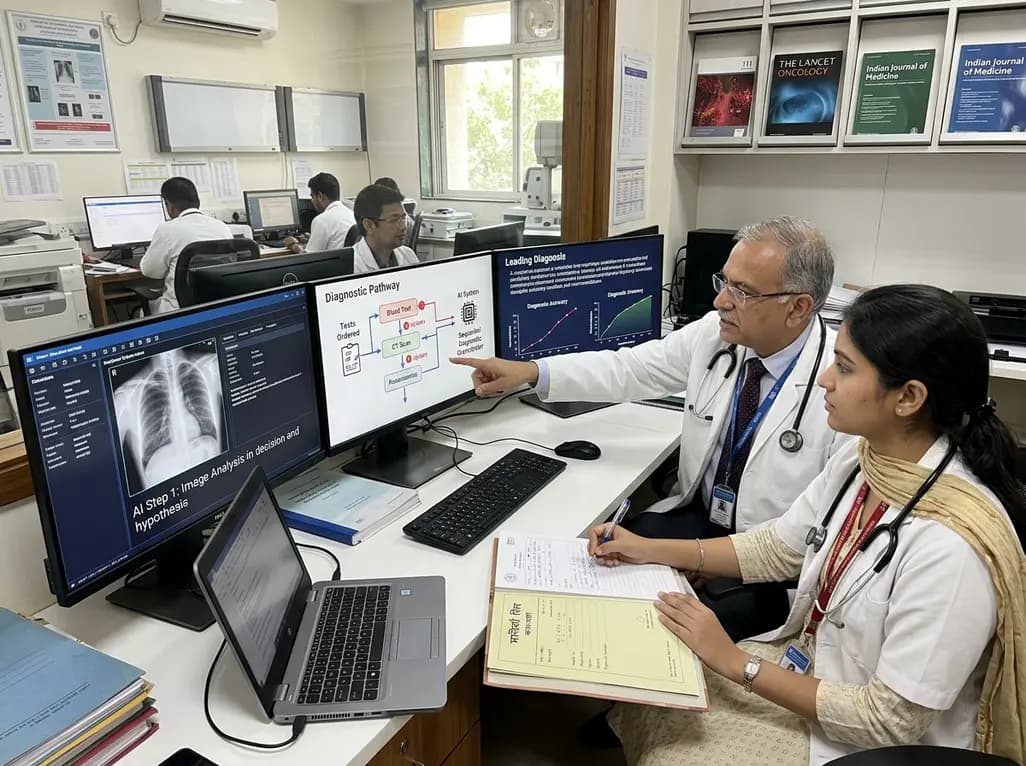
A breakthrough peer-reviewed study demonstrates that a sequential AI diagnosis system can mirror real-world clinical reasoning. By ordering stepwise tests and updating hypotheses dynamically, this multi-agent orchestrator achieved superior diagnostic accuracy while reducing investigative costs.
Today

A prenatal case highlights severe glutaric acidemia type II presenting as bilateral hyperechoic cystic kidneys at 18 weeks. Whole-exome sequencing revealed a novel homozygous ETFDH frameshift variant, demonstrating the power of rapid genetic testing in fetal renal anomalies.
Today

Review how tailored exercise programs benefit frail older patients with heart failure. Explore pathophysiological mechanisms, individualized training prescriptions, and strategies to overcome adherence barriers in clinical practice.
Yesterday

This comparative study evaluates posterior labral tears with and without glenohumeral instability, highlighting distinct demographic patterns, MRI underestimation in stable shoulders, and successful arthroscopic repair outcomes.
Yesterday

A clinical study demonstrates that early intervention with tocilizumab, either as monotherapy or bridged with corticosteroids, achieves significant proptosis reduction and resolves active inflammation in treatment-naive thyroid eye disease.
Yesterday
