

Loading, please wait...
Loading, please wait...

Biological clocks coordinate nearly every mammalian physiological cascade, establishing homeostatic stability across 24-hour solar cycles. In clinical neurology, clinicians have long recognized the critical role of circadian rhythms in epilepsy, as unprovoked seizures frequently exhibit marked diurnal clustering. However, quantifying real-world chronobiological disruption has historically remained difficult due to reliance on brief in-hospital monitoring protocols. Recent breakthroughs in consumer digital health now provide an unprecedented window into ambulatory physiology. By evaluating long-term biometric signals from non-invasive sensors, investigators can systematically characterize patient-specific biological cycles over months rather than mere hours.
Circadian rhythms modulate core cellular and network excitability within the central nervous system. Consequently, endogenous molecular clocks regulate cortical threshold changes, neurotransmitter synthesis, and autonomic tone across the day-night cycle. Furthermore, standard chronobiological markers such as core body temperature, hormone secretion, and resting pulse reflect the integrity of the hypothalamic suprachiasmatic nucleus. In people with epilepsy, cortical hyperexcitability interacts continuously with these oscillating regulatory circuits. Therefore, chronobiological vulnerability might not only trigger paroxysmal events but could also stem from broader neurobiological disturbances. Traditional evaluation tools, such as short-term electroencephalography, frequently miss these multi-day patterns. Consequently, continuous ambulatory biometrics offer a compelling mechanism to quantify chronic physiological instability across authentic real-world environments.
To overcome traditional diagnostic limitations, investigators increasingly utilize wearable smartwatches equipped with photoplethysmography sensors to track physiological trends. Specifically, continuous heart rate recordings provide an accessible proxy for autonomic oscillation and endogenous circadian phase. In a notable investigation published in Epilepsia, researchers retrospectively analyzed more than 70,000 hours of wearable smartwatch data collected from 143 people with epilepsy and 31 healthy controls. The scientific team extracted circadian oscillations directly from continuous heart rate time series. Subsequently, mathematical modeling allowed investigators to compute daily parameters, including circadian period duration, acrophase, and oscillation amplitude. By measuring daily deviations across several months, the team quantified intraindividual variability with high statistical fidelity.
The study demonstrated marked chronobiological differences between people with epilepsy and healthy control subjects. Notably, people with epilepsy exhibited significantly greater intraindividual variability in circadian period duration, averaging 76 minutes of daily drift compared to 57 minutes in control participants. Furthermore, patients with epilepsy displayed pronounced acrophase variability, shifting approximately 64 minutes compared to 48 minutes observed among healthy cohorts. Interestingly, baseline circadian amplitude showed minimal variance between the two groups, indicating that the strength of autonomic oscillation remained preserved. These rigorous findings illustrate that the temporal pacing of physiological rhythms, rather than their raw magnitude, experiences profound disruption in patients living with seizure disorders.
Crucially, the researchers explored whether observed rhythm instability reflected immediate postictal perturbations or an underlying endophenotype. Surprisingly, the data revealed no correlation between intraindividual circadian variability and overall seizure frequency. In addition, comparative analyses demonstrated that periods with active seizures exhibited identical circadian variability to weeks characterized by complete seizure freedom. Therefore, the observed temporal drift does not appear to represent an acute postictal artifact or transient physiological exhaustion. Instead, these analytical observations suggest that circadian instability represents an intrinsic chronobiological disturbance. Neurological network reorganization or chronic antiseizure drug regimens may permanently alter central clock synchronization, independently of active ictogenesis.
These chronobiological insights introduce practical avenues for improving individualized epilepsy management. Clinicians frequently encounter refractory patients who report unexplained fatigue, autonomic complaints, and refractory seizure cycles despite therapeutic antiepileptic drug levels. Recognizing baseline circadian fragility encourages neurologists to prescribe personalized chronotherapeutic dosing schedules that align peak plasma concentrations with known biological vulnerability windows. Furthermore, incorporating wearable sensor tracking into routine clinical assessment empowers physicians to monitor patient physiological stability remotely. Routine lifestyle guidance emphasizing rigorous sleep hygiene, structured light exposure, and consistent daily schedules may stabilize fragile endogenous rhythms, thereby mitigating downstream autonomic stress.
Intraindividual circadian variability measures how much a patient's internal biological rhythm deviates daily from a standard 24-hour cycle. High variability means the peak timing and daily period length fluctuate inconsistently over time, reflecting impaired endogenous temporal synchronization rather than a stable, predictable biological rhythm.
No, the researchers found no significant statistical correlation between higher circadian variability and elevated seizure frequency. Furthermore, circadian drift persisted equally during weeks with seizures and weeks without seizures, indicating that circadian dysregulation is an intrinsic characteristic of epilepsy rather than a simple postictal effect.
Clinicians can utilize consumer smartwatches and medical-grade wearables that track continuous heart rate, physical activity, and sleep patterns over long durations. Analyzing these multi-week longitudinal data streams helps practitioners identify autonomic instability, irregular sleep-wake patterns, and chronobiological shifts that warrant lifestyle or pharmacological chronotherapy adjustments.
Disclaimer: This content is for informational and educational purposes only and does not constitute medical advice or establish a doctor-patient relationship. Healthcare professionals must exercise independent clinical judgment. Refer to the latest local and national guidelines for clinical practice.
References
Smith BC et al. More variable circadian rhythms in epilepsy captured by long-term heart rate recordings from wearable sensors. Epilepsia. 2025 Aug. doi: 10.1111/epi.18424. PMID: 40286232.
Karoly PJ et al. The circadian code: how multiday rhythms organize epileptic seizures. Nature Reviews Neurology. 2021;17(9):576-588.
Baud MO et al. Endogenous multidien rhythm of epileptic activity in humans. The Lancet Neurology. 2018;17(4):328-337.

Read summarized clinical updates, watch expert medical content, and earn CME certifications right from your smartphone.
Open your smartphone camera to scan and install.





A landmark study in Epilepsia utilizing over 70,000 hours of continuous wearable sensor data shows that people with epilepsy experience significantly greater intraindividual circadian rhythm variability than healthy controls, highlighting intrinsic chronobiological dysregulation independent of acute seizures.
Today

A Bayesian component network meta-analysis of 130 RCTs reveals that self-monitoring and gamification provide the clearest positive effects in mHealth physical activity interventions, while social comparison may have adverse psychological trade-offs.
Today

The GESS-AEEM consensus establishes a clear clinical implementation framework for testosterone therapy in postmenopausal women with hypoactive sexual desire disorder, focusing on transdermal dosing, precise laboratory monitoring, and safety communication.
Today
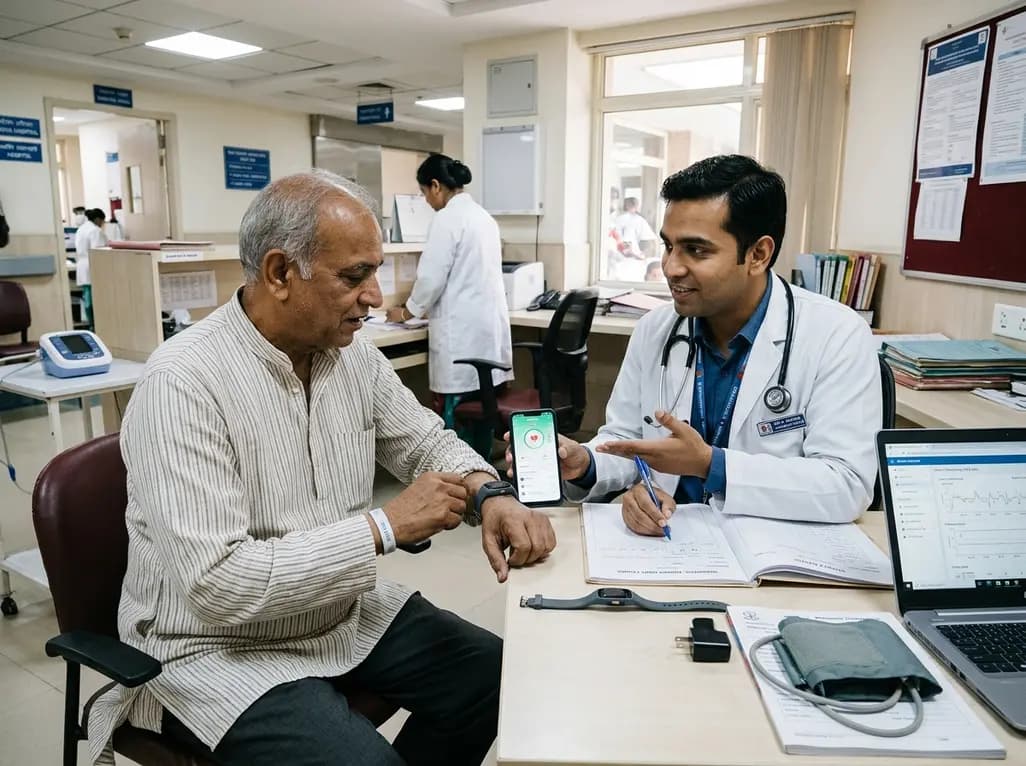
A multicenter observational study evaluated an 8-week digital health monitoring platform using wearable sensors in ambulatory heart failure. While participants achieved high daily wear-time of 11.7 hours and 80% completion, initial recruitment revealed significant technology-related onboarding barriers.
Today

A paired cadaveric study compared triple and quintuple percutaneous Achilles tendon lengthening. While quintuple hemisection showed numerically greater elongation, differences were not statistically significant.
Yesterday

A clinical decision-support framework using health checkup data from 231,683 adults predicts incident obesity with high discrimination (AUROC 0.918). The system integrates temporal survival analysis and risk-factor explanations to prioritize individualized preventive interventions.
Today
